IN MEMORIAM: Benicia’s Joel Fallon: Is Crude by Rail really do or die?

Is this really adios?

[Re-posting today in memory of Joel Fallon, who died on August 11, 2016 (obituary). Joel was Benicia’s first and most beloved Poet Laureate, an inspiration to all who knew him and a thoughtful, visionary activist. Originally reposted from The Benicia Herald and here on the Benicia Independent.]

April 25, 2014 by Joel Fallon

WHAT AM I MISSING HERE? Are Benicians just kittens in a burlap sack, down by the riverside, resigned to the inevitable?

Let’s see if I’ve got this right.

(a) We’re in earthquake country (see evidence of the Green Valley fault in terrain on the way to Cordelia);

(b) We’re next to fragile wetlands (for spectacular views, click Google Maps/Benicia, hybrid setting, find rail line and follow to Sacramento);

(c) We’re contiguous with an important commercial waterway;

(d) We host an outfit whose headquarters has fought attempts to safeguard our environment (see Valero Energy Corporation’s position and funding regarding Proposition 23);

(e) A local outfit, under direction from its far-off headquarters, plans to process a dangerous, toxic product;

(f) The outfit is served by a rail system with a recent history of tank car derailment;

(g) Parts of this railroad system (built by Central Pacific RR in 1877), running through marshland to the Carquinez Strait, repeatedly sank into unstable marshy terrain, requiring hundreds of thousands of tons of rock, gravel and other materials to stabilize it;

(h) Other parts of the antique rail infrastructure seem poorly maintained and may be unsafe, e.g., the Benicia-Martinez rail bridge, built between 1928 and 1930 for Southern Pacific RR to replace the train ferry to Port Costa;

(i) Old tank cars are a problem — an area newspaper reports that BNSF railway officials told federal regulators in March of concerns that older, less robust tank cars will end up transporting crude oil because of Canadian rail pricing policies;

(j) Emergency responders are unprepared to handle spills or fires in the event of derailment of cars headed to any of five Bay Area refineries. State Sen. Jerry Hill, D-San Mateo, after listening to testimony from emergency responders, said, “There is a potential for very serious problems and very disastrous problems.” Chief of the Contra Costa Fire District is quoted saying, “… with the sheer volume that will be coming in, we are going to see more accidents.” The 2007-08 Solano County Grand Jury, after investigating the county’s fire districts, reports a general need for more funding, heavy dependence on dedicated volunteers and the preponderance of old fire trucks, while noting the high cost of HAZMAT suits and problems with communications caused by incompatible equipment and radio frequencies.     

And yet, despite this unbelievably horrific backdrop, certain elements in town warn us to hush lest Valero be forced out of the competitive (i.e., tar sands crude) market, destroying its “desire to remain in Benicia.”

Clearly, Valero Benicia Refinery cannot be faulted for all of the foregoing. Good workers deserve good jobs; they should be able to tell their grandkids they helped, rather than harmed, the environment. Valero Benicia is just one of many links in a chain of factors that could lead to the disaster so many in this community fear.

Am I “agenda driven” as charged? Bet your raggedy backside I am. My agenda involves doing homework to find threats to my home, my town, my state and my nation, and advising others of my findings (just in case they might care). If you detect it, yell “GAS” to alert the rest of the platoon; then put on your mask, while you can still breathe.

For a glimmer of the scope of Big Oil’s operations from sea to shining sea and beyond, see the astounding number of outfits similar to Valero Energy Corp. in the U.S and Canada. Find ’em in Wikipedia (“independent oil companies — Americas”). Select a company to see its history of oil spills. Wonder why the Keystone XL pipeline is planned to extend to Texas? Check out which corporations own the pipeline and the benefits associated with Foreign Trade Zones (32 FTZ in Texas compared to 17 in California, and 15 in New York).

If folks look around a bit they may discover that Big Oil, like Big Coal and other corporate behemoths, extends powerful influence throughout the land of the free and the home of the brave. Many were hoodwinked by Operation Iraqi Liberation, in which Big Oil colluded with Big Government to achieve absolute power of life and death over us and our enemy — the one with phantom WMDs and a vast, very real amount of oil.

Is this really adios, Pilgrim? — or just “I double-dog dare you”? I don’t believe it’s Valero’s style to leave town. It’s not in the corporation’s best interests and shouldn’t be its preferred option.

What are those options? They include:

Option 1. Stay put, but back away from risky tar sands crude and focus on products involving minimum environmental risk. Backing away for good business reasons is not the same as “backing down.” CVS decided to stop selling cigarettes. The firm considered it “the right thing to do for the good of our customers and our company. The sale of tobacco products is inconsistent with our purpose — helping people on their path to better health.” Barrons online says, “We think that CVS — like anyone who quits smoking — is making a good long-term decision, even if it makes things rough short-term.” Others consider it a PR coup! CVS gained the respect of millions of customers for what is perceived as a moral and ethical decision. I shop CVS more often since they made that brilliant call; so do my friends.

Backing away from tar sands crude would take similar corporate guts; but the public would be pleased with the image of a moral, ethical, highly principled corporation — a Valero that gives a damn. Sales at Valero service stations might even increase.

Option 2. Continue to pursue tar sands crude; seeking high profitability despite increased environmental risk. The downside: prices at the pump are too high. Californians are already angry; they may avoid Valero service stations and products. I’ll urge my friends to do so. Word of mouth is powerful and spreads quickly. Contempt for an outfit that doesn’t respect its customers or our environment could lead to loss of sales in the country’s most populous state. Cesar Chavez showed us boycotts work. Most folks I know didn’t buy grapes.

Option 3. “Re-purpose” Valero’s operations in Benicia (and elsewhere) to enhance instead of degrade the environment while remaining profitable. Valero is an energy outfit. Turning to alternate sources of energy is ultimately inevitable. Valero should expand its vision and not limit itself to fossil fuels. Farmers in Ireland who grew only potatoes learned about diversification too late.

(a) Pursue wind farming if feasible and profitable. A recent Mother Earth News article about mountaintop removal coal mining in Appalachia cites a 2007 study that determined placing wind turbines on Coal River Mountain would provide power to 70,000 West Virginia homes while generating $1.7 million in local taxes each year. Better than ripping off the tops of mountains and dumping enormous amounts of debris into streams and rivers.

(b) Pursue solar energy if feasible and profitable. Produce solar products for sale and/or operate a solar power facility to resell power. See an article by Don Hofmann, president of RegenEn Solar LLC, looking at mountaintop removal mining and suggesting solar power instead. He recognizes there are challenges but is optimistic about lower-cost solar cells and technology in the future. He notes that the U.S. fossil fuel industry received $72 billion in subsidies from 2002 to 2006 and asks us to imagine that kind of money put into solar development.

(c) Pursue other approaches (geothermal, tidal, et al.) if appropriate and profitable.

Option 4. Determine feasibility of combining 3a, 3b and/or 3c. If appropriate and profitable, pursue the combination.

Option 1 would be the easiest and would be enthusiastically supported by most folks in Benicia, applauded by most Californians and recognized as a principled business decision.

Option 2 is the least desirable from an environmental standpoint. While profitability is high, it may incur the contempt and wrath of the public, possibly leading to damaging boycotts and a decline in profitability.

Option 3a thru 3c may seem starry-eyed, wild and outside the box. They would require imagination, foresight and courage. It can be done. CVS is showing the way and TESLA is succeeding with electrically powered cars. Examine pluses and minuses — Valero could take a quantum leap and be regarded as an industry trailblazer. Its reputation would be enhanced. Envious competitors might scoff and want Valero to take a pratfall but ultimately they would have to follow suit.

In conclusion the priority order of Valero’s options should be:

Option 1 — Most desirable (preferred)
Option 3/4 — Most “outside the box” (defer initially, but plan for the future)
Option 2 — Least desirable (avoid).

If Valero is really in the long-term energy game, it should choose Option 1 and start thinking seriously about Option 3. If, instead, its focus is on short term — high profits while risking irreparable harm to the environment — then Option 2 is their ticket.

If Valero wants to be recognized as rich, principled, brave and famous instead of rich, unscrupulous and infamous, then it should open door No. 3 as soon as possible.

Finally: I don’t believe it is “adios” for Valero Benicia Refinery. Unfortunately, I think Valero will not choose a clean path. They will probably press on with dirty tar sands crude. After that, “¿Quien sabe?”

I don’t intend to “go gentle into that good night.” Instead I prefer to “rage against the dying of the light.”

This whole thing could be like a colonoscopy, but a lot less fun.

Joel Fallon is a Benicia resident.


The Benicia Herald’s Poetry Corner was recently dedicated to Joel Fallon…

“For Joel Fallon” by Ronna Leon

Reposted from the Benicia Herald, Poetry Corner, August 19, 2016

You called them “dead Mother poems”
and scorned their cloying sentiment, easy forgiveness.
Your poem about your Mother named her Kali.
You hungered for life – anger, difficulty, competition, sex.
You insisted that wringing a tear from a stone
was superior to opening well oiled floodgates.


Now you are dead and my tears come unbidden
looking at the bookshelf, pulling a stubborn weed,
eating a pastry.
“Keep smiling” you’d instruct,
but I don’t want to brush these tears away,
each glistens with memory, swells with loss.
You are in them, like it or not.Ronna Leon was Benicia’s third poet laureate from 2010 to 2012


“Hope is the Thing with Feathers (Dedicated to Joel Fallon)” by Johanna Ely

Reposted from the Benicia Herald, Poetry Corner, August 19, 2016

“Hope is the thing with feathers
that perches in the soul
and sings the tune without the words
and never stops-at all”
-Emily Dickinson


If such a tiny bird,
perhaps left for dead,
or suffering from an injured wing,
its feathers matted and torn,
finds refuge in your broken heart,
then reach inside yourself
and touch this living thing called Hope,
gently bind its limp and useless wing
with Love’s tattered cloth,
and press it to your shattered heart
until it heals,
until this lovely creature sings again,
then let it fly,
and nest in someone else’s heart,
the stranger,
the neighbor,
the old friend,
the one who just like you,
needs to hear its song.
Johanna Ely is Benicia’s current poet laureate

“Joel’s Passing” by Mary Susan Gast

Reposted from the Benicia Herald, Poetry Corner, August 19, 2016

“So, I may have been wrong after all – this damn cancer may indeed be the death of me.”
-Joel Fallon, in an email of June 30, 2016

He died on the morning of August 11.
That night, meteor showers dazzled the skies:
The Perseids, at their peak.
No reason to doubt that Joel hitched a ride
On that celestial glory train,
Meeting up with all the other streaming luminaries,
Fireball to fireball.

Mary Susan Gast served as Conference Minister of the Northern California Conference United Church of Christ, now retired, and is a member of Benicia’s First Tuesday Poetry Group

Phillips 66 oil-by-rail project may be in jeopardy – deadline Aug 15

Repost from The Tribune, San Luis Obispo

Phillips 66 oil-by-rail project may be in jeopardy

By David Sneed, July 22, 2016 8:06pm

HIGHLIGHTS
• Oil company faces Aug. 15 deadline to pay $240,000 in fees and supply information or SLO County will withdraw the application
• County also is critical of Phillips 66’s recent decision to begin trucking crude oil to the Nipomo Mesa refinery
• It is unclear whether a Sept. 22 Planning Commission hearing on the rail project will take place

The Phillips 66 refinery on the Nipomo Mesa has been trucking in oil since February as it continues to pursue a plan to accept oil by rail.
The Phillips 66 refinery on the Nipomo Mesa has been trucking in oil since February as it continues to pursue a plan to accept oil by rail. Joe Johnston Tribune

A controversial proposal by the Phillips 66 oil company to bring crude oil by rail to its Nipomo Mesa refinery is at a crossroads.

The oil company has been given an Aug. 15 deadline to give the San Luis Obispo County department of planning and building additional information about the project — the company wants to install a rail spur connecting the refinery with the main line — and to pay more than $240,000 in fees or the project application will be withdrawn.

In a July 8 letter to the company, county supervising planner Ryan Hostetter wrote, “This letter serves to inform Phillips 66 that without the necessary information and funding, the county cannot complete processing the application as directed by the Planning Commission.”

As of July 22, the county had received only part of the information it has requested and none of the money, Hostetter said.

Phillips 66’s proposal to build the spur so it can bring in three trains per week, each carrying 2.2 million gallons of crude oil, has faced a storm of opposition. Communities on the rail line across California have weighed in, many saying they feared a disastrous derailment.

Phillips 66 did not respond directly to questions by The Tribune on Friday as to whether the company plans to meet the county’s Aug. 15 deadline to pay the fees and provide the missing information. Instead, it sent this statement:

“Phillips 66 presented a strong proposal, and we remain confident about the project,” the statement said. “We understand and respect the review and approval process with the county, and look forward to the next step in the EIR process.”

The county has also informed Phillips 66 that its recent decision to truck oil directly into the refinery is likely a violation of the county’s permit and will require a new permit as well as a trucking plan detailing the new oil-by-truck method. The refinery has been receiving crude oil by pipeline. The county found out about the trucking during an April 15 Planning Commission hearing on the rail spur project.

“Bringing in crude by truck is a modification of the refinery and, additionally, may have the potential to cause significant impacts,” Hostetter said in a June 30 letter to Phillips 66.

The refinery’s maintenance supervisor, James Anderson, responded to the county in a letter dated July 14 in which he denied the assertions that the trucking of oil is a modification of the refinery and disputes the notion that a trucking plan is required. The letter refers to the refinery’s official name, the Santa Maria Refinery.

“Phillips 66 does not need any new permits or modifications to its existing permits to deliver feedstocks by truck to SMR (Santa Maria Refinery) in the manner in which it is currently performed,” Anderson’s letter stated. “Such activity has been a long-standing practice, albeit intermittent, and is not part of the rail extension project.”

Hostetter said the July 14 letter answered some but not all of the county’s questions. No deadline was given for providing the information.

“They are not sitting on it, but we need more information to make a formal call on whether trucking is an allowed use or if they need a new permit,” Hostetter said.

Anderson’s letter went on to give some details about the refinery’s recent oil-by-truck activities:

▪ It began in February.
▪ The number of truck trips per day has ranged from 1 to 25.
▪ Trucks generally hold up to 150 barrels of oil. A barrel contains 42 gallons.
▪ The oil is delivered into an existing pipeline via a flexible hose.
▪ The oil generally originates within California.

Phillips 66 has proposed installing a 1.3-mile rail spur connecting to the main line as a way to expand its sources of crude oil and continue to support the 200 employees who work at the Nipomo refinery. The proposal calls for deliveries from three trains per week; each train would have three locomotives and 80 rail cars to haul 2.2 million gallons of crude oil.

Earlier this year, the county Planning Commission held five full days of hearings that drew thousands of people from around California. The commission has scheduled a hearing for Sept. 22, at which a final decision could be made.

At its most recent hearing, the commission asked for a variety of additional information from Phillips 66, such as how many trains per year would arrive at the refinery under the three-trains-per-week scenario, how many trains could arrive in one day and what impact that would have on air quality around the refinery.

Few of those questions have been answered. Whether the commission even has a Sept. 22 hearing and whether it will be able to make a final decision if a hearing is held, depends on how much additional funding and information Phillips 66 provides, Hostetter said. For example, the company has proposed only funding the project through the Planning Commission phase but not through the likely appeal to the Board of Supervisors.

County policy requires that development applicants pay all the county’s costs in processing their permit, including the cost to hire consultants and write an environmental impact report. The county has estimated the cost of processing the application through the Board of Supervisors appeal hearing to be $240,697.73.

If the county withdraws the application, Phillips 66 could reapply at a later date.

U.S. Government Just Approved an Enormous Oil Pipeline

Repost from Mother Jones

The Government Quietly Just Approved This Enormous Oil Pipeline

Four reasons why people are outraged.

By Alexander Sammon, Aug. 12, 2016 6:00 AM
ewg3D/Thinkstock

It took seven years of protests, sit-ins, letter writing, and, finally, a presidential review to prevent the Keystone XL oil pipeline from being built. Now, in a matter of months, America’s newest mega-pipeline—the Dakota Access Pipeline Project (DAPL)—has quietly received full regulatory permission to begin construction. Known also as the Bakken Pipeline, the project is slated to run 1,172 miles of 30-inch diameter pipe from North Dakota’s northwest Bakken region down to a market hub outside Patoka, Illinois, where it will join extant pipelines and travel onward to refineries and markets in the Gulf and on the East Coast. If that description gives you déjà vu, it should: The Bakken Pipeline is only seven miles shorter than Keystone’s proposed length.

The proposed route of the recently approved Bakken Pipeline – Dakota Access

The $3.78 billion project is being built by Dakota Access, LLC, a unit of the Texas-based Energy Transfer Partners. (Former Texas Gov. Rick Perrya friend of Iowa Gov. Terry Branstad, sits on ETP’s board.) According to the firm, the Bakken Pipeline will transport up to 570,000 barrels of crude oil per day. Advocates have celebrated the supposed 12,000 jobs the pipeline will create in construction, while repeating calls to end American dependence on foreign oil—a platform called into question by new laws allowing US producers to export crude. The US Army Corps of Engineers gave its blessing at the end of July, clearing the final hurdle for the massive infrastructure project, which is slated to be operational by the fourth quarter of 2016.

Though the project hasn’t gotten too much national media attention, there’s been plenty of local opposition. Groups like the Bakken Pipeline Resistance Coalition, a collective of 30-plus environmentalists’ and landowners’ associations, along with Native American groups, have cried foul. Here are the four things they’re most outraged by:

How many jobs…really: According to Dakota Access’s DAPL fact sheet, the pipeline will create 8,000 to 12,000 construction jobs. An earlier draft of those figures claimed 7,263 “job-years” to be created in Iowa alone. Not so fast, says professor David Swenson, associate scientist in the Department of Economics at Iowa State University. Swenson crunched the numbers himself and came to a much more modest conclusion: 1,500 jobs total per year in Iowa for the course of construction. And given that most of these jobs are skilled, Swenson expects many of the hires will be from out of state, as Iowan contractors specializing in large-scale underground pipe-fitting and welding are scarce. The long-term forecast for job creation is even bleaker. The Des Moines Register reports that there will only be 12 to 15 permanent employees once the pipeline is completed. (DAPL has since walked back its job estimate slightly.)

Spill, baby, spill: As Sierra Club’s Michael Brune puts it, “It’s not a question if a pipeline will malfunction, but rather a question of when.” And, though they spill less often than trains do, the International Energy Agency found that pipelines spill much more in terms of volume—three times as much between 2004 and 2012. The Bakken Pipeline’s route takes it through active farmland, forests, and across the heartland’s major rivers: The Big Sioux, the Missouri, and the Mississippi, some with multiple crossings, though the US Fish and Wildlife Service claims that no “critical habitat” is endangered. It also runs through sacred Native American lands (more on this below).

Enbridge Inc., a stakeholder in the Bakken pipeline, has a speckled track record on spills. In 2010, an Enbridge pipeline spilled 1.2 million gallons of crude into the Kalamazoo River, one of the worst inland spills in American history. Because the pipeline qualifies as a utility (despite being privately owned and for-profit), the Army Corps of Engineers was able to certify it without performing an environmental impact statement, as all utilities projects qualify as “minimal impact.” These projects are subject to environmental assessments every five years.

Don’t tread on me: Private property owners, particularly in Iowa, have bristled at the Bakken Pipeline’s expropriation of land. ETP asked the Iowa Utilities Board to grant it the powers of eminent domain, the process by which a government can repossess private property for public use even if the private property owner does not voluntarily sell. The IUB, a three-person committee appointed by Republican Gov. Terry Branstad, granted ETP that right for its for-profit private pipeline, a practice that is not uncommon, in order to purchase 475 parcels from resistant landowners. This has led to numerous pending lawsuits, with the Des Moines Register reporting that the issue may make it all the way to the Iowa Supreme Court. In May 2015, ETP was embroiled in scandal after a contracted land agent, working on behalf of the Bakken Pipeline, allegedly offered an Iowan landowner a teenage prostitute in exchange for voluntary access to his property. (No charges were brought after the Iowa Department of Criminal Investigation determined that the case did not meet the legal standard for pimping, solicitation, or conspiracy.)

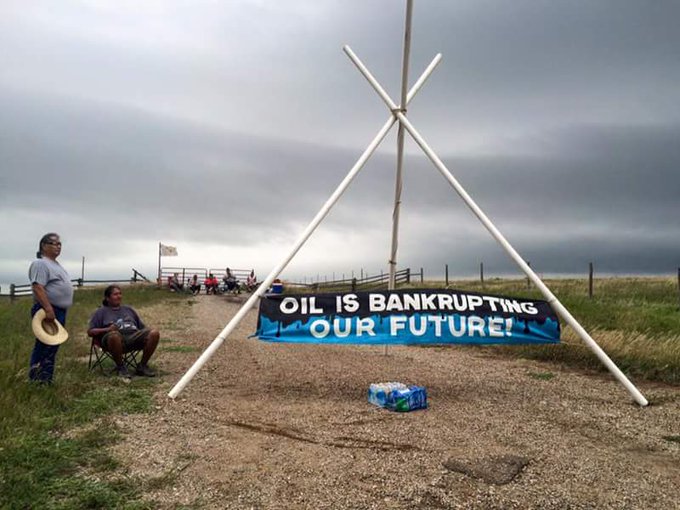
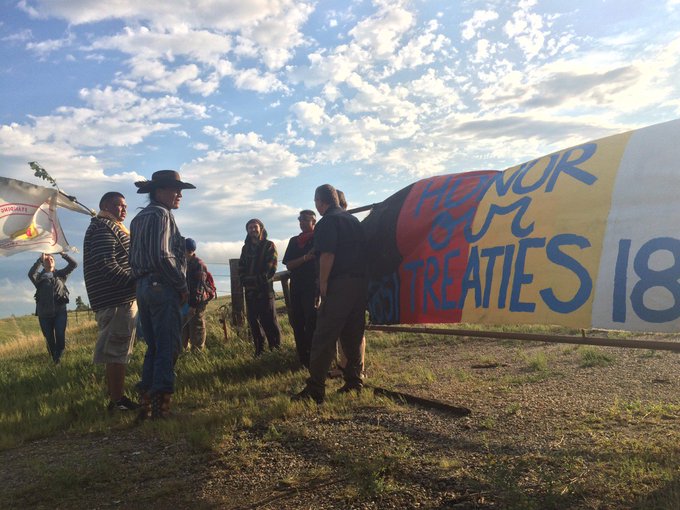
DisRezpect: The pipeline will cross through sacred lands and pass under the Missouri River twice. For the Standing Rock Sioux, the Missouri provides drinking water and irrigation, while its riverbanks grow innumerable plants of cultural import, including sage and buffalo berries. The tribe launched a campaign called “Rezpect Our Water” and staged a 500-mile relay race in protest, hoping to sway the Army Corps of Engineers in the permitting process. Last weekend, a group of 30 Native youth completed a three-week run from North Dakota to Washington, DC, where they delivered a petition of 160,000 signatures opposing the pipeline’s construction.

Now, even though the Corps has given the go-ahead, the tribe has not given up the fight. They recently filed suit against the Corps in federal court. The suit seeks an injunction, asserting that the pipeline will “damage and destroy sites of great historic, religious, and cultural significance,” a violation of the National Historic Preservation Act.

Though the pipeline seems to be a done deal, resistance of all types continues. Last week, the Des Moines Register reported that authorities are investigating suspected arson against the ETP’s heavy machinery. The fires, three separate incidents across two Iowa counties, resulted in nearly $1 million in damage to bulldozers and backhoes. The acts appeared to be intentional incidents of monkeywrenching.

On Thursday, a group of protesters, including the Standing Rock Sioux and their allies, gathered in North Dakota to oppose the pipeline, blocking the construction site. The police ultimately broke up the demonstration, resulting in at least five arrests.

No Dakota Access pipeline from Camp of the Sacred Stones blockade @POTUS@FLOTUS@USACEHQ
2:03 PM – 11 Aug 2016

Oil industry desperate: claims oil spills are good for wildlife and the economy

Repost from Hazmat Magazine

Testimony Implies Oil Spills Are Good For Wildlife and the Economy

By J Nicholson, August 11, 2016

As reported in thinkprogress.org, the Washington State Energy Facility Site Evaluation Council (EFSEC) has been holding hearings on the matter of a proposed oil-by-rail terminal that could be built in Vancouver, Washington.  If approved, it would be the largest oil-by-rail facility in the country, handling some 360,000 barrels of crude oil, shipped by train, every single day.  It would also greatly increase the number of oil trains that pass through Washington, adding a total of 155 trains, per week, to the state’s railroads.

Environmentalist activists worry that an increase in oil trains could lead to an rise in oil train derailments, like the kind seen in early June when a Union Pacific train carrying Bakken crude derailed outside the Oregon town of Mosier, spilling 42,000 gallons of oil near the Columbia River.

But according to witnesses that testified before the EFSEC on behalf of Vancouver Energy – the joint venture between Tesoro Corp. and Savage Cos. and the entity behind the Tesoro-Savage terminal proposal – oil spills might not actually be that bad for the environment.

“The Draft Environmental Impact Statement identifies many economic impacts arising from an accident associated with Project operations, but fails to recognize economic activity that would be generated by spill response,” Todd Schatzki, vice president of Analysis Group — a consulting group that released an economic report on the terminal commissioned by Tesoro Savage — wrote in pre-filed testimony.  “When a spill occurs, new economic activity occurs to clean-up contaminated areas, remediate affected properties, and supply equipment for cleanup activities. Anecdotal evidence from recent spills suggests that such activity can be potentially large.”

Schatzki’s pre-filed testimony also includes references to both the Santa Barbara and BP oil spills’ role as job creating events.  He notes that the Santa Barbara oil spill created some 700 temporary jobs to help with cleanup, while the BP spill created short term jobs for 25,000 workers.  Schatzki does not mention that BP has paid individuals and businesses more than $10 billion to make up for economic losses caused by the spill.  Nor does he mention that California’s Economic Forecast Director predicted that the 2015 Santa Barbara oil spill would cost the county 155 jobs and $74 million in economic activity.

For the Columbia River region, the impacts of an oil spill could be equally economically devastating — a report from the Washington Attorney General’s office found that an oil spill could cost more than $170 million in environmental damages.

Keystone Pipeline (Credit: cfact.org)

Schatzki also argued that an oil spill would not necessarily have a large impact on commercial and recreational fisheries.  The Columbia River, which cuts between Oregon and Washington and borders much of the oil-train route, is one of the most important fisheries for both states.  In 2015, the total economic value of Columbia River salmon was $15.5 million, according to the Oregon Department of Fish and Wildlife.

Those fisheries, however, would not necessarily be impacted by an oil spill, Schatzki argued, because fishermen would simply avoid the areas where the spill had taken place, moving their operations elsewhere.  During cross examination, however, Schatizki said that he did not look at other fishermen’s responses to oil spills when crafting this analysis, nor did he specifically look at the length of fishing seasons or the geographic extent of various fisheries within the Columbia River.

In testimony given on July 7th, another Tesoro-Savage-associated witness, Gregory Challenger, argued that oil spills could actually have benefits for fish and wildlife.  Challenger, who worked with Vancouver Energy to analyze potential impacts and responses in the event of a worst-case discharge at the facility and along the rail line, told the committee that when oil spills cause the closure of certain fisheries or hunting seasons, it’s the animals that benefit.

“An oil spill is not a good thing.  A fishery closure is a good thing.  If you don’t kill half a million fish and they all swim upstream and spawn, that’s more fish than were estimated affected as adults,” Challenger said during his testimony.  “The responsible party is not going to get credit for that, by the way.”

 To prove his point, Challenger cited National Marine Fisheries Service data that showed that 2011, the year after the BP oil spill, had been a record year for seafood catch in the Gulf of Mexico.  And while that’s true, Shiva Polefka, policy analyst for the Center for American Progress’s Ocean Policy program, cautioned against trying to make sweeping statements for how all ecosystems would respond to an oil spill.  Following the Exxon Valdez spill in 1989, researchers discovered that crude oil had soaked into the rocky beaches near the spill site, emitting toxic compounds for years that had long-term adverse impacts on salmon and herring populations.

“Does cutting fishing effort benefit fish?  Absolutely,” Polefka said.  “Enough to mitigate the horrible effects of large oil spills in every case?  Absolutely not.”

During his testimony, Challenger also brought up the Athos 1 oil spill, which sent 264,000 gallons of crude oil into the Delaware River in 2004.  The spill, Challenger said, took place during duck hunting season, and forced an early closure for recreational hunting in the area.

“There were an estimate of 3,000 birds affected by the oil, and 13,000 birds not shot by hunters not shot by hunters, because of the closed season,” he said.  “We don’t get any credit for that, but it’s hard to deny that it’s good for birds to not be shot.”

According to U.S. National Oceanic Atmospheric Administration (NOAA), seabirds are especially vulnerable to oil spills, because of the way that oil affects their usually-waterproof feathers — when those feathers become matted with oil, a seabird loses its ability to regulate its temperature.  Often, it will try to preen itself to remove the oil, which only forces the oil into its internal organs, causing problems like diarrhea, kidney and liver damage, and anemia.  Oil can also enter into a seabird’s lungs, leading to respiratory problems.

Opponents of the terminal were quick to dismiss Schatzki and Challenger’s testimony as “hollow,” especially in the face of the recent derailment and oil spill in Mosier.

oil spill07“We see Tesoro moving towards these more desperate arguments to try to downplay the risk of the project,” Dan Serres, conservation director with Columbia Riverkeeper, told ThinkProgress. “It’s hard to imagine that EFSEC will buy the argument that oil spills pose anything other than a grave risk to the Columbia River estuary.”

Following the EFSEC hearings, the committee will submit a recommendation to Washington Governor Jay Inslee to approve, conditionally approve, or deny the project.