Benicia-Martinez bridge – a Bay Area LIFELINE in the “big one”

The Earthquake Effect: 30 years after Loma Prieta quake, scientists call Bay Area ‘Tectonic Time Bomb’

ABC 7 Eyewitness News, by Jennifer Olney, October 17, 2019

“The only big bridges built to Lifeline standards are the San Francisco-Oakland Bay Bridge and the Benicia-Martinez Bridge. The other big bridges are expected to stand up in a big quake, but might not be usable for some time after.”


SAN FRANCISCO — Thirty years after the Loma Prieta earthquake rocked the San Francisco Bay Area, killing 63 people, scientists have a chilling reminder: that quake was just a warm up.

“The first thing for people to realize is that Loma Prieta was not the big one,” warned Richard Allen, head of the U.C. Berkeley Seismological Lab.

The Loma Prieta quake in Oct. 1989 left 16,000 homes uninhabitable, knocked out a section of the Bay Bridge and caused the collapse of a double decker freeway in Oakland.

The disaster prompted an explosion of research in the Bay Area and a lot of science-based predictions about what will happen when the “real big one” hits. David Schwartz, geologist emeritus with the U.S. Geological Survey (USGS), describes the Bay Area as a “tectonic time bomb.”

ABC7 ORIGINAL SERIES: ‘The Earthquake Effect’ provides in-depth coverage on Bay Area’s readiness for the next major earthquake

“It is going to be the challenge of all our lives when we have this earthquake happen here” according to Mary Ellen Carroll, head of the San Francisco Office of Emergency Management.

The last time the San Andreas Fault unleashed its full power in the Bay Area was the Great San Francisco Quake of 1906, believed to have been magnitude 7.9.

That earthquake left an estimated 3,000 people dead and 225,000 homeless. The USGS calculates the 1906 quake released 16 times more energy than the Loma Prieta quake.

Now scientists say the network of faults running under the Bay Area is locked and loaded. The USGS calculates there is a 72 percent chance of a major quake here by the year 2043.

VIDEO: The catastrophic fall and slow rise of the Bay Bridge after Loma Prieta

“Regardless of where you live in the Bay Area, you’re not far from a fault, and there are enough faults that, if any one of them has a major earthquake, it’s going to affect the entire Bay Area,” according to USGS Geologist Belle Philibosian.

Schwartz believes many people will be surprised at the amount of damage that occurs in a major quake, despite years of improved engineering, retrofitting, rebuilding and planning.

He points to what he calls a “smaller” quake, the magnitude 6.0 temblor that hit Napa in 2014. Damage estimates ran up to a billion dollars. But in a magnitude 7.0 or a 7.9 like the one in 1906, Schwartz expects the damage to be spread over a much, much wider area.

“If you have a minute and a half or two minutes of shaking, it’s really unclear what that’s going to do to a lot of structures that are out there,” he added.

The reason California is at such high risk for earthquakes is that we are right on the edge of two huge tectonic plates in the earth’s crust — the Pacific Plate on the west and the North American Plate on the east.

RELATED: Hayward Fault – Here’s how close you are to the most dangerous fault in America

The San Andreas Fault runs between the two plates, right through California. The Pacific Plate is constantly moving north. The movement is usually so slow we don’t feel it, but sometimes the pressure builds and the ground shoots forward faster, causing an earthquake.

Scientists believe the continued movement of the plates over millions of years will eventually lead to Los Angeles being right alongside San Francisco.

Many researchers believe the Hayward Fault is actually a bigger threat to public safety than the San Andreas. Some call it the “most dangerous fault in America.”

The Hayward Fault runs just east of the San Francisco Bay, passing through 11 cities — San Jose, Fremont, Union City, Hayward, Castro Valley, San Leandro, Oakland, Berkeley, El Cerrito, Richmond and San Pablo.

VIDEO: What to pack in your earthquake emergency kit

Images from ABC7’s SKYMAP7 clearly show why the danger is so great. The Hayward Fault is underneath some of the most heavily populated areas in the Bay Area, with about 300 buildings directly on the fault itself.

“So when it moves, it moves two feet, or three feet or six feet, those structures are going to be stressed and many of them are going to fail” said Schwartz.

Some of the buildings along the fault are iconic structures including the Mormon Temple and Claremont Hotel in Oakland and the UC Berkeley Football Stadium.

Many of the major structures near the fault have had major seismic improvements, but most of the structures are homes that were built before new, tougher building standards. Experts say there is way to know how many of them will perform when a big earthquake hits the fault.

The Hayward Fault also crosses a lot of critical infrastructure including roads, utility lines and water mains.

The last time a really big earthquake hit the Hayward Fault was in 1868. Back then there were about 25,000 people in the area around the fault. Now there are about two million, most of whom probably have no idea what is happening right below them.

“Hayward Fault is pretty unique in that it creeps, so it actually is moving very, very slowly, all the time” explained Angeline Catena with the Math Science Nucleus.

VIDEO: Pet preparedness: How to keep your furry babies safe during a disaster or emergency

Over the past million years, that non-stop movement actually created the East Bay Hills, and the movement is not stopping.

Catena took us to Fremont’s original City Hall that sits right on the Hayward Fault. Back in 1972, a huge crack appeared in the floor and it has been growing ever since. Fremont’s city government was moved to a new building and the old building was never repaired, so the crack remains as an ongoing record of how the fault keeps growing, moving in three different directions.

Nearby is a muddy Tule pond that was once the epicenter for research on the Hayward Fault. Schwartz and other scientists spent years digging trenches and analyzing data from the pond. That research determined that over the past 1,700 years, there have been 12 large earthquakes on the Hayward Fault.

Research at the pond is over and now a BART extension to San Jose runs right across it, directly over the fault. BART has spent millions of dollars of voter approved bond money on seismic upgrades all over the system.

Schwartz also showed us around downtown Hayward where the fault’s signature is especially obvious, from some buildings slowly sliding apart, to others completely abandoned.

“You can cover the fault up, but in the end the fault always wins” Schwartz said.

Braces and bolts tell the story of constant effort to prepare for the next big earthquake, but it’s a neverending battle. Cracks are filled in and covered up, but they just keep coming back.

Experts say it is critical the public understand the danger that is coming. That’s why the U.S. Geological Survey and its partners developed a project they call “HayWired.” It is a science-based scenario showing what could happen if a magnitude 7.0 earthquake hits the Hayward Fault.

An animated video shows the scenario. In a quake with an epicenter underneath the city of Oakland, the rupture races 52 miles along with fault toward Fremont and Richmond, with speeds up to 7-thousand miles per hour.

In the scenario, the ground in Berkeley and Hayward shifts 3 to 5 feet, ripping through buried pipes and wires. Violent and extreme shaking lasts up to thirty seconds or longer causing extreme damage.

“The predictions in the HayWired scenario are grim: 800 dead and 18,000 injured. Of course, this is just one possible way a major earthquake may play out.

Back at the San Francisco Department of Emergency Management, executive director Mary Ellen Carroll explained that realistic scenarios of what to expect in a big quake are a serious planning tool.

“How we prepare for something that we haven’t experienced is that we pretend,” she said.

Carroll showed us around the command center where her team sometimes practices for major earthquakes, often in coordination with other similar departments in other cities and counties around the bay.

“We are looking at thousands of buildings lost, potentially hundreds of thousands of people that may be trapped in the city, depending on the time of day,” she said. “There will be many injuries and deaths. There’s just no way around that. It’s not good scenario.”

RELATED: A look at the most powerful earthquakes in California history above 7.0 magnitude

And don’t think you are safe just because you don’t live or work right on a fault.

“The shaking intensity isn’t right at the fault or just at the fault, it is over a pretty wide swath as you go away from the fault,” according to Richard Allen at the U.C. Berkeley Seismological Lab. In a big quake he says, “You are going to feel strong shaking across the entire region.”

For example, the 1989 Loma Prieta earthquake epicenter of was in the Santa Cruz Mountains, but some of the worst damage was actually 50 miles away. The effects of a bigger quake could travel even farther.

The experts say you should expect major power outages, most communication including mobile phones and the internet will be down, thousands of people may have no water for weeks, maybe months. In addition to shake damage, major fires could cause even more destruction.

“The question is what will that be like for those of us who survive,” Carroll said. “The steps that we take to prepare individually are so critical.”

As bad as a major quake will be, every expert we talked to agreed, we are safer now than we were 30 years ago.

The Bay Area region has spent an estimated $80 billion on a wide range of seismic improvements since Loma Prieta.

Disaster recovery expert Mary Comerio says it is money well spent and she cites a long list of improvements.

RELATED: Earthquake scale: How they are measured and what the magnitude and intensity scales mean

“We have required hospitals to be significantly upgraded all across the state, locally we have improvements to Hetch Hetchy, the water supply system and to BART,” she said. “We have also had retrofit ordinances for brick buildings and soft story apartments. Many of our police and fire stations, 911 call centers, city halls have been seismically upgraded.”

Caltrans has spent over $9 billion improving and strengthening the large bridges in the Bay Area, including the completely new eastern side of the San Francisco Bay Bridge which was finished in 2013.

“We’ve had tens of thousands of professionals come here over the last twenty years and help us with this,” said Caltrans Bay Area Chief of Public Information Bart Ney. “It’s the biggest thing that we’ve ever done as a state is prepare this region for the next earthquake.”

Even so, a major earthquake is likely to do serious damage to many roads and Bay Area airports, so Caltrans has built what it calls Lifeline Routes. Lifelines are specific highways engineered to withstand the region’s strongest expected earthquake.

“These are going to be the roadways that emergency services use to begin the relief for the area once this earthquake hits” according to Ney.

The only big bridges built to Lifeline standards are the San Francisco-Oakland Bay Bridge and the Benicia-Martinez Bridge. The other big bridges are expected to stand up in a big quake, but might not be usable for some time after.

One of the enduring lessons from Loma Prieta is that in a large scale disaster, many of us will be on our own for hours, maybe even days. Our preparation for disaster will make the difference, and so will regular people who step up when first responders are overwhelmed.

After Loma Prieta, those experiences led to the formation of a more organized citizen response for future disasters. Teams of volunteers are now constantly training all over the Bay Area, learning basic search and rescue and some first aid.

FROM THE ARCHIVES: ABC7’s Peabody Award winning coverage of 1989 Loma Prieta Earthquake

Looking back at ABC7 News Peabody Award winning coverage of the terrifying hours after the Loma Prieta quake, it is the courage and heart shown by both first responders and ordinary citizens that stands out.

Volunteers helped fight fires, searched for survivors in rubble, staffed shelters and took displaced neighbors into their homes. Restaurants donated meals and union workers provided free labor to help repair homes. All proving over and over that when it comes to fundamental values in a crisis ,we in the Bay Area are made of the right stuff.

There is a lot that is inspiring about what happened after the Loma Prieta earthquake, but there is still plenty of reason to be concerned about what is going to happen to each of us when a major quake hits. The best thing you can do is be ready.

Take a look at ABC7’s in-depth coverage of the Loma Prieta earthquake here.

Bay Area quake caused refineries to flare; ‘What happens if there’s a big one?’

Bay Area quake caused refineries to flare; ‘What happens if there’s a big one?’

10/15/19, 5:39 p.m.
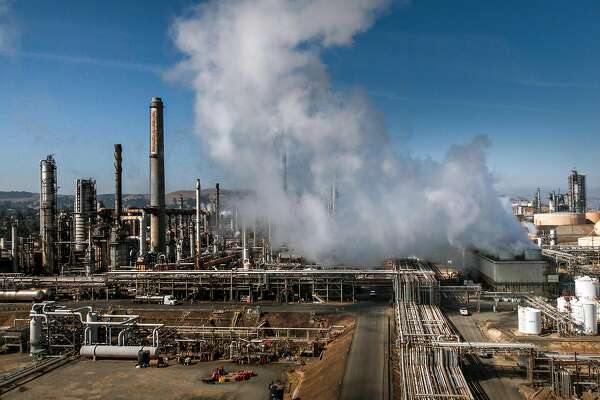
The Marathon refinery in Martinez, shown here on Tuesday, experienced a problem due to Monday’s quake and had to flare. Photo: Paul Kuroda / Special to The Chronicle

A 4.5-magnitude earthquake centered in Pleasant Hill on Monday night caused flaring at the two refineries in Martinez, local officials said.

Flaring is a safety procedure to burn off excess gas. At the Marathon Petroleum refinery in Martinez, flaring stopped at 6:30 a.m. Tuesday, according to a company spokesman.

Portions of the Marathon refinery shut down after the quake and things restarted early Tuesday, Contra Costa County health department spokesman Will Harper said.

Flaring also occurred at the Shell refinery in Martinez, Harper said.

Shell spokesman Ray Fisher said by email that “some equipment was temporarily affected by the quake,” but operations were back to normal Tuesday morning.

The Chevron refinery in Richmond sustained “no known damage,” according to a spokeswoman. Valero spokeswoman Lillian Riojas said in an email Tuesday that there were no major disruptions at the company’s Benicia refinery, and operations are continuing.

But the problems in Martinez prompted some people to wonder what will happen when a bigger quake strikes.

“Thank God for a small one last night, but what happens if there’s a big one?” said Torm Nomprasseurt, a senior community organizer with the Asian Pacific Environmental Network who has lived on the fence line of the Chevron Richmond refinery since 1975.

When there is a siren warning the community because of a flare at the Chevron plant, he shelters in place with his family.

“But if an earthquake happened … and we can’t stay in our house, what are we going to do?” he said.

“This is one of the challenges of living in an earthquake area with the industrial belt,” Rep. Mark DeSaulnier, D-Concord, said Tuesday. He said officials have “gotten progressively better in the 25 years” with notifying communities about instances like flaring at refineries.

Amy Myers Jaffe, who served on the California Energy Commission’s Petroleum Market Advisory Committee and is now based at a think tank in New York, said refineries carry significant safety and environmental risks. In an earthquake, underground pipes can rupture and storage tanks of gasoline or other chemicals burn.

Robert Young, associate professor of chemical engineering practice at USC School of Engineering, who used to work for Exxon, said “flaring is a very important safety measure” because it combusts highly hazardous or acutely toxic materials instead of releasing them into the ground or inside the facility.

The plants are equipped with safety devices that tell operations to shut down automatically when a vibration is detected, said Ralph Borrmann, spokesman for the Bay Area Air Quality Management District.

“It’s a normal process that occurs when the safety devices get triggered,” Borrmann said.

The air quality district is conducting an investigation following the quake, part of standard protocol.

At 11:10 p.m. Monday, due to the Marathon refinery problems, Level 1 of the community warning system was issued, the company said. On a scale of 0 to 3 that meant there were no expected off-site health impacts and only the health department and other county agencies were notified, according to Harper, the Contra Costa County spokesman. In the case of more significant incidents, the county would issue an advisory to the community.

Separately on Tuesday afternoon, at least two tanks caught fire after an explosion at a tank farm at a NuStar facility in Rodeo in Contra Costa County. A 4.7-magnitude earthquake struck near Hollister (San Benito County) on Tuesday shortly after noon, but it was unclear whether the explosion was quake-related. Hollister and Rodeo are 100 miles apart.

The tank farm stores fuels and hydrocarbons, according to Randy Sawyer, Contra Costa County health officer, who said officials were trying to determine the explosion’s cause.

The Contra Costa County Sheriff’s Office released a shelter-in-place alert: “There is a hazardous materials emergency in Crockett and Rodeo at the NuStar facility. The danger will be much less indoors. Go inside, and close all windows and doors. Turn off all heaters, air conditioners, and fans,” the alert read.

“Unless you are using your fireplace, close your fireplace dampers and vents. Cover any cracks around doors or windows with tape or damp towels. Stay off the phone unless you need to report a life-threatening emergency at your location. Remain sheltered indoors until you receive further official instructions. Stay off the phones and do not call 911 unless you have a life threatening emergency.”

According to the company website, the facility has 24 tanks and holds a capacity of 3.04 million barrels.


Chronicle staff writer Anna Bauman contributed to this report.  Mallory Moench and Megan Cassidy are San Francisco Chronicle staff writers. 

There are three types of climate change denier—and most of us are at least one

The Conversation, by Iain Walker & Zoe Leviston, October 9, 2019
Greta Thunberg’s fiery oration has prompted outrage, but even if you agree with her you might still be ignoring her message. EPA/Justin Lane

Amid the cacophony of reactions to Greta Thunberg’s appearance before the United Nations Climate Action Summit, a group of self-proclaimed “prominent scientists” sent a registered letter to UN Secretary-General António Guterres. The letter, headed “There is no climate emergency,” urged Guterres to follow:

…a climate policy based on sound science, realistic economics, and genuine concern for those harmed by costly but unnecessary attempts at mitigation.

The group, supported by 75 Australian business and industry figures, along with others around the world, obviously rejects the scientific consensus on climate change. But this missive displays remarkably different tactics to those previously used to stymie climate action.

The language of climate change denial and inaction has transformed. Outright science denial has been replaced by efforts to reframe climate change as natural, and climate action as unwarranted.

However, this is just another way of rejecting the facts, and their implications for us. Denial can take many forms.

Shades of denial

The twin phenomena of denial and inaction are related to one another, at least in the context of climate change. They are also complex, both in the general sense of “complicated and intricate,” and in the technical psychological sense of “a group of repressed feelings and anxieties which together result in abnormal behaviour.”

In his book States of Denial, the late psychoanalytic sociologist Stanley Cohen described three forms of denial. Although his framework was developed from analyzing genocide and other atrocities, it applies just as well to our individual and collective inaction in the face of the overwhelming scientific evidence of human-induced climate change.

The first form of denial is literal denial. It is the simple, conscious, outright rejection that something happened or is happening—that is, lying. Australian senators Pauline Hanson and Malcolm Roberts, among others, have at one time or another maintained this position—outright denial that climate change is happening (though Senator Hanson now might accept climate change but denies any human contribution to it).

Interestingly, former Australian prime minister Malcolm Turnbull recently blamed “climate change deniers” in his own government for blocking any attempt to deal with climate change, resulting paradoxically in higher energy prices today.

It is tempting to attribute outright denial to individual malice or stupidity, and that may occasionally be the case. More worrying and more insidious, though, is the social organization of literal denial of climate change. There is plenty of evidence of clandestine, orchestrated lying by vested interests in industry. If anyone is looking for a conspiracy in climate change, this is it—not a collusion of thousands of scientists and major science organizations.

The second form of denial is interpretive denial. Here, people do not contest the facts, but interpret them in ways that distort their meaning or importance. For example, one might say climate change is just a natural fluctuation or greenhouse gas accumulation is a consequence, not a cause, of rising temperatures. This is what we saw in the letter to the UN.

The most insidious form of denial

The third and most insidious form is implicatory denial. The facts of climate change are not denied, nor are they interpreted to be something else. What is denied or minimized are the psychological, political, and moral implications of the facts for us. We fail to accept responsibility for responding; we fail to act when the information says we should.

Of course, some are unable to respond, financially or otherwise, but for many, implicatory denial is a kind of dissociation. Ignoring the moral imperative to act is as damning a form of denial as any other, and arguably is much worse.

The treatment of Thunberg, and the vigour with which people push away reminders of that which they would rather not deal with, illustrate implicatory denial. We are almost all guilty, to some extent, of engaging in implicatory denial. In the case of climate change, implicatory denial allows us to use a reusable coffee cup, recycle our plastic, or sometimes catch a bus, and thus to pretend to ourselves that we are doing our bit.

Almost none of us individually have acted as we ought on the science of climate change. But that does not mean we can’t change how we act in the future. Indeed, there are some recent indications that, as with literal denial, implicatory denial is becoming an increasingly untenable psychological position.

While it is tempting, and even cathartic, to mock the shrill responses to Thunberg from literal and interpretive deniers, we would do well to ponder our own inherent biases and irrational responses to climate change.

For instance, we tend to think we are doing more for the planet than those around us (and we can’t all be right). We also tend to think literal deniers are much more common in our society than they in fact are.

These are just two examples of common strategies we use to deny our own responsibility and culpability. They make us feel better about what little we actually do, or congratulate us for accepting the science. But they are ultimately self-defeating delusions. Instead of congratulating ourselves on agreeing with the basic scientific facts of climate change, we need to push ourselves to action.

This article is republished from The Conversation under a Creative Commons license. Read the original article.

Massive fire at refinery in Crockett sends flames, black smoke into air

Massive fire at refinery in Crockett sends flames, black smoke into air

SFGATE, by Katie Dowd, Tuesday, October 15, 2019, 3:33 pm PDT
[BenIndy Editor: Alert Solano sent out this message by text and email at 3:27pm today.:  “Benicia Fire Department is currently monitoring the fire at the Nustar Refinery in the Crockett area of Contra Costa County. We are monitoring the air quality in town. As of this time, there are no impacts to Benicia from this incident. We will provide updates as more information becomes available.”  – R.S.]
A fire in Crockett sent flames and black smoke into the Bay Area on Oct. 15, 2019. Photo KTVU

A massive fire has broken out at a NuStar Energy facility in Crockett, sending plumes of flame and thick black smoke into the air on Tuesday afternoon.

The Vallejo Fire Department confirmed to KTVU the fire started in the NuStar Energy storage tanks on San Pablo Ave. Television reports indicate there may have been an explosion as well.

Aerial footage shows at least two storage tanks appear to be fully engulfed. The hills behind the tanks, which are golden with dry grass, have also caught fire. An airplane is currently conducting air drops on the hills.

A video posted to YouTube shows the top of one of the storage tanks being flung into the air as the fire rages.

Nearby residents in Crockett, Hercules and Rodeo should shelter in place and keep their windows closed, as the black smoke could contain contaminants that are hazardous to those with lung problems.

“Go inside, and close all windows and doors. Turn off all heaters, air conditioners, and fans,” cautioned the Contra Costa County Sheriff’s Office. “Unless you are using your fireplace, close your fireplace dampers and vents. Cover any cracks around doors or windows with tape or damp towels.”

HEADS UP, COMMUTERS: The NuStar fire has closed I-80

NuStar Energy L.P. is a San Antonio-based company that bills itself as “one of the largest independent liquids terminal and pipeline operators in the nation.” Contra Costa County District One Supervisor John Gioia said on KTVU that their tanks “store products for local refineries.”

“There was an explosion there,” Gioia said. “A couple tanks are on fire.”

A Phillips 66 refinery is located next door, but does not appear to have incurred any damage.

The cause of the explosion and fire are still unknown. No injuries have yet been reported.

This is a breaking news story and will be updated when more information becomes available.

Katie Dowd is an SFGATE Senior Digital Manager.