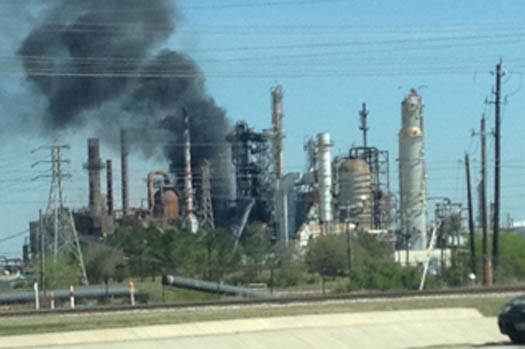
Explosion rocks refinery in Pasadena, injuring one
By Deborah Wrigley, Saturday, March 05, 2016 11:06PM
PASADENA, TX (KTRK) — One person was burned after an explosion at a Pasadena refinery Saturday morning.
Officials at Pasadena Refining Systems, Inc., say the fire began around 10:15am at their refinery off SH 225 and Lawndale Street.
The victim suffered burns to his hands.
Residents in the area told abc13 they felt a powerful blast right before flames began to rise from the plant.
A spokesperson says it all started with an issue involving a compressor. A fire quickly broke out, with burning diesel fuel sending huge plumes of black smoke into the air.
The refinery has their own firefighters, who were able to put out the blaze. Pasadena Police and fire are on standby to assist. The fire was able to be contained and air monitoring indicated no issues.
Drivers and bystanders tell Eyewitness News they could see the smoke miles away from the site of the fire.
The Washburn tunnel was closed by authorities after the explosion.
Viewer photo from the explosion at Pasadena Refining System off SH 225.
According to the Environmental Protection Agency, the plant has a history of ‘significant violations’ of the U.S. Clean Air Act, and was assessed $1,143,000 in fines because of these violations.
A complaint was filed against the company for failure to follow regulations in connection with the storage of a motor vehicle and engine fuels. The company also paid $2,000 in fines for this in August 2014.
The plant is known to store several chemicals, including Ammonia, Benzene, Ethylene, Hydrogen Cyanide, N-Hexane, Propylene, and Sulfuric Acid.
According to the EPA, there are 20,901 households in the area around the plant, and 24,484 children also live in the area.
News Analysis: Inspector General Cites Failure of Federal Railroad Administration on Oil Train Safety
By Matt Krogh, March 2, 2016
2015 Paul K. Anderson
In a scathing critique, the US Department of Transportation Inspector General called out the Federal Railroad Administration (which is an agency within DOT) for failing to adequately evaluate or reduce the risks of a catastrophic oil train accident to the American public. The conclusion: The FRA is failing to provide adequate oversight and policing of oil trains, and FRA fails to enforce the rules or prosecute violators when they find dangerous violations.
Oil trains are too dangerous for the rails. The Inspector General makes this point in the first sentence of the review, citing the fatal Lac Megantic oil train disaster. But we’ve heard from far too many local, county, and state officials around the country who believe the federal government is overseeing oil trains and guaranteeing public safety. It’s true that century-old railroad law puts railroads under federal control. That makes sense because a continental railroad system would grind to a halt if it was regulated by thousands of different local and state government entities. But no one should let “pre-emption” or federal-control get in the way of local permitting decisions, especially when it comes to public safety. Especially when it comes to preventing a calamity that could reduce another town to ashes.
This Inspector General report makes it clear the FRA is failing the American people with a good cop/good cop approach when it comes to mile-long oil trains carrying millions of gallons of toxic, explosive crude through US cities and towns.
Here’s some key quotes from the DOT IG report, reviewed in an excellent article by AP reporter Joan Lowy:
the Agency has no overall, national understanding of the risk environment and cannot be sure that the regions consider all appropriate risk factors
This points to a key flaw in FRA oversight: they assume that region-based inspection systems are all that are needed, and fail to look nationally, comprehensively, at the risks of moving oil by train.
…do not take into account risk factors such as the condition of transportation infrastructure, the shippers’ compliance histories, or the proximity of transportation routes to population centers.
This begs the question, what does the FRA look at in risk assessment? Track conditions, how good the individual railroads are at safety, and how close people are living to oil train routes seem pretty important.
FRA issues few violations, pursues low civil penalties, and does not refer possibly criminal violations to the office of inspector general
The FRA turns a blind eye to criminal violations, settles for low fines, and fails to bring in the Office of Inspector General when criminal investigations are warranted. We need a bad cop, folks.
One inspector noted that the Office of Chief Counsel has effectively “numbed” a large portion of inspectors into not writing violations and stated that some inspectors have preconceived notions that violations will not get through the process.
It’s true that the FRA does have inspectors — but the FRA’s buddy culture with the railroads means that hard-working inspectors on the ground have lost faith in the agency’s willingness and ability to regulate railroads.
respondents just smile and cut the check
By respondents the Inspector General means railroads. They don’t argue with miniscule fines, but then why should they? They are happy to pay small fines as a normal operating expense, and get back to moving vast quantities of explosive, toxic crude oil through America’s population centers.
While the specific circumstances of all of these violations may not have warranted maximum penalties, FRA settled for 5.1 percent of the roughly $105.6 million dollars in penalties it could have levied…
No, seriously, the fines are miniscule. FRA is only issuing 5% of the fines they could levy under the law. Wouldn’t it be nice if the highway patrol took the same approach to speeding tickets? It would, but then, the Wild West of our highways would be littered with the smoking wreckage of souped-up Camaros.
By applying the same penalty to all violations of a regulation, FRA is distancing its enforcement actions from the context of the behaviors they are meant to rectify, thus weakening penalties’ deterrent effect. Furthermore, by bundling violations, FRA’s settlement process removes penalty enforcement from the context of each violation and low penalties diminish the potential deterrent effect of the penalties set in the guidelines and the regulatory maximums.
And there you have it: it doesn’t matter the scale or the number of fines you get, you can talk your way out of it in the settlement process.
The Inspector General audit of the Federal Railroad Administration found an agency that fails to understand and regulate the severe threat to 25 million Americans living in the blast zone. When it comes to oil trains the FRA seems to work for the railroad and oil industry, and not the American people. Local and state officials faced with permitting decisions need to recognize their responsibility to protect the public, just as the FRA now needs to do their job when it comes to deadly oil trains.
Inspector General Report: Rail Hazmat Safety Violations should be prosecuted
By Joan Lowy, Associated Press, February 28, 2016
Sarah Feinberg, Federal Railroad Administration administrator
WASHINGTON (AP) — Federal regulators are failing to refer serious safety violations involving freight rail shipments of crude oil and other hazardous cargo for criminal prosecution, and are going lightly on civil fines, according to a report released Friday by a government watchdog.
The Federal Railroad Administration routinely applies only modest civil penalties for hazardous materials safety violations, even though inspectors request penalties only for serious or repeated infractions, said the report by the Department of Transportation’s inspector general.
Instead, the agency’s attorneys have made it a priority to process penalties quickly and avoid legal challenges, the report said.
And, although the agency processes hundreds of safety violations each year, it appears that not a single case has ever been referred for criminal investigation, the report said. After examining a random sample of safety violations over five years, the inspector general’s office found 17 cases it said should have referred for criminal investigation.
Based on that sample, the inspector general’s office estimated 20 percent, or 227 out of 1,126 violations, may have warranted criminal referral. The agency’s attorneys told the watchdog that they didn’t make criminal referrals because they didn’t know the procedures for doing so, and they didn’t think it was part of their job.
“As a result, penalties have little deterrent effect, and criminal penalties aren’t being pursued,” wrote Mitchell Behm, assistant inspector general for surface transportation.
Concern about rail shipments of hazardous cargo has been heightened in recent years by a series of fiery oil train explosions in the U.S. and Canada, including one just across the border in Lac-Megantic, Quebec, that killed 47 people. More than 400,000 tank cars of oil are shipped across the country annually.
Rep. Peter DeFazio of Oregon, the senior Democrat on the House Transportation and Infrastructure Committee, said the report confirms “that the federal government has failed to provide the necessary oversight to protect communities across the country from serious accidents involving the rail transportation of hazardous materials.”
One case the report said should have been referred for criminal investigation involved a company that produced tank car valves that hadn’t been put through a required design approval process. The valves subsequently leaked hazardous liquids. In another case, a company may have deliberately failed to disclose that a shipment included radioactive containers.
Matt Lehner, an FRA spokesman, said most of the inspector general’s recommendations are being implemented. He noted that the agency collected $15 million in fines for violations in the 2015 federal budget year, a 12 percent increase over the previous year and the most in the agency’s history
The inspector general’s office also found that the agency doesn’t have a complete understanding of the risks of hazardous cargo shipments because the agency makes safety assessments by looking narrowly at operations in specific regions, not the nation as a whole.
The regional evaluations also don’t include an assessment of the risks of transporting highly volatile and hazardous materials like crude oil near cities and major population centers, the report said.
Without an accurate national assessment, the railroad administration can’t be sure that all the appropriate risk factors are being considered when deciding which operations are most in need of inspections, the report said.
The inspector general also faulted the agency’s complex records system, saying it makes difficult for inspectors to access safety information on rail operations outside their region. As a result, the railroad administration and a sister agency, the Pipeline and Hazardous Materials Safety Administration, don’t share critical and up-to-date information with safety inspectors and investigators in different regions throughout the country.
Benicia’s own videographer, Dr. Constance Beutel, is reducing the 20 hours of Planning Commission hearings into watchable shorts. I understand that she has winnowed the 20 hours down to 4, and has produced these two beautiful outtakes. (If you only have time for one, I’d recommend you watch the first, “Oxygen and Crude By Rail.”)
Oxygen and Crude By Rail(Public comment by Phyllis Ingerson, longtime resident of Benicia)
Stop Crude By Rail!(“Oil Trains” by Andy Shaw, of Benicia, CA, Tune: The Wreck of the Edmund Fitzgerald, by Gordon Lightfoot)