The Martinez Refining Company’s manager told the Martinez City Council on Wednesday operators were unaware last Thanksgiving’s release of spent catalyst was affecting the outside community until the next day, and the refinery held off notifying authorities until it could assess whether the release was harmful. NBC Bay Area’s Jodi Hernandez reports. Click the “play” arrow icon to play the video on the page.
The Martinez Refining Company’s manager told the Martinez City Council on Wednesday operators were unaware last Thanksgiving’s release of spent catalyst was affecting the outside community until the next day, and the refinery held off notifying authorities until it could assess whether the release was harmful.
Refinery manager Daniel Ingram apologized and told the council the company has taken numerous corrective actions to make sure the events of last Thanksgiving weekend don’t happen again.
The refinery released an estimated 20 to 24 tons of “spent catalyst” into the surrounding community from about 9:30 p.m. Nov. 24 until the following morning, when residents found their yards and vehicles covered in metallic dust.
The refinery failed to alert the county health department and the community warning system, both of which are legally mandated within 15 minutes of a release.
County health officials didn’t find out about the release until the following Saturday when alerted to social media posts about the dust.
Martinez Refining Company (MRC). | Anda Chu / Bay Area News Group.
Ingram told the council the delay was at least partially because refinery officials were unaware there was a community impact until the next day, when contacted by a community member. Then they were busy trying to ascertain whether the release was harmful.
Ingram said the refinery has since “adjusted our procedures” so it notifies outside authorities as soon as the slightest measure of a release is noted.
“The moment that alarm goes off, we’re making that notification immediately,” Ingram said.
Initial testing of the Thanksgiving release showed the dust contained elevated levels of aluminum, barium, chromium, nickel, vanadium and zinc, all of which can cause respiratory problems.
Ingram said the refinery has taken 11 specific corrective actions: two associated with equipment, six associated with refinery procedures, and three associated with better training.
As an example, the unit in which the Thanksgiving problem occurred was coming back online after being in a “hot standby mode.”
Bringing it back online was a manual task controlled by an individual who was handling multiple control points. Now more of the process is automatic and, if there’s a problem, the process must be stopped sooner.
Ingram also addressed three smaller releases of “coke dust” incidents that have occurred since July. Coke dust is a byproduct of oil refining. The first release, on July 11, lasted less than a minute and created steam with coke dust, which was carried into the community by wind.
The second release was on July 22 and was contained on-site. The third release happened Oct. 6 and was termed by refinery officials as “brief” in a unit that has since been taken offline. Nevertheless, all three incidents are still being investigated. But Ingram pointed out that, under the refinery’s new procedures, the refinery notified the health department and the community immediately.
Ingram said internal investigations have prompted procedural corrections to have been made, as well as started new ‘red tag” safety drills, going through various emergency scenarios to respond better in the future.
“We do sincerely apologize to our neighbors and the community for these incidents. And I know that actions speak louder than words … we are working overtime right now to investigate thoroughly each and every of these incidents and come up with the appropriate corrective actions that address the root causes of these incidents.”
Ingram talked about the refinery’s new “Goal 0” safety policy, which refers to zero safety incidents as a cultural goal of the company. He said everyone at the refinery is dedicated to Goal 0.
“We know we have to earn the right to operate in the community that hosts us, and we are very, very disappointed that we have failed to do that,” he said.
Ingram said the refinery has implemented new mandatory safety training and has expanded its environmental safety staff, hiring new senior environmental engineers and 20 new operators. He also said he will return to give the council regular monthly updates.
The Contra Costa County District Attorney’s Office is investigating MRC for failing to notify authorities of the Thanksgiving release. The Board of Supervisors put together an oversight committee, including residents from affected areas, to investigate the cause and whether the release increased risk of community health problems. [Emph. added by BenIndy.]
[Note from BenIndy: Both the Biden administration and Big Oil have been touting carbon capture and sequestration (CCS), sometimes called carbon dumping, as a way to address the climate crisis. However, many climate scientists and activists are seriously concerned about CCS’s sudden surge to the forefront of the climate conversation. Why are oil giants like Valero teaming up with BlackRock-funded concerns to build pipelines across America? Could it have anything to do with the billions of dollars in tax breaks on the table? On Friday, November 3, at 12 pm, Scientists Speak Up (a Stanford student group working to combat science misinformation) are hosting a discussion about CCS, how it actually supports oil and gas production as well as the chilling impact Big Oil and the Biden administration’s fixation on CCS could have on exploring more innovative or aggressive tech and mitigation. Finally, the discussion will touch on Big Oil’s disturbing, ever-growing influence in academic research. Click here to learn more about how to attend this important conversation and we will include a link with an event flyer at the end of this post. (The BenIndy was not asked to promote this event and is not affiliated with Scientists Speak Up in any way. We just thought the event looked very interesting and timely given a looming proposal to install a CCS pipeline in Solano County.)]
Carbon capture pipeline nixed after widespread opposition
A sign against a proposed carbon dioxide pipeline outside a home in New Liberty, Iowa, US, on Sunday, June 4, 2023. The Biden administration is all-in on carbon capture and storage. But the pipelines needed to move the greenhouse gas around face stiff local opposition. | Miriam Alarcon Avila for Bloomberg via Getty Images.
Navigator CO₂ says regulatory hurdles are too much to overcome.
A company backed by BlackRock has abandoned plans to build a 1,300-mile pipeline across the US Midwest to collect and store carbon emissions from the corn ethanol industry following opposition from landowners and some environmental campaigners.
Navigator CO₂ on Friday said developing its carbon capture and storage (CCS) project called Heartland Greenway had been “challenging” because of the unpredictable nature of regulatory and government processes in South Dakota and Iowa.
Navigator’s decision to scrap its flagship $3.1 billion project—one of the biggest of its kind in the US—is a blow for a fledgling industry that is an important part of President Joe Biden’s climate strategy. CCS projects attempt to lock carbon underground for decades, preventing it from adding to heat-trapping gasses in the atmosphere.
It also represents a setback for the carbon-intensive corn ethanol refining industry, a pillar of the rural Midwestern economy which is targeting industry-scale CCS as a way to reduce emissions.
Navigator’s project would have laid pipelines across five US states—South Dakota, Nebraska, Minnesota, Iowa, and Illinois—to collect CO₂ from ethanol and fertilizer plants and pipe the gas to an underground storage site in Illinois.
It was backed by several deep-pocketed investors, including BlackRock, US oil refiner Valero Energy and Poet, a top US biofuel refiner. [Emph. added by BenIndy.]
Matt Vining, Navigator’s chief executive, said: “As good stewards of capital and responsible managers of people, we have made the difficult decision to cancel the Heartland Greenway project.”
Heartland Greenway is part of a wave of CCS projects aiming to tap into billions of dollars in tax breaks available under the Inflation Reduction Act, the landmark climate law signed by Biden last year. The incentives aim to help companies build carbon capture infrastructure, which has not yet proven it is commercially viable on a large scale.
Note from the NorCal ACLU – Solano Chapter, co-led by Kris Oyota Kelley and Vallejo mayoral candidate Andrea Sorce:
This morning, California Attorney General Rob Bonta held a press conference to announce a stipulated judgment (consent decree) with the Vallejo Police Department.
This agreement compels the City of Vallejo to implement long-overdue reforms and establishes an independent court-supervised monitor to ensure progress. It will not solve all of our police accountability issues, but it is a major step in the right direction for public safety in Vallejo.
We appreciate everyone who signed the petition and will keep you updated as our efforts progress. The ACLU NorCal Criminal Justice team will be investing significant resources in Vallejo going forward, and we will continue to push for the remainder of our petition demands.
[Note from BenIndy: There is still a lot of work to do – please sign the petition by clicking this link. ]
Attorney General Bonta Announces Stipulated Judgment with the Vallejo Police Department to Strengthen Accountability, Police Policies and Practices
Click the image to view the document. You will be redirected to the website of the Office of the Attorney General.
Sunday, October 15, 2023
[Images added by BenIndy]
VALLEJO – California Attorney General Rob Bonta today announced that the California Department of Justice (DOJ) has entered into a stipulated judgment with the city of Vallejo and the Vallejo Police Department (VPD) regarding reforms to VPD’s policies and practices. The stipulated judgment continues and expands upon the reform work started under a Memorandum of Understanding (MOU) between the DOJ and VPD. The agreement announced today resolves DOJ’s complaint alleging the VPD engaged in a pattern and practice of unconstitutional conduct. As part of the agreement, the city of Vallejo and VPD will undertake a comprehensive set of actions — to be led by an Oversight and Reform Evaluator — to promote public safety, reduce unlawful uses of force, eliminate racial and identity disparities, strengthen accountability systems, continue to increase support for officers, and protect the statutory and constitutional rights of the people of Vallejo.
“Maintaining trust between our law enforcement and the communities they serve is a foundational part of public safety,” said Attorney General Bonta. “Today’s agreement with the city of Vallejo and its police department is another important step toward correcting injustices, building trust, and enhancing public safety for the people of Vallejo. We cannot afford to be complacent. The reforms laid out in the agreement are needed and necessary to continue healing the relationship between law enforcement and the community. It’s past time the people of Vallejo have a police department that listens and guarantees that their civil rights are protected. My office is committed to staying engaged, working collaboratively with VPD and the city and ensuring a fair, thorough, and transparent process.”
Heather Skinner, Ronell Foster’s mother-in-law, speaks about transparency during a press conference held by the office of lawyer John Burris in front of City Hall in Vallejo. Ronell Foster was killed by VPD in 2018. | Chris Riley / Times-Herald.
“The City of Vallejo is encouraged by the progress made to date by our staff and the Department. We are optimistic about the continuation of our collaboration with the California Department of Justice and its team in the next phase of this important work,” said Vallejo Mayor Robert McConnell. “We have made significant progress but there is still more to do. The City Council is unanimously committed to seeing our efforts through to conclusion. It is the goal of the City of Vallejo and the VPD to continue to build on the progress made to date, to strengthen our relationships and advance our efforts to build trust with the community.”
“The Vallejo Police Department is committed to the completion of the remaining original recommendations and the additional recommendations under the new Agreement,” said Vallejo Police Department Interim Chief Jason Ta. “Improvements will be made to new and existing policies and procedures, which we are confident will increase accountability, efficiency, transparency, and community partnerships while at the same time improving relationships with the public and building mutual trust and respect from the community we serve.”
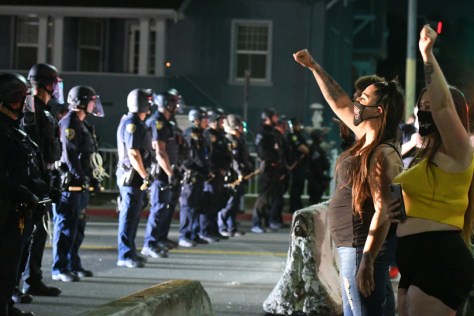
Protesters face off against police officers during a peaceful march over the killing of Sean Monterrosa, the 22-year-old San Francisco man, who was shot and killed by a Vallejo Police officer in 2020. | Chris Riley / Times-Herald.
“This Agreement is a continuation of the reform process Vallejo Police Department started three years ago,” said Vallejo City Manager Michael Malone. “City management and Vallejo Police Department are committed to engaging the community and dedicating the resources needed to ensure this ongoing effort is successful within the terms of our new Agreement.”
“During the past 3 years of the City’s collaborative agreement with the California Department of Justice we have fostered a positive working relationship that has produced significant results,” said Vallejo City Attorney Veronica Nebb. “Our work is not complete and we look forward to continuing our joint efforts with the California Department of Justice for the benefit of the community, the Department and the City.”
On June 5, 2020, DOJ, the city of Vallejo, and VPD entered into a MOU for VPD to institute a comprehensive modernized policing plan that included implementing 45 reform recommendations made by VPD’s expert consultants, as well as additional review from DOJ to expand upon and add any additional recommendations needed to modernize VPD’s current policies and practices, assist with implementation of the recommendations, and independently evaluate VPD’s compliance with the recommendations. The California Department of Justice’s (DOJ) decision to enter into an MOU with VPD to reform its policing came in light of several high-profile uses of force, including a number of officer-involved shootings.
Alicia Saddler speaks outside City Hall at a rally addressing police shootings in Vallejo, Calif., on Feb. 28, 2019. Saddler’s brother, Angel Ramos, was killed by VPD in 2017. | Brock Stoneham / NBC News.
When the MOU expired on June 5, 2023, VPD had achieved substantial compliance with 20 out of the 45 agreed-upon recommendations. During the review of VPD’s systems and practices under the MOU, DOJ concluded that VPD failed to uniformly and adequately enforce the law, based in part, because of defective or inadequate policies, practices, and procedures. DOJ is currently seeking a judgment with court oversight requiring VPD and the city of Vallejo to implement the remaining reforms, and to implement additional reforms addressing civilian complaints, bias-free policing, stops, searches, seizures and arrest, and ongoing oversight of these reforms.
The parties have agreed on a comprehensive five-year plan to address the numerous areas that need improvement and modernization to bring VPD into alignment with contemporary best practices and ensure constitutional policing. VPD will implement the remaining recommendations that have not been completed from the 45 Recommendations contained in the May 2020 report titled “Vallejo Police Department: Independent Assessment of Operations, Internal Review Systems and Agency Culture” (“2020 Recommendations”). Additionally, under the agreement VPD will implement additional recommendations, including to:
Address unreasonable force by holding officers and supervisors accountable for not identifying, adequately investigating, or addressing force that is unreasonable or otherwise contrary to VPD policy; and refer uses of force that may violate law or VPD’s use of force policy to their Professional Standards Division (internal affairs) for further investigation or review.
Enhance, promote, and strengthen partnerships within the community, to continue engaging constructively with the community to ensure collaborative problem-solving and bias-free policing, and to increase transparency and community confidence in VPD.
Utilize its Chief’s Advisory Board (CAB) and the Police Oversight and Accountability Commission (POAC), to continue to develop and amend significant policies that impact the community, including to its use of force policies, community-policing strategy and policies, bias-free policing policies, and civilian complaint policies.
Develop a policy that defines and limits the use of pretextual stops.
Enhance and revise training with respect to investigatory stops, reiterating that race, color, ethnicity, national origin, religion, gender, gender identity, disability, or sexual orientation are not to be used as a factor in establishing reasonable suspicion or probable cause, except as part of actual and credible descriptions of a specific suspect.
Prohibit officers from conducting consent searches during consensual encounters. Officers may not conduct a consent search after detaining a subject unless an officer reasonably suspects that the subject has contraband or evidence related to that detention, and the consent must be documented on body camera footage or a signed consent form.
Ensure stops, searches, and seizures comply with the law, as part of an effective overall crime prevention strategy that does not contribute to counterproductive tension with the community.
Commit to providing bias-free services and enforcing laws in a way that is professional, nondiscriminatory, fair, and equitable.
Work with the Evaluator to develop a policy and protocol for responding to calls involving a person in mental health crisis or suffering from a mental health disability. The policy and protocol will include utilizing professional civilian staff, who are trained professionals in responding to mental health crises, to respond when appropriate and available.
Develop and implement policies, guidelines, and training to ensure all supervisors and managers:
Exercise appropriate supervisory oversight
Conduct objective and impartial investigations
Are held accountable for meeting agency standards and expectations
Engage with and listen to community feedback
Incorporate community feedback when able and appropriate
Develop and evaluate policing strategies and tactics reflective of contemporary best community policing practices
Conduct an ongoing audit of incidentswhere an officer points a firearm at a member of the public or brandishes a firearm in the presence of a member of the public to ensure that its officers are not drawing a firearm solely based on the mere existence of a potential risk (e.g., public contact, pedestrian/traffic stop).
A copy of the stipulated judgment is available here, and a copy of the complaint is available here.
Rep. Pete Aguilar (D-Calif.) blasted Rep. Jim Jordan (R-Ohio) in an impassioned speech nominating Minority Leader Hakeem Jeffries (D-N.Y.) for Speaker on the House floor Tuesday.
“A vote today to make the architect of a nationwide abortion ban, a vocal election denier and an insurrection insider to the Speaker of this house would be a terrible message to the country and our allies,” Aguilar said, speaking of Jordan.
“Mr. Speaker, it would send an even more troubling message to our enemies, that the very people who would seek to undermine democracy are rewarded with positions of immense power,” he continued.
He ripped the GOP’s Speaker nominee for putting the country’s national security at risk, for his role in not certifying the 2020 election results and for launching “baseless investigations.” Jordan has been a leading figure in House impeachment probes into President Biden and his son Hunter.
“We’re talking about someone who has spent his entire career trying to hold our country back, putting our national security in danger, attempting government shutdown after government shutdown, wasting taxpayer dollars on baseless investigations with dead ends, authoring the very bill that would ban abortion nationwide without exceptions and inciting violence on this chamber,” Aguilar said.
“Even leaders of his own party have called him a legislative terrorist,” he added.
That monicker was once used by former Speaker John Boehner (R-Ohio) to describe Jordan.
Aguilar also took aim at Jordan for voting no on a series of legislative action, including approving natural disaster relief in states after they were ravaged by hurricanes and wildfires. When listing out examples of what legislative action Jordan opposed, some Democrats appeared to join in chorus, saying “he said no” along with Aguilar.
“When the Mississippi River floods devastated the south and communities across state lines needed Congress to act, he said no,” he said. “When our veterans were suffering from disease and dying as a result of their service to our country and Congress passed a bipartisan solution, he said no.”
The California Democrat criticized the House for considering electing a member “who has not passed a single bill in 16 years.”
Aguilar called on the House to find a bipartisan way forward, accusing Republicans of throwing the House into “chaos” by failing to come to a consensus on a new Speaker. He said that they are gathered to vote on a new leader because “this hallowed chamber has been led to a breaking point by two dangerous forces — extremism and partisanship.”
He also urged those on both sides of the aisle to vote for Jeffries.
“Only Hakeem Jeffries can be trusted to keep his word. Only Hakeem Jeffries can lead us out of the chaos and towards the path of governance. It brings me immense pride to nominate our friend the Democratic leader Hakeem Jeffries as Speaker,” he said.
Jordan, who narrowly secured the GOP nomination for Speaker in an internal vote last week, failed to clinch the 217 votes necessary on the first ballot. The vote was 200 for Jordan, 212 for Jeffries and 20 for other members. It’s unclear when a second vote might be held.





You must be logged in to post a comment.