

All posts by Roger Straw
The death of RBG; news orgs remember legal legend; election jolted; McConnell warns of ‘pressure from the press’; views from right and left

Oliver Darcy here. It feels wrong to tease any of the stories in this newsletter here when there is such significant and tragic news…
The death of RBG
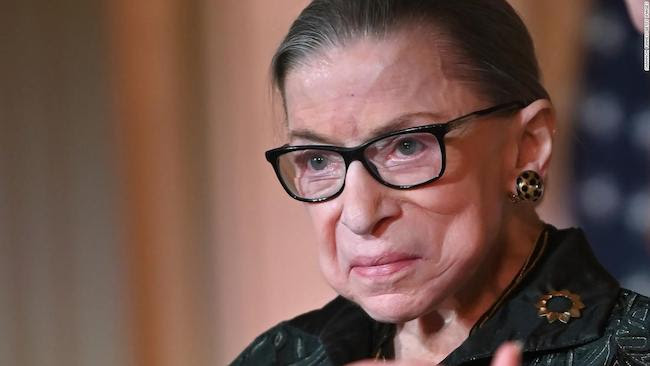
Only a tiny fraction of stories leave a control room in shock and a news anchor visibly startled. Only a small number of stories cause a host to interrupt their own script, mid-paragraph, for breaking news, cautiously digesting the information being relayed by his or her producers before conveying it to the audience. Only few stories cause newspapers to rip up and redo their front pages on a Friday night.
The death of Ruth Bader Ginsburg was one of those stories.
‘We have breaking news right now’
On MSNBC, Joy Reid was talking about Trump University when she abruptly stopped in the middle of the segment. “I’m going to hold on because we have some breaking news that we have to report,” Reid said, before taking a breath and informing her audience that Ginsburg had passed away at the age of 87.
CNN, meanwhile, was on a commercial break when Erin Burnett suddenly cut in. “We have breaking news right now,” Burnett told viewers with an urgency reserved for only the biggest news stories. It took Fox News several more minutes to bring their viewers the breaking story. The network was airing the Trump rally in Minnesota. Eventually Martha MacCallum broke in with a Fox News Alert, cutting away from Trump as he attacked the “fake polls.”
How news orgs remembered her
>> New Yorker: “Ginsburg bore witness to, argued for, and helped to constitutionalize the most hard-fought and least-appreciated revolution in modern American history: the emancipation of women. Aside from Thurgood Marshall, no single American has so wholly advanced the cause of equality under the law…”
>> WaPo: “Born in Depression-era Brooklyn, Justice Ginsburg excelled academically and went to the top of her law school class at a time when women were still called upon to justify taking a man’s place. She earned a reputation as the legal embodiment of the women’s liberation movement and as a widely admired role model for generations of female lawyers…”
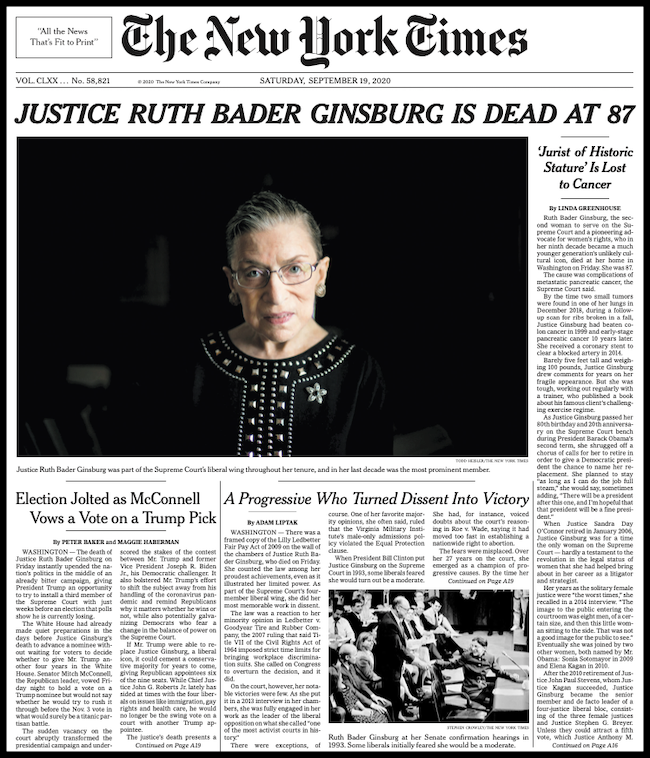
>> NYT: “Barely five feet tall and weighing 100 pounds, Justice Ginsburg drew comments for years on her fragile appearance. But she was tough…”
>> CNN: “Ginsburg developed a rock star status and was dubbed the ‘Notorious R.B.G.’ In speaking events across the country before liberal audiences, she was greeted with standing ovations as she spoke about her view of the law, her famed exercise routine and her often fiery dissents…”
Front and center
Ginsburg’s death will place the Supreme Court front and center of not only the presidential race, but in Senate races all across the country. This is one of the issues that will define the weeks leading up to the election. The precedents set by landmark cases like Roe v. Wade are quite literally at stake, as well as a host of other issues the court will decide in the years to come. And as Jim Sciutto pointed out, “A 5-3 conservative court may have some very big decisions to make about the upcoming election.”
Mitch McConnell vowed on Friday night to ensure Trump’s nominee — should he nominate someone, and all indications are that he will — gets a vote, and as Dana Bash pointed out on CNN, filling the bench has been the majority leader’s “singular focus.” Which is to say it’s very difficult to imagine a scenario where Republicans don’t move forward at some point between now and January 20th. Brit Hume made a smart point on Fox, noting that Trump’s promise to appoint conservative judges was an argument that actually helped persuade some Republicans who were otherwise uncomfortable with voting for him in 2016. Biden’s campaign has made significant effort to win over Republican voters in this race. Will the future of the court hinder Biden’s efforts? Or will it rally the left even more?
McConnell warns of ‘tremendous pressure from the press’
In a note McConnell sent to GOP senators, the majority leader wrote, “Over the coming days, we are all going to come under tremendous pressure from the press to announce how we will handle the coming nomination.” McConnell’s advice? “For those of you who are unsure how to answer, or for those inclined to oppose giving a nominee a vote, I urge you to all keep your powder dry. This is not the time to prematurely lock yourselves into a position you may later regret.”
>> McConnell is advising his colleagues that they should withhold from their constituents how they are leaning on an issue of incredible importance with an election fast approaching…
‘My most fervent wish’
Will Ginsburg’s dying wish be honored? We’ll see. Before she died, Ginsburg dictated a statement to her granddaughter Clara Spera, NPR’s Nina Totenberg reported. The statement read, “My most fervent wish is that I will not be replaced until a new president is installed.”
Fox guests call for Trump to make nomination
Some guests on Fox wasted no time calling for Trump to nominate a justice to fill the vacancy. Ned Ryun said the President should “seize the moment” and make a nomination. Ted Cruz later told Sean Hannity that he believes Trump should “next week nominate a successor to the court.” Cruz added, “I think it is critical the Senate takes up and confirms that successor before Election Day.”
Expect this pressure to ramp up and be at full speed by the end of the weekend. Right-wing media will undoubtedly call for Trump to make a nomination. The mindset for conservatives has, for some time, been defined by what the late Andrew Breitbart used to say: “#WAR.” In other words, arguments about rules and precedent are not likely to be effective. There are no rules in war — and that is the state that right-wing media has conditioned its audience to be in.
> Related: Matt Gertz at the progressive media watchdog Media Matters put together a compilation of “when Fox hosts said that you shouldn’t push a Supreme Court nomination during an election year…”
The view on MSNBC
Brian Stelter writes: “Chris Hayes‘ guest Rebecca Traister took a big gulp of wine as Hayes reported McConnell’s statement. Hayes ended his hour by saying, ‘The future is unwritten, and anyone who tells you they know what is going to happen is wrong. We are utterly uncharted territory.’ Rachel Maddow agreed and said humility is essential in a moment like this. Maddow then interviewed Hillary Clinton, who said ‘She stood on the side of moving us toward a more perfect union…'”
NYT’s historic A1
FOR THE RECORD, PART ONE
— CNN and Fox News are staying live until 1am ET and starting Saturday morning coverage early at 5am…
— “Trump is expected to put forth a nominee to fill Ruth Bader Ginsburg’s seat on the Supreme Court in the coming days,” sources told ABC’s John Santucci and Katherine Faulders… (ABC News)
— Trump is “likely to meet again with those on his short list in the coming days,” a source told NYT’s Peter Baker and Maggie Haberman… (NYT)
— “An already chaotic and corrosive presidential campaign was jolted anew,” Philip Rucker, Matt Viser, Sean Sullivan and Josh Dawsey wrote… (WaPo)
— CNN’s Ariane de Vogue reported that Ginsburg, “even after her fifth diagnosis with cancer was working on a book with one of her former clerks, Amanda Tyler. It was based on her life on gender equality…” (CNN)
— Within thirty minutes of the bulletin, each of the top ten Twitter trending topics in the US were related to RBG… (Twitter)
— Watch the moment that Bill Maher broke the news to his panel. You can hear gasps from people in the audience… (“Real Time”)
Solano County daily COVID update: 31 new cases overnight, test rate remains low at 2.9%
[For a complete archive of day by day data, see my Excel ARCHIVE – R.S.]
Friday, September 18: 31 new cases overnight, no new deaths. Since the outbreak started: 6,085 cases, 55 deaths.
By Age Group
City Data
Friday, September 18: 31 new cases overnight, no new deaths. Since the outbreak started: 6,085 cases, 55 deaths. Compare previous report, Thursday, Sept 17:
 Summary


- Solano County reported 31 new cases today, total of 6,085 cases since the outbreak started. Over the last week, Solano reported 265 new cases, an average of 38 per day.
- Deaths – no new deaths today, total of 55 Solano deaths.
- Active cases – Solano reported 13 more ACTIVE cases today, total of 264. Note that only 27 of these 264 people are hospitalized, so there are a lot of infected folks out among us, hopefully quarantined. Is the County equipped to contact trace so many infected persons? Who knows? To my knowledge, Solano County has no reporting on contact tracing.
- Hospitalizations – the number of currently hospitalized persons was 2 fewer today, total of 27. The total number hospitalized since the outbreak started remained unchanged at 316 (see age group hospitalization stats below).
- ICU Beds –The County reported 45% of ICU beds available, up 2% from yesterday and down from 56% on Monday. (After 7 weeks, still no information about availability of ventilators.)
- Testing – The County reports today that 737 residents were tested since yesterday, new total of 83,332. Solano has a long way to go: only 18.6% of Solano County’s 447,643 residents (2019) have been tested.
Positive Test Rate
 Solano County reported today that our 7-day average test rate dropped to 2.9% from yesterday’s 3.1%. I was skeptical about the remarkably low rate last week: our supposedly smooth 7-day moving average jumped all over the place recently (see note about delayed adjustments below). For the record, just two weeks ago we saw Solano rates above 7% for the first time since we peaked at 9.3% on July 22. Last week we bottomed out at 2.7%. The County’s line graph looks like a flat line and tells us absolutely nothing, not worth posting here. Health officials and news reports focus on percent positive test rates as one of the best metrics for measuring the spread of the virus. The much more stable California relatively stable 7-day test rate fell slightly today from 3.4% to 3.3%. (Note that Solano County displays past weeks and months in a 7-day test positivity line graph which also shows daily results. However, the chart does not display an accurate number of cases for the most recent days, as there is a lag time in receiving test results. The 7-day curve also lags behind current unknown results.)
By Age Group

- Youth 17 and under – 3 new case today, total of 664 cases, representing 10.9% of the 6,085 total cases. No new hospitalizations among this age group, a total of 5 hospitalizations since the outbreak began. Thankfully, no deaths. In recent weeks it seems too many youth are ignoring public health orders. Cases among Solano youth rose steadily over the summer, from 5.6% of total cases on June 8 to 11% on August 31 and has remained around 11% since then. Youth are 22% of Solano’s general population, so this 11% may seem low. The significance is this: 1) youth numbers have increased steadily and at a faster rate than the other age groups, and 2) youth are SERIOUSLY NOT IMMUNE (!) – in fact 5 youth have been hospitalized.
- Persons 18-49 years of age – 19 new cases again today, total of 3,645 cases. This age group is 41% of the population in Solano, but represents 60% of the 6,085 total cases, by far the highest percentage of all age groups. The County reported no new hospitalizations in this age group today, total of 103 hospitalized since the outbreak began. No new deaths among this age group today, total of 4 deaths. Some in this group are surely ignoring public health orders, and many are providing essential services among us. I expect his group is a major factor in the spread of the virus.
- Persons 50-64 years of age – 4 new cases today, total of 1,164 cases. This age group represents 19% of the 6,085 total cases. No new hospitalizations today, total of 85 hospitalized since the outbreak began. No new deaths in this age group today, a total of 11 deaths.
- Persons 65 years or older – On Monday, I reported Solano’s LARGEST SINGLE WEEKEND INCREASE in new cases in this age group since I began keeping records on April 20: 31 new cases. Also 3 new hospitalizations and 2 deaths. The County reported another 14 new cases yesterday, and 5 new cases today. This group also saw 3 new hospitalizations yesterday. I believe the recent spike is related to news of an outbreak at the Parkrose Gardens Alzheimer’s and Dementia care facility in Fairfield, where 31 patients and 8 staff were reported on September 15 to have tested positive. This age group’s 611 cases represent 10% of the 6,085 total cases. Total hospitalizations since the pandemic began remained unchanged today at 123, and deaths also remained unchanged, total of 40 in this age group. In this older age group, 20.1% of cases required hospitalization at one time. This group accounts for 40 of the 55 deaths, or 73%.
City Data

- Benicia added 1 new case today, total of 159 cases since the outbreak began.
- Dixon added 3 new cases today, total of 405 cases.
- Fairfield added 22 new cases today, total of 1,983.
- Rio Vista added 1 new case today, total of 42 cases.
- Suisun City added 1 new case today, total of 437 cases.
- Vacaville added 4 new cases today, total of 1,009 cases.
- Vallejo added 9 new cases today, total of 2,019 cases.
- Unincorporated areas added no new cases today, total of 19 cases.
Cases, Hospitalizations & Deaths by Race / Ethnicity
 The County report on race / ethnicity includes case numbers, hospitalizations, deaths and Solano population statistics. This information is discouragingly similar to national reports that indicate significantly worse outcomes among black and brown Americans. Note that all of this data surely undercounts Latinx Americans, as there is a large group of “Multirace / Others” which likely is composed mostly of Latinex members of our communities.
- Asian Americans are 14% of Solano’s population, and account for 9% of cases, 12% of hospitalizations, and 18% of deaths.
- Black Americans are 14% of Solano’s population, and account for 11% of cases, but 18% of hospitalizations, and 22% of deaths.
- Latinx Americans are 26% of Solano’s population, but account for 31% of cases, 33% of hospitalizations, and 26% of deaths.
- White Americans are 39% of the population in Solano County, but only account for 21% of cases, 22% of hospitalizations and 20% of deaths.
More…
The County’s new and improved Coronavirus Dashboard is full of much more information, too extensive to cover here on a daily basis. The Benicia Independent will continue to summarize daily and highlight a report or two. Check out the Dashboard at https://doitgis.maps.arcgis.com/apps/MapSeries/index.html?appid=055f81e9fe154da5860257e3f2489d67.
RIP, RBG
Good and faithful servant
– The Benicia IndependentBREAKING
Ruth Bader Ginsburg, Supreme Court’s Feminist Icon, Is Dead at 87
The second woman appointed to the Supreme Court, Justice Ginsburg’s pointed and powerful dissenting opinions earned her late-life rock stardom. [continued…]
You must be logged in to post a comment.