So today 20 innocent people were gunned down by a white supremacist in a Walmart in El Paso, Texas. Another 26 were seriously injured, some critically. Earlier this week, two store workers were killed in a Walmart in Mississippi. And on Sunday this week, another white supremacist gunman opened fire at the Gilroy Garlic Festival near San Jose, California, killing three of us and injuring 15 .
In just this last week, according to MassShootingTracker.com, 43 were killed and 75 injured in mass shootings. In 2019, 291 mass shootings have taken place so far – that’s 291 mass shootings in 215 days! In those 291 horrific events, 335 individuals have been murdered and 1,111 others were injured.
In May, a gunman killed 13 people at a municipal building in Virginia Beach. The month before, on the last day of Passover in April, a vocal anti-Semite attacked a synagogue in Poway, California, killing one person and injuring three.
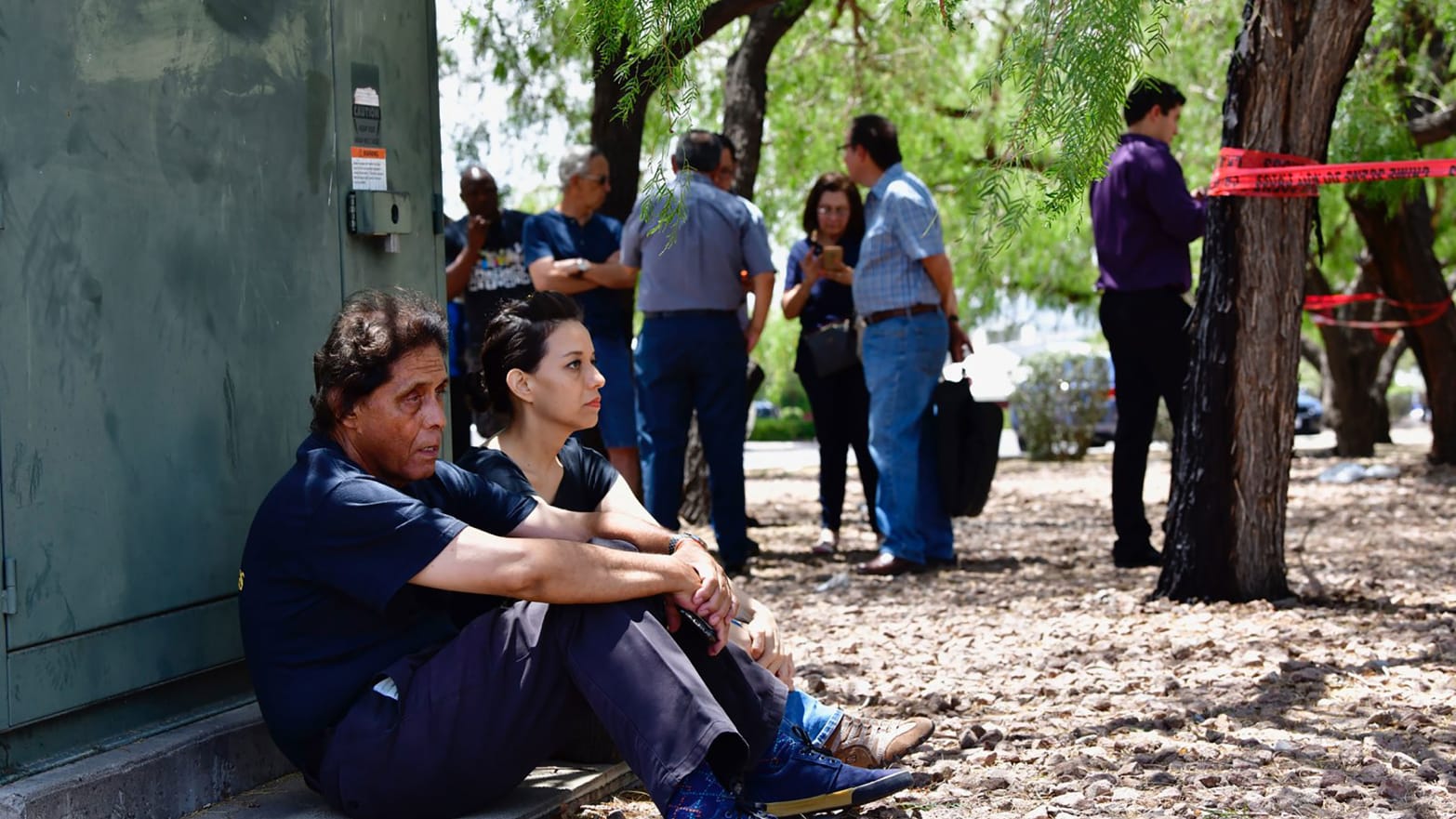
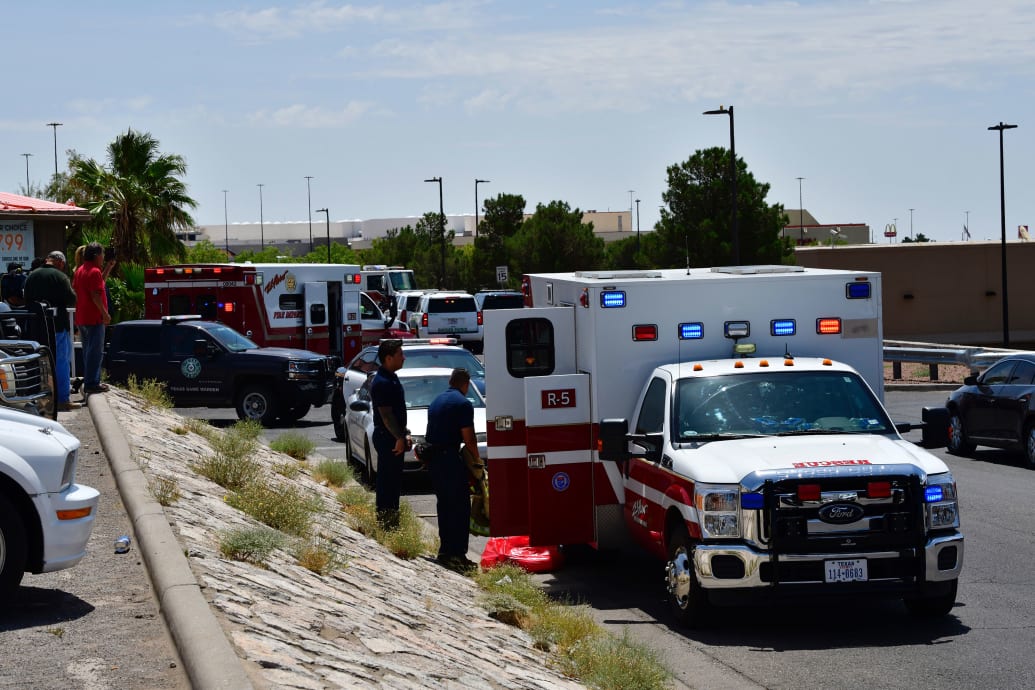
The most recent shooting in El Paso(below) caught my attention today, and deserves your careful consideration. What will our leaders DO to stop this!?
Mass Shooting at El Paso Walmart Leaves 20 Dead
The gunman “started shooting everyone, aisle by aisle,” an eyewitness says.
The Daily Beast, by Jordyn Rozensky, Justin Hamel, Anna Kaplan,
Justin Hamel/The Daily Beast
EL PASO—A lone gunman killed at least 20 people inside a crowded Walmart on Saturday morning, according to eyewitnesses and officials.
“A day that would’ve been a normal day for someone to leisurely go shopping, turned into one of the most deadly days in the history of Texas. Lives were taken who should still be with us today. Twenty innocent people from El Paso have lost their lives, and more than two dozen more are injured,” Texas Governor Greg Abbott said at an evening press conference.
At least 22 people were transported to area hospitals, including a 4-month-old girl. At least nine people were in critical condition at Del Sol Medical Center, where three of them were said to be in “life-threatening” condition. The victims there ranged in age from 35 to 82, but no further details were immediately available.
Police have not yet identified those killed, though Mexican President Andrés Manuel López Obrador announced on Twitter late Saturday that three Mexican nationals were among the 20 people killed.
Police said one person is in custody and they have ruled out multiple shooters. The suspect has been identified as 21-year-old Patrick Crusius of Texas, according to a senior law-enforcement source. Authorities are investigating a purported manifesto posted online shortly before the attack.
Justin Hamel/The Daily Beast
“Right now we have a manifesto from this individual, that indicates to some degree, it has a nexus to potential hate crime,” El Paso Police Chief Greg Allen said at a press conference. Allen, who stopped short of naming the suspect, said authorities were still working to “validate” that the manifesto was penned by the alleged gunman.
More than a thousand people were inside the Walmart near the Cielo Vista Mall when the shooting started around 11 a.m. A woman named Karina, who declined to give her last name, said she was driving in the parking lot with her 7-year-old daughter when she saw a white man in his twenties in front of the store’s main entrance, dressed in all black and carrying a long rifle. Karina said she heard what sounded like “balloons popping” and saw the gunman shoot another man at “point-blank” range.
Then the gunman entered the store, as captured by surveillance footage.
Miguel Rodriguez said he was shopping for a toy for his 7-year-old son when he heard gunshots and ducked to the ground. He said a person “started shooting everyone, aisle by aisle, with rage.”
Justin Hamel/The Daily Beast
Britney, a 19-year-old who declined to give her last name, said she was with her 16-year-old brother and her mother in the store’s underwear aisle when she heard shooting. The family dropped to the ground. Then Britney said she grabbed her mother and brother’s hands and they ran out of the store.
⚠️Video from inside JCPENNY in Cielo Vista Mall as it was being evacuated, due to an active shooter in the area.
Video: Victoria Balderrama pic.twitter.com/7v67DL4mPG
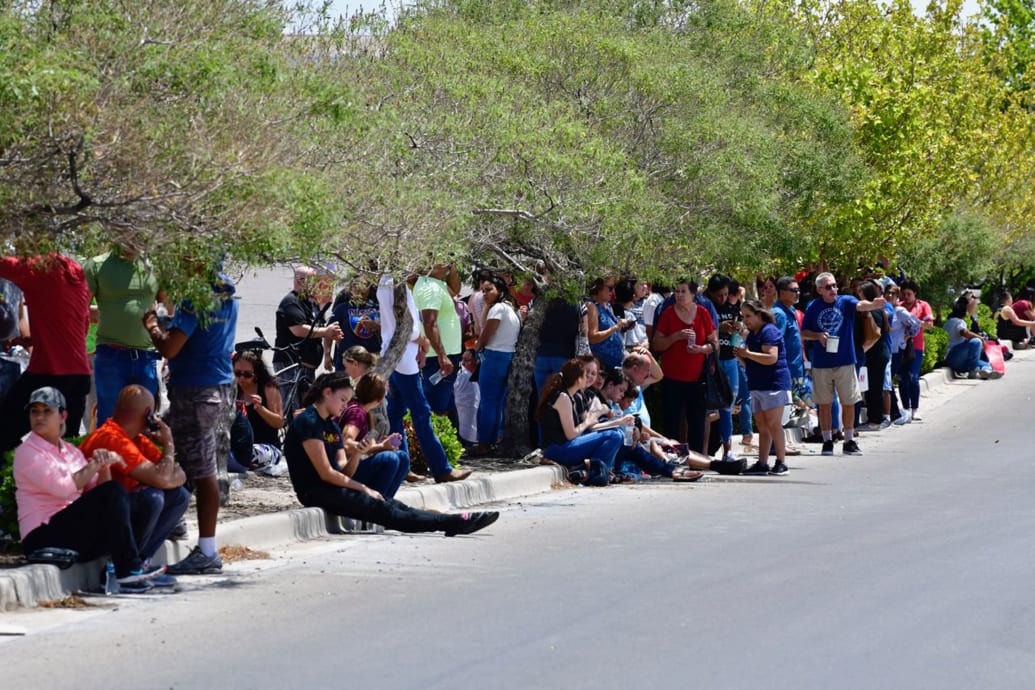
Dozens of people from inside the mall who were evacuated lined a nearby street. A man carrying a Bible went from group to group, asking people to pray with him.
Justin Hamel/The Daily Beast
The El Paso shooting is the latest in a series of deadly attacks on public places. On Monday, a disgruntled employee killed two people in a Walmart store in Mississippi. Last Sunday, a gunman killed three people and injured 15 at the Gilroy Garlic Festival near San Jose, California. In May, a gunman killed 12 people at a municipal building in Virginia Beach. The month before, on the last day of Passover in April, a vocal anti-Semite allegedly attacked a synagogue in Poway, California, killing one person.
By Ian Austen, July 16, 2019
Three days after the disaster, workers were still combing through debris. Credit Paul Chiasson/The Canadian Press, via Associated Press
When things go wrong, those in power often promise to make it right. But do they? In this series, The Times is going back to the scene of major news events to see if those promises were kept.
The runaway train hurtled into the center of town shortly after midnight, with no one aboard to apply the brakes or sound a whistle to warn residents about the deadly cargo bearing down on them.
When it reached a tight curve, the freight train, going 65 miles an hour, derailed. Amid a deafening, horrific screech of rupturing metal, more than a million gallons of fuel spilled and exploded.
The blast incinerated most of downtown Lac-Mégantic, Quebec. In a community of just 5,600, 47 people were killed.
The scale of the disaster on July 6, 2013, not only shocked and outraged Canada, it also raised alarm in towns and cities across the country, where a growing number of trains, laden with oil, explosives and toxic chemicals, were rolling through urban centers day and night.
Canada’s government, and the railway industry, vowed to quickly address people’s fear.
“This is an unbelievable disaster that has occurred here,” Stephen Harper, the Conservative prime minister at the time, said after inspecting the destruction. “They’ll be investigations to ascertain what has occurred to make sure that it can’t happen again.”
And there have been changes — at least on paper.
Railways are now required to look for alternative routes to keep shipments of dangerous goods out of urban areas, but trains filled with risky cargo still rumble day and night through Calgary, Edmonton, Montreal, Toronto and other cities.
Not much has changed since that night in Lac-Mégantic, either. Six years after the catastrophe, the core of the town remains a wasteland, with much of the once-vibrant downtown a weed lot.
The emotional scars have been slow to heal, too.
“People are still afraid,” said Jamie Stearns, who owns a local landscaping business. “Personally, when I hear the whistle of the train, it comes right back — the shivers.”
Railway tracks leading toward the crash site in Lac-Mégantic. Credit Ian Willms for The New York Times
WHAT WE FOUND
Setting the Stage for Disaster: Deregulation
The Lac-Mégantic derailment came at a time of surging oil and gas production in Canada. It also followed a trend of deregulation that had turned over much in the way of safety oversight to the railways themselves.
In its report after the accident, Canada’s Transportation Safety Board portrayed the company responsible, the now-defunct Montreal, Maine and Atlantic, as a threadbare operation at which saving time and cutting costs trumped safety.
But the railway’s use of a skeleton crew, vulnerable tanker cars and routes going straight through population centers were all allowed under the country’s regulations.
“Lac-Mégantic was the violent consequence of a series of policy decisions interacting — whether they were deregulation or privatization or austerity — and the consequence was that there was a steady erosion of safety,” said Bruce Campbell, who prepared several studies on the accident as executive director of the Canadian Center for Policy Alternatives, a research group in Ottawa.
After the accident, Canada’s government did reverse that deregulation trend, increasing its oversight of railways, adding inspectors and introducing new safety rules. And for the first time, railways now must be licensed by Transport Canada to operate. If the regulator finds serious safety violations, it can immediately revoke that permit.
But the efficacy of some of these changes remains an open question. And one of the most important new rules comes with a loophole enormous enough for train after train to barrel right through.
After the crash, an impromptu shrine went up at a local church. Credit Ian Willms for The New York Times
WHAT WE FOUND
Avoid Urban Centers? Easier Said Than Done.
In 2016, the government ordered all railways to start examining the routes they were using to ship dangerous cargos. They were told to see if they could identify alternative runs using remote rail lines instead of ones threading through urban areas.
In theory, this regulation could help reduce the chances of a deadly accident in a populated area. In practice, however, little has changed on the ground — or, more accurately, in the centers of Canada’s most populous cities.
Locomotives pulling tanker cars heavy with oil, propane and noxious chemicals continue to be a common sight in the hearts of several major Canadian cities. Look up at any time in downtown Winnipeg, and you’re likely to see tanker cars passing by on the city’s busy elevated tracks.
Transport Canada, the department responsible for making and enforcing rail regulations, said the railways did not give it reports on how many dangerous-goods trains, if any, they’ve moved away from cities following their obligatory safety reviews.
Canadian Pacific and Canadian National, the two major railways that haul the overwhelming majority of Canada’s rail traffic, referred questions about dangerous cargo in cities to the Railway Association of Canada, their lobbying group. In an email, the association declined to provide any statistics about reroutings,citing “security purposes.”
The closing of some rail lines in remote areas to increase efficiency, combined with the fact that many Canadian communities were built around railway tracks, means “there really aren’t any alternatives,” Mr. Naish said.
The Federal Railroad Administration requires similar reviews of routes with dangerous cargos in the United States. But in a statement, it suggested that dangerous cargo is rarely rerouted because “alternatives may increase overall transit time, require additional handling, or introduce other operational risks.”
Louis-Serges Parent and his ex-wife, Thérèse Lachance, at the site where their home once stood. It was destroyed in the disaster. Credit Ian Willms for The New York Times
WHAT WE FOUND
Improved Technology, but Unproven
The government’s most notable change after Lac-Mégantic: All tanker cars of the type that crumpled in the derailment have stopped carrying anything that is toxic or can explode or burn.
The cars that ruptured were an old design, called DOT-111, with limited crash resistance.
Lisa Raitt, who became the transport minister in the Conservative government nine days after the crash, announced that this design would be gradually phased out, and that by 2025, these tankers would no longer be carrying flammable products.
Her successor, Marc Garneau, who took office in 2015 in Justin Trudeau’s Liberal government, twice sped up that schedule, and in January of this year, the goal was met.
Taking the place of many of the old tankers is a new design, with substantial reinforcement and other safety improvements, called DOT-117. But limitations in crash testing mean that while the new cars promise much on paper, their effectiveness in a real-world disaster remains to be seen.
“We won’t know for sure until we see how they perform in actual accidents,” said Ms. Fox, of the safety board. “I know that’s not very reassuring.”
A tanker car from the wreck left in Lac-Mégantic. Credit Ian Willms for The New York Times
WHAT WE FOUND
To Control a Train, 2 Is Better Than 1
Another critical policy change was an order given just weeks after the disaster obligating all trains in Canada to once again carry at least two crew members. That only one worker was operating the Lac-Mégantic train was a major factor in the catastrophe.
In the United States, the Federal Railroad Administration recently abandoned a proposed regulation that would have required at least two-person crews on most trains.
Thomas Harding was the lone engineer on the train, which was carrying crude oil from North Dakota to an oil refinery in New Brunswick. Mr. Harding took control of the train in Montreal.
Late in the evening of July 5, he stopped for the night in Nantes, a hamlet uphill from Lac-Mégantic, and parked his train on the mainline.
Though exhausted after the journey, Mr. Harding took the laborious step of setting the mechanical hand brakes — a train’s version of an automobile parking brake — on the five lead locomotives, an equipment car and an empty boxcar.
That was the first big mistake. Investigators calculated that Mr. Harding should have also secured the hand brakes on 18 to 26 of the tank cars before retiring to his hotel.
But the corner cutting by the solo worker initially didn’t matter. The train stayed put because he had also applied air brakes on the locomotives. Not long after he left, however, a small fire broke out in the lead locomotive. A fire crew extinguished it and, following the railway’s instructions, shut down the engine.
That was the second big mistake. Turning off the lead engine also cut off the brakes’ air compressor, eliminating the pneumatic pressure needed to keep the brakes applied. When the brakes ultimately released about an hour after midnight, the train began rolling downhill for seven miles to Lac-Mégantic, gaining speed all the way.
Mayor Julie Morin with a plan for the reconstruction of downtown Lac-Mégantic. Credit Ian Willms for The New York Times
WHAT WE FOUND
Recurring Runaways
Making sure that no one now operates a train alone was applauded by safety experts. But requiring multiple crew members is no guarantee runaway trains won’t happen.
The number of runaway trains in Canada has increased by about 10 percent over the last decade, with 62 trains taking off on their own in 2017. In February, three Canadian Pacific employees died when a runaway train that had been parked on a mountain slope in British Columbia flew off a bridge.
Hand brakes have not evolved all that much since the 19th century, and applying them is slow, backbreaking work.
“Hand brakes are good,” said Ms. Fox. “But they need to have some other defense, because hand brakes can be defective.”
There’s little sign, however, that Canadian railways are adopting new technologies, like electronically controlled brakes, that have the potential to stop runaway trains.
Much of Lac-Mégantic remains a wasteland. Credit Ian Willms for The New York Times
WHAT WE FOUND
A Barren, Devastated Downtown
The fuel explosion that took 47 lives also destroyed 40 buildings in Lac-Mégantic, a resort and industrial town abutting a scenic lake.
A $150 million decontamination program led to the demolition of another 37 buildings and the removal of 294,000 tons of rubble and soil. Adding to the pain of many survivors, the first thing to be rebuilt at the disaster site were the rail tracks themselves, an important lifeline for the town’s factories.
While new roads now run through the former disaster zone, most of it is barren, filled with underused parking lots.
Driving through the wound that was once downtown remains too painful for many in Lac-Mégantic. In a disaster that killed nearly 1 percent of the town, it’s not a question of if residents knew someone who died, but how many.
“Every time I cross this desert, I feel death’s been there, and it’s still there,” said Gilbert Carette, a member of a citizens’ rail safety group formed after the wreck. “The best medicine to heal people’s minds would be to fill this empty place.”
For many residents, the most important project is moving the tracks to the northern edge of town. Last year, the federal and Quebec governments agreed to pay for a $100 million rail bypass, but the estimated completion date is four years away.
The town’s reconstruction office does have ambitious plans for a new downtown, but Julie Morin, mayor since 2017, said that developers would stay away until the train line was moved. She does not anticipate that anything approaching the old downtown will return for a generation.
“It’s really haunting us, cause we’re still living this tragedy,” said Mr. Carette. “People have that feeling that everything is frozen downtown.”
The still-desolate landscape also serves as a wrenching reminder for the country as a whole about the risks that come with the railways running through so many towns.
Ms. Fox, of the safety board, said the disaster had left a mixed legacy.
“It would be unfair to say that no progress has been made,” she said. “But I also think it would be inaccurate to say that we can sit back and relax. Because there’s still more that can be done.”
The Takeaway: A concerted push on safety, but trains still pull deadly cargo through downtowns across Canada.
Correction:An earlier version of this article misstated when Lisa Raitt was transport minister. She became minister nine days after the crash; she was not the minister at the time of the crash.
A native of Windsor, Ontario, Ian Austen was educated in Toronto and currently lives in Ottawa. He has reported for The Times about Canada for more than a decade.
A version of this article appears in print on , Section A, Page 4 of the New York edition with the headline: Years After Fiery Crash, Deadly Cargo Still Rides the Rails.
The world already has enough fossil fuel plants and high-emitting industrial facilities, buildings, and cars to drive average global warming above a 1.5°C threshold, according to an article earlier this month in the journal Nature.
“1.5°C carbon budgets allow for no new emitting infrastructure and require substantial changes to the lifetime or operation of already existing energy infrastructure,” write a team of researchers led by Dan Tong of the University of California Irvine.
The study concludes that existing fossil infrastructure “merely needs to continue operating over the course of its expected lifetime, and the world will emit over 650 billion tons of carbon dioxide, more than enough to dash chances of limiting the Earth’s warming to a rise of 1.5°C (or 2.7°F). That’s a level of warming that has become increasingly accepted as a scientific line-in-the-sand,” the Washington Post reports.
“And it gets worse: Proposals and plans are currently afoot for additional coal plants and other infrastructure that would add another nearly 200 billion tons of emissions to that total. Some of these are now actually under construction. In other words, human societies would need not only to cancel all such pending projects but also timeout existing projects early, in order to bring emissions down adequately.”
The Post points to the 41 gigatons of carbon dioxide entering the atmosphere each year, 36 of them from fossil fuel burning and cement production, and compares those totals to the 420- to 580-gigaton carbon budget remaining to produce a 50 to 66% chance of limiting average warming to 1.5°C.
“That amounts to between 10 and 14 years at current emissions, with one year, 2018, already used up and another, 2019, halfway gone,” writes climate specialist Chris Mooney. “What the new study is saying is that existing infrastructure translates into about 16 years of current emissions just on its own, with another roughly five years in the pipeline in the form of currently planned infrastructure.”
While other research on fossil infrastructure has presented a less dire verdict, Mooney adds, “the new study contends that it contains the latest, and most plausible, estimates. Its figures for existing fossil fuel infrastructure are for 2018.”
Study co-author Ken Caldeira of Stanford University’s Carnegie Institution for Science was involved in a similar study a decade ago, and found that existing infrastructure equated to only 1.2°C average warming.
“A decade ago, we found, there’s not enough infrastructure, and now, over the past decade, we have built enough stuff,” he told the Post. “And a lot of that stuff that was built, was built in Asia—the rise of China, and to a lesser extent India and the other southeast Asian countries, [is] the biggest change in direction regarding amount of infrastructure.”
Part of the problem is that those new plants are “younger”, the Post notes, meaning a longer expected operating life before they’re shut down. “And the picture is actually worse than the study suggests, because the research does not include emissions caused by human-led deforestation of tropical forests and other landscapes.”
Elmar Kriegler of Germany’s Potsdam Institute for Climate Impact Research said the new article “shows the huge role that the buildup of coal-fired power plants and heavy industry in China has played over the past 15 years,” driving recent increases in global CO2 emissions and accounting for half of the future emissions associated with new infrastructure. “If this buildup of coal infrastructure is going to repeat itself in other rapidly growing economies, notably India and South East Asia, the world will stand no chance to hold warming to well below 2.0°C.”
At the same time, “whether it is already too late for limiting warming to 1.5°C, as the authors claim in their headline, is too early to say,” Kriegler continued. “As the article points out, this will depend on whether the world can prematurely retire some of the heavy polluting infrastructure that has been put in place.”
The Post notes that some of those early retirements are already taking place, as solar and wind undercut coal and other forms of fossil fuel generation on price. The article also holds out hope for carbon capture technology to remove CO2 from existing fossil infrastructure.
“To me, the optimistic take on it is that most of the emissions associated with the higher warming scenarios come from infrastructure that’s yet to be built,” Caldeira said. “So avoiding those outcomes is still within our control, and it’s largely a political and social decision.”
But he cautioned: “I’m just hoping that nobody will be writing a decade in the future, ‘Oh, we built enough infrastructure to go through 2.0°C, but we can still avoid 2.5.’
By Mary Susan Gast
(Italics sung to the traditional spiritual tune, “Motherless Child”)
Nikki Basch Davis, Welcome To This World Little One (used with permission)
Sometimes I feel like a motherless child,
Sometimes I feel like a fatherless child,
Sometimes I feel like a tossed-away child,
A long way from home,
A long way from home.
See, here’s the thing,
Mr. Candidate for the U.S. House of Representatives,
Ms. Fox News Sage, and other Assorted Apologists for the detention of children,
The crying and the sobbing and the calling out
For Mami and Papi
That you write off
As nothing more than you’d hear
On a typical morning
At the neighborhood daycare dropoff,
Or that you equate to a summer camp experience,
Really is intrinsically, substantially, irreconcilably
Different.
At daycare—at least at the daycares I’ve known—
Nobody wrenches you away from your mother
While she’s nursing you,
Nobody wrestles your father away from you
While he screams your name and you scream in terror,
Nobody loads you on a plane and dumps you
In the middle of the night
In places with names like Grand Rapids or Topeka.
At summer camp nobody keeps you in a cage where you sleep when you can, scrunched and contorted,
Tormented by lice, covered by the bleak aluminum wisp of a blanket,
Where you wake for weeks on end in the same soiled clothes,
Your cough untreated, your fears untended,
Stalked by nightmares that don’t dissipate with the dawn.
Where there is no play, no food that warms and nourishes,
Where the exuberant unruly energy for which childhood is noted
Withers, wailing and clutching its forsaken heart.
And most of all—
Listen up, here—
Most of all the difference is
That at the end of the day, at the end of camp,
The person who dropped you off
Picks you up, and takes you home, undamaged.
Back to the people who love you.
[I hope] Some day you’ll feel like an eagle in the air, Some day you’ll fly like an eagle in the air, Some day you’ll be like an eagle in the air, A long way from home—no more! You’ll find your way home.




You must be logged in to post a comment.