Solano County secures move to orange tier, then discloses large number of previously unreported cases and 5 new deaths


By Roger Straw, Tuesday, June 1, 2021

Solano County reports 104 new infections today, and 5 new deaths.  82 of the newly reported cases are from Vacaville

Solano County COVID report on Tuesday, June 1.
[Source: see far below.  See also my ARCHIVE spreadsheet of daily Solano COVID updates.]
Solano County COVID-19 Dashboard – SUMMARY:

Solano County reported 104 new COVID cases over the 4-day weekend,  82 of them from Vacaville.  I suspect the County is playing “catch-up” with previously-unreported cases from Vacaville.  Monthly: We saw 1,288 new cases in April, an average of 43 per day.  In May, Solano reported 920 new cases, an average of 30 per day.

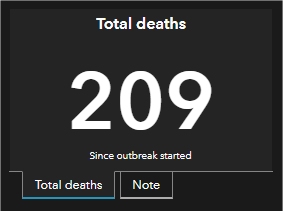
Solano County also reported 5 new COVID deaths today, a total of 243 deaths here since the pandemic began.  2 of the 5 reported today were age 50-64, and 3 were 65+ years of age.

SOLANO NOW IN ORANGE TIER – Solano County was finally moved into the orange tier today, the last Bay Area County to leave the red tier.  See details in the County’s press release, also in the account of the Vallejo Times-Herald.

JUNE 15 RE-OPENING Solano County Public Health highlighted on its dashboard last week that the State of California will discontinue COVID tier assignments on June 15.  The County references a thorough but outdated California Department of Public Health (CDPH) announcement of April 4, 2021.  A more current but less detailed CDPH announcement isBeyond the Blueprint for Industry and Business Sectors – Effective June 15.”  The ending of the State’s tier system is being hailed as a return to normal, but it falls short of that for Mega Events (gatherings of crowds greater than 5,000 [indoors] and 10,000 [outdoors]).  And… ALL of us are advised to get vaccinated and continue to take precautions when sharing indoors air with others who may or may not be vaccinated.

MASKS Governor’s update: “California will align its mask guidance with CDC’s on June 15, 2021.  California will keep existing mask guidance in place until June 15 when it aims to fully reopen the economy. After that, the state plans to allow fully-vaccinated Californians to go without a mask in most indoor settings. You will still have the option to wear a mask if you choose.”  Governor’s update based on a May 3 CDPH guidance.

Solano’s Active cases are now at 212 up from Friday’s 181.  Our percent positivity rate rose dramatically today from 4.9% to 10.6%.

>> The virus is still active here.  Stay safe, get vaccinated, wear a mask in crowds and social distance if you’re not sure who’s vaccinated!  We will get through this together.

Cases by City on Tuesday, June 1:  Something is clearly now (or sometime in the past) going on in Vacaville!

  • Benicia remained steady today, total of 999 cases since the outbreak began.
  • Dixon added 1 case today, total of 1,917 cases.
  • Fairfield added 12 new cases today, total of 9,074 cases.
  • Rio Vista added 1 new case today, total of 388 cases.
  • Suisun City remained steady today, total of 2,279 cases.
  • Vacaville added 82 new cases today (!) – total of 8,772 cases.
  • Vallejo added 8 new cases today, total of 9,865 cases.
  • Unincorporated areas remained steady today, total of 103 cases.

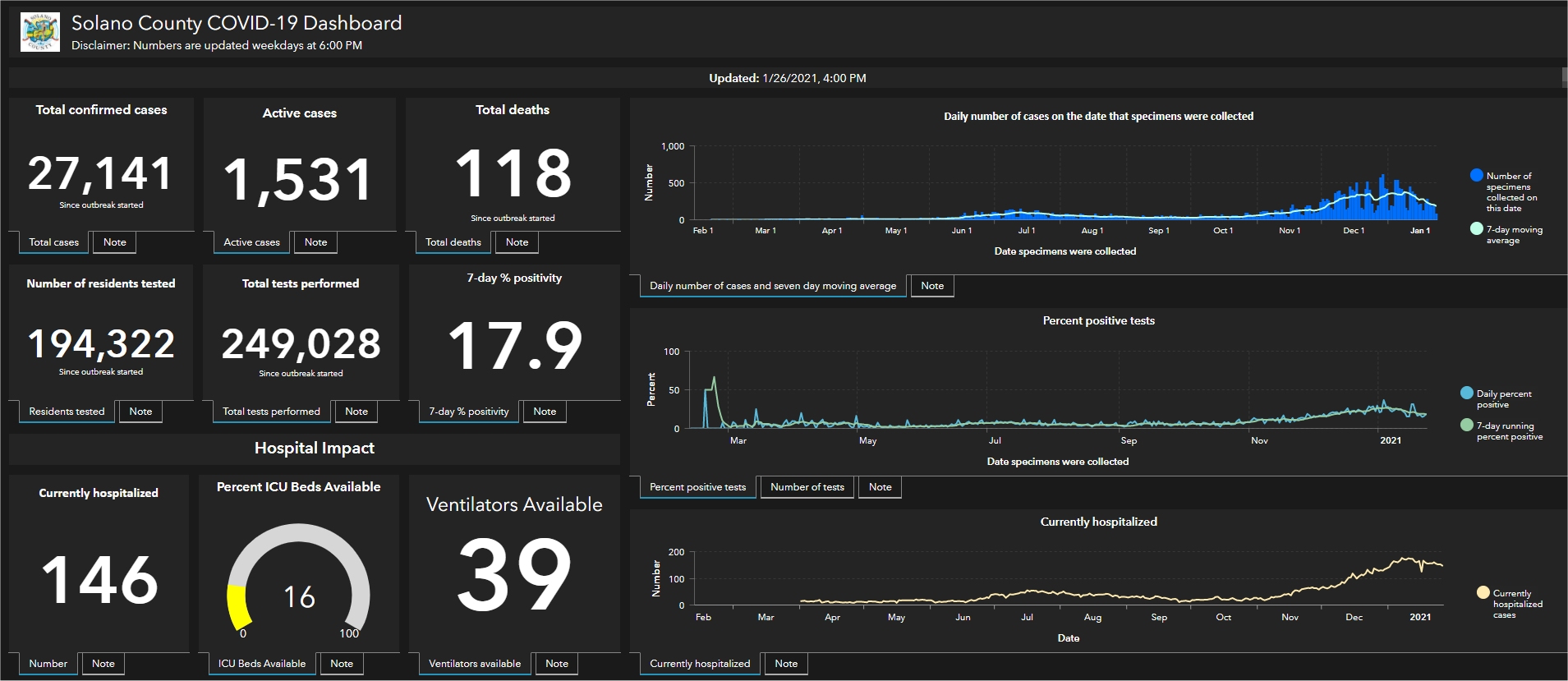
COMPARE: Screenshots from Solano County COVID Dashboard on Friday, May 28:


The data on this page is from today’s and the previous Solano County COVID-19 Dashboard.  The Dashboard is full of much more information and updated weekdays around 4 or 5pm.  On the County’s dashboard, you can hover a mouse or click on an item for more information.  Note the tabs at top for SummaryDemographics and Vaccines.  Click here to go to today’s Solano County Dashboard.


Sources

Solano County moves to orange tier, finally leaves red behind

Solano County moving into orange tier

Vallejo Times-Herald, by Thomas Gase & Nick Sestanovich, June 1, 2021

This summer is looking to be less restrictive than last, as the state of California announced Tuesday that Solano County will be moving into the orange tier of the state’s Blueprint for a Safer Economy.

The blueprint establishes tiers for businesses and other entities to reopen following last year’s shutdowns as a result of the COVID-19 pandemic. The state is on track to remove the tiers entirely starting June 15, effectively removing nearly all restrictions for businesses.

Solano County has been in the red tier since March, having previously been in the most restrictive purple tier for four months. The county had previous been in the red tier from September to November.

Under this reopening:

  • Restaurants are now allowed to serve meals indoors at 50 percent capacity or a maximum of 200 people, whichever is fewer. This also applies to wineries, breweries and distilleries that serve meals.
  • Breweries, wineries and distilleries that do not serve meals may open indoors with modifications, including 25 percent capacity indoors or a maximum of 100 people, whichever is fewer.
  • Retailers may operate indoors with modifications.
  • Movie theaters and places of worship may operate indoors at 50 percent capacity or a maximum of 200 people, whichever is fewer.
  • Gyms, health club and yoga studios can operate indoors at 25 percent capacity.
  • Graduation ceremonies can be held outdoors at 33 percent capacity with assigned seating and additional modifications.

The reason for the move to the orange tier was a continuing decrease in cases to below six per 100,000, low hospitalizations and more than 225,000 residents receiving at least one vaccine dose, according to a Solano County news release.

Dr. Bela Matyas, Solano’s public health officer, said the county qualified for the orange tier based on a significant decrease in cases per day, positivity rates and its health equity metric, which measures positivity rates in disproportionately impacted areas. Hospitalizations have also been low as of late.

Vaccinations were also up, with 64 percent of eligible residents ages 16 and older and 62 percent of residents ages 12 and older receiving the COVID-19 vaccine as of Friday, Matyas said.

When the state lifts its restrictions June 15, Matyas said Solano would lift all of its requirements although health officials will still recommend businesses retain precautions that are easy to retain if they choose to do so, such as physical barriers at restaurants or hand sanitizer dispensers.

“Things that have involved investments already made, I would think would be easy to maintain,” he said.

Additionally, Matyas said the California Division of Occupational and Safety Hazards (Cal/OSHA) may continue to require certain precautions of its employers.

Armando Gomez, a manager at Napoli Pizzeria & Italian Food in Vallejo, was pleased for the change.

“Personally, I’m excited,” Gomez said. “We get to fill up some more tables that were empty. We had four tables inside and now we can do about eight. We’ve managed to hang on there during this pandemic but this will also help.”

Solano County Public Health Administrator Jayleen Richards said there were some other benefits about moving up to the orange tier, even if the removal of tiers is just two weeks away.

“Yes we are pleased we are able to open up more and although the tiers will be gone soon we don’t view this as too little, too late,” Richards said. “This coming week we have a few graduations and some of them will be able to benefit with larger size restrictions. I know Vacaville was planning on doing just one ceremony instead of two if they could get the necessary requirements.”

Benicia, Vallejo and Jesse Bethel high schools had previously planned to do two ceremonies. The schools may be able to do one now depending on it of its maximum capacity requirements.

Richards said there were a few reasons for the upgrade in tiers.

“I believe it’s just more and more people getting vaccinated,” Richards said. “We were also expecting an increase in COVID-19 cases after Mother’s Day and it wasn’t that bad. It seems everyone was doing a good job and social distancing during that weekend. However, some places are still at a higher risk and will need to continue to use precautions.”

Two other Bay Area counties in the orange tier — Napa and Alameda — could be eligible to move to the yellow tier by next Tuesday. That would leave Sonoma, Solano and Contra Costa counties as the only remaining orange tier counties in the region.

Statewide, 48 percent of Californians live in yellow tier counties. And only four counties — Del Norte, Shasta, Yuba and Stanislaus — remain in the red tier indicating a “substantial” COVID-19 spread. There are no counties in the most restrictive purple tier.

For more information, go to Solanocounty.com/depts/ph/coronavirus.asp.

Bay Area News Group contributed to this story.

State moves Solano County into orange tier

Solano County moves into the less restrictive Orange Tier of the State’s Blueprint for a Safer Economy, effective June 2

Press Release by Solano County, June 1, 2021

SOLANO COUNTY – The State of California announced today that Solano County will move from the Red Tier into the less restrictive Orange Tier of the Blueprint for a Safer Economy effective Wednesday, June 2, 2021. The California tier-based metrics have helped provide a framework for reopening businesses, schools and other community venues.

In the last two weeks, Solano County has seen a continued decline in case rate to below 6 per 100,000 to qualify for the orange tier. COVID-19 related hospitalizations remain low, and 225,477 county residents have received at least one dose of the COVID-19 vaccine.

“We are seeing a substantial decrease in the spread of COVID-19 in our community, therefore enabling us to move down to the next tier and expanding capacity for our businesses,” said Bela T. Matyas, M.D., M.P.H., Solano County Health Officer.  “While we are nearing the end of the pandemic, we continue to encourage our community members to get vaccinated to protect themselves from severe illness and death. Solano Public Health remains dedicated to eliminating barriers to vaccinate the community against COVID-19 by focusing on providing pop-up clinics – meeting people where they are.”

MOVING FROM THE RED TIER INTO THE ORANGE TIER ALLOWS:

  • Restaurants, including wineries, breweries and distilleries that serve meals, can operate indoors with 50 percent capacity or a maximum of 200 people, whichever is fewer
  • Breweries, wineries, and distilleries that do not serve meals may open indoors with modifications, including 25 percent capacity indoors, or 100 people, whichever is fewer
  • Retail establishments can operate indoors with modifications
  • Movie theaters and places of worship can operate indoors with 50 percent capacity or a maximum of 200 people, whichever is fewer
  • Gyms and health clubs, including yoga studios, can operate indoors with 25 percent capacity
  • Graduation and commencement ceremonies can be held outdoors at 33 percent capacity with assigned seating and other modifications

COVID-19 INFORMATION
For more information on COVID-19, visit the following websites, including:

  1. Resources for industry guidance – https://Covid19.Ca.Gov/Safer-Economy/
  2. COVID-19 vaccine information in Solano County – www.SolanoCounty.com/CovidVaccine
  3. COVID-19 statistics, including cases and vaccinations – www.SolanoCounty.com/COVID19
  4. Vaccine clinics throughout the State of California – https://MyTurn.Ca.Gov
  5. Solano County Public Health Facebook – www.Facebook.com/SolanoCountyPH

Is this Benicia’s future? New Mexico stuck with $8 billion in fossil fuel cleanup

New Mexico Stuck With $8 billion in Cleanup for Oil Wells, Highlighting Dangers From Fossil Fuel Dependence

The oil industry boasts that it fills state coffers with revenues from drilling, but a new study finds a serious gap in funding available to tackle the environmental legacy of abandoned wells.

DeSmog.com, by Nick Cunningham, May 26, 2021
Oil stored in tanks. Credit: Bureau of Land Management (CC BY 2.0)

New Mexico is facing more than $8 billion in cleanup costs for oil and gas wells, an enormous liability that taxpayers could be left to pick up if drillers go out of business or walk away from their obligations.

Cleaning up old wells at the end of their operating lives can be expensive, and typically states require drillers to cover part of the cleanup cost at the outset, known as financial assurance requirements. The money is tapped later on when the well or pipeline must be dismantled and cleaned up.

But a study commissioned by the New Mexico State Land Office published on April 30 found that “financial assurance requirements do not exist for much of the oil and gas infrastructure explored in this study, and in some cases where such requirements are imposed, operators may have multiple ways of minimizing or avoiding those requirements.” The study was conducted by the Center for Applied Research, an independent analytical firm.

Inadequate bonding requirements means there is a serious gap in available funding to properly clean up after the fossil fuel industry. According to the report, it could cost as much as $8.38 billion to clean up the state’s tens of thousands of wells and associated pipeline infrastructure. Alarmingly, however, New Mexico only has $201 million tucked away for cleanup, leaving a hole of $8.1 billion.

“That’s $8.1 billion that we don’t have,” New Mexico Commissioner of Public Lands Stephanie Garcia Richard said in a statement. “Enormous sums of taxpayer money and money meant for public schools, along with the long-term health of our lands, are on the line.”

The industry likes to boast that oil and gas revenues contribute roughly a third of the state’s general fund — a fact that the New Mexico Oil & Gas Association (NMOGA) triumphantly advertised in a recent report and regularly highlights on social media.

Indeed, drilling accounts for a large source of state revenues. In April 2021, for example, the state took in $109 million in royalties, a record high. Those funds will be funneled into public services, including schools and hospitals.

As the report exposed, however, the massive liability put onto the public in cleanup costs somewhat undercuts the notion that the oil and gas industry is a financial godsend.

The industry has helped fill state coffers in recent years, with oil production booming to roughly 1 million barrels per day, more than double production levels from five years ago. According to the report, last year the oil and gas industry produced nearly 370 million barrels of oil and 2 trillion cubic feet of natural gas from roughly 60,000 wells, which was transported on 35,000 miles of pipelines.

But as the State Land Office study highlights, the industry is leaving behind enormous costs for the state and the general public to deal with at a later date, a liability that is mostly obscured from public discussion.

The average cost to plug an old well and reclaim the surface is over $182,000 per well, but the state only has the finances to cover a little over $3,200 per well. The funding gap is even more staggering for pipelines. Decommissioning and reclamation costs are roughly $211,000 per mile of pipeline, but available financial assurance only totals about $51 per mile.

A pump jack in Roswell, New Mexico. Credit: BLM(CC BY 2.0)

The risk to the public from inadequate bonding requirements is compounded by the fact that oil and gas drillers can go out of business long before wells are cleaned up, which can be years or even decades later. The U.S. shale industry has burned through hundreds of billions of dollars in cash, and there have been more than 250 bankruptcies of North American oil and gas companies since 2015. And as the clean energy transition accelerates, the financial challenges to the industry are likely to only grow more severe.

The state has long suffered from the roller coaster cycles of extractive industry, according to James Jimenez, executive director of New Mexico Voices for Children, a health, education, and economic advocacy organization. “We’ve made policy choices in boom times that have really exacerbated our over-dependence on oil and natural gas revenues,” Jimenez told DeSmog.

“Because of the really volatile nature of the oil and gas industries, we haven’t had sustainability in the programs,” he said. A dependence on a boom-and-bust industry has forced the state to make cuts to school systems during downturns in the past.

“We need to reduce this over reliance we have on oil and natural gas to fund really basic important programs like our K-12 education and higher education systems,” Jimenez said. He added that the state should diversify its revenue base, such as through progressive taxation on the wealthy and supporting non-extractive business sectors.

Even as money flows to the state from drilling today, the unfunded liabilities of cleanup that are dumped onto the public also highlight the downside to such high levels of drilling. “The $8 billion that it would take to do the cleanup would have to come from somewhere,” Jimenez said. Dollars spent on cleaning up the waste from the oil and gas industry, are dollars not spent on other important needs, such as rural broadband or road infrastructure, he added.

“The answers are simple and urgent — raise royalty rates and taxes on the industry, stash away the revenues in our Permanent Fund to stabilize cash flows, and spend current budget dollars on investments to diversify our economy,” Thomas Singer, senior policy advisor at the Western Environmental Law Center, told DeSmog via email.

NMOGA did not respond to a request for comment.

Well pad near Roswell, NM. Credit: BLM(CC BY 2.0)

On top of the financial risks from abandoned wells, the fossil fuel industry brings numerous environmental and public health hazards as well. Oil and gas operations have contributed to a deterioration in air quality in the state. And in northwestern New Mexico, there have been more than 300 accidents since 2019, including oil spills, fires, blowouts, and gas releases, and much of it has occurred on Navajo land, as reported by Capital & Main.

A recently published peer-reviewed study found that shut-in conventional oil wells in the Permian basin could be leaking a substantial amount of methane, a powerful greenhouse gas that exacerbates climate change.

“New Mexicans must recognize that while industrialization of our landscape to produce oil and gas brings revenue today, if not properly cleaned up, it also jeopardizes our economy of the future,” Singer said. Allowing drillers “to defer this obligation indefinitely puts the state and taxpayers at great risk that they will have pick up the tab or leave these areas as polluted sacrifice zones.”