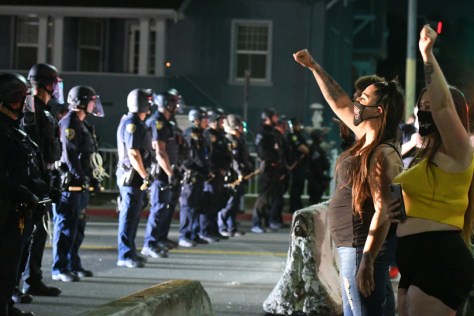
Protesters face off against police officers during a peaceful march over the killing of Sean Monterrosa, the 22-year-old San Francisco man, who was shot and killed by a Vallejo Police officer during looting on Tuesday. (Chris Riley—Times-Herald)Vallejo Times Herald, by Thomas Gase, June 6, 2020
When Black Lives Matter protesters met up Friday afternoon at Vallejo City Hall around 5 p.m., they were met by blocked streets. That didn’t seem to phase a crowd intent on honoring a 22-year-old man who also saw his own path cut short.
Hundreds of people marched for about 2.5 miles, starting down Georgia Street, then making a left on Sonoma Boulevard and then finally a right on Redwood Street to Walgreens —the place where Sean Monterrosa was killed by a Vallejo police officer on Tuesday morning.
During the march, the East Bay Times, in conjunction with the Times-Herald, released a story reporting that the officer who killed Monterrosa was Jarrett Tonn.
The marchers discovered this about halfway through the march while blocking the intersection of Tennessee Street and Sonoma Boulevard.
“That’s where it happened,” Maui Wilson said. “The police station was blocked off and Walgreens we knew would be a little safer. We had people marching with wheelchairs and we also had kids and the elderly. There is a time and place for everything, but safety was a key issue.”
Before moving to San Francisco to live with his girlfriend, Monterrosa lived in San Lorenzo with Lynda and Jorge Moreno for nine months. When Lynda heard they were going to Walgreens as the destination of the march she said, “it felt right.”
Once at Walgreens, the large crowd, which had grown substantially during the trip, with many cars honking in support, paid respects to Monterrosa by taking a knee in silence, as well as holding up their hands as if surrendering.
The kneeling and hands up were to symbolize Monterrosa, who was at the same Walgreens Monday night and early Tuesday morning as the store was being looted. According to Vallejo Police Chief Shawny Williams, officers in a unit saw a “single male dressed in a black hooded sweatshirt standing on the east side of the building.” The person was later identified as Monterrosa.
In a report on Wednesday, Williams went on: “The officers saw this individual begin running toward the black sedan when he stopped and abruptly turned toward the officers, crouching down in a half-kneeling position as if in preparation to shoot, and moving his hands toward his waist area near what appeared to be the butt of a handgun. Investigations later revealed that the weapon was a long, 15-inch hammer, tucked into the pocket of his sweatshirt.”
That’s when the officer, Tonn, reportedly fired his pistol five times, striking Monterrosa once. Monterrosa was declared dead several hours later.
In a Wednesday press conference, Williams refused to say the killing was excessive force. On Friday, California Attorney General Xavier Becerra came to an agreement with the City of Vallejo and the Vallejo Police Department to collaborate on a comprehensive policing plan in an effort to modernize and reform VPD’s policies and practices and increase public trust.
On Friday night, the VPD sent out a press release explaining the situation with Monterrosa on Tuesday morning.
“As officers arrived, Mr. Monterrosa was attempting to flee with others in a vehicle. Rather than continuing his escape, Mr. Monterrosa chose to engage the responding officers,” the statement reads. “Mr. Monterrosa abruptly pivoted back around toward the officers, crouched into a tactical shooting position, and grabbed an object in his waistband that appeared to be the butt of a handgun. At no time did Mr. Monterrosa make any movements consistent with surrendering. Fearing that Mr. Monterrosa was about to open fire on the officers in the vehicle, the officer was forced to fire multiple rounds through his windshield. The officer used deadly force as a last resort because he had no other reasonable option to prevent getting shot.”
Meanwhile, angry protesters shouted demands that the VPD release body cam footage. The department has 45 days to release the footage, while Williams has said he wants to release in a shorter time period.
The crowd remained peaceful for the most part until at least 8 p.m. Police kept their distance as well, with only a pair of officers on motorcycles a few blocks away as a helicopter also followed the march from the sky. The National Guard was also on hand at City Hall, but didn’t intercede during the rally. Many protesters were able to hug members of the National Guard moments before beginning the march.
“We’re here to show support for the community,” Sgt. James Fontenot said. “We want to take care of each other. The city asked us to be here and we were happy to do it. There’s been a lot of turmoil and we’re here to do whatever to keep everyone safe.”
Fontenot would not say how long the National Guard is in town, saying “We’re here for as long as the community needs us before directing us to go somewhere else.”
During the rally, Jorge Moreno, a longtime childhood friend of Monterrosa, spoke with passion and anger, but called for peace and an end to racial discrimination.
“Tonight, we want the badge off,” Moreno said. “This guy (Tonn) is an 18-year-old veteran. He knew what he was doing. They always do stuff like that and get away with it.
Intersections were blocked off at Sonoma Boulevard and Valle Vista Street, along with Sonoma and Redwood Street, Redwood and Couch Street, and Tennessee and Sonoma Boulevard. Most of the cars stuck in traffic seemed to be in support of the cause, honking and watching as protesters kneeled and raised their hands while shouting, “No justice, no peace. No racists, no peace” as well as, “Say his name, Sean Monterrrosa!”
While sitting at the intersection of Tennessee and Sonoma, Vallejoan Chiara Reeves yelled out, “Yeah we definitely look dangerous like this!”
Earlier in the night, Lynda and Jorge Moreno reflected on the life of Monterrosa and also the night he died. Jorge, along with other friends, have a group chat that has been going on for years.
“He (Monterrosa) sent a message out that night saying that ‘He was going out’ but he didn’t specify what he would be doing,” Lynda Moreno said. “Another friend said he had a bad feeling and told him to stay safe.”
“I think he found himself in a position he didn’t want to be in, but circumstances around him didn’t allow him to get out of it,” Lynda continued. “He got caught up in something he didn’t want. His girlfriend felt scared and called him up and I guess heard the whole thing on the phone. She heard gunshots and then she screamed his name over and over but didn’t hear a response.”
While Lynda said she’ll remember his laugh and smile, Jorge also said hearing the news of his friend’s death was very difficult.
“I found out from a friend calling me,” Jorge said. “I found out sitting on the couch he used to sleep on while he was living here. I was a little older than him, but he had a big heart.”
Protester DeMarcus Tanner said change needs to come immediately in the police department.
“Are you telling me five of these officers couldn’t have just gotten out and tackled him to take him down?” Tanner said. “Where does the gun come into play? Police officers are supposed to be there to protect, but where is the protection? We’re in a recession and nobody wants this. First we were losing lives due to the coronavirus, now we’re losing lives due to the police.”
Lynda Moreno also spoke of change, but needs to see it.
“There has been a lot of talk of it, but I haven’t seen it. They say they want to change, but say what you mean and mean what you say,” Lynda Moreno said. “Nobody should be abusing power like this.”
Tom Cotton’s ‘Send in the troops’ op-ed is just wrong
Retired General: “Sen. Tom Cotton couldn’t be more wrong.” (To see video, click here to go to the CNN page.)CNN, by Peter Bergen, CNN National Security Analyst, June 4, 2020
Republican Sen. Tom Cotton, a military veteran who is close to President Trump and who is sometimes mentioned as a future US defense secretary, wrote an op-ed Wednesday in the New York Times under the headline, “Send in the Troops’ in which he made the case that federal troops are needed to stamp out “anarchy” caused by the protests sweeping the United States that Cotton claimed recalls “the widespread violence of the 1960s.”
But this comparison is off base. The riots that racked US cities in 1968 following the assassination of Martin Luther King Jr. were of a far deadlier and more destructive nature than the occasionally violent protests we have seen during the past week. In 1968, more more than 40 were killed, according to the Atlantic.
I write only three blocks away from 14th Street NW in Washington DC, a key commercial corridor, much of which went up in flames during the 1968 riots. During the four days of riots in Washington, more than 1,000 fires were set, 8,000 people were arrested, 13 people were killed, and more than 900 businesses were damaged. It took more than three decades before 14th Street ever really fully recovered.
Nothing remotely close to this is happening now in Washington where there certainly has been some unforgivable vandalism during the past week, but the demonstrations have been largely peaceful affairs and that is true for many of the protests around the country.
So far there have been some dozen deaths that may be linked to the protests that have spread across the United States over the killing of George Floyd. That is a dozen too many deaths, but would bringing in federal troops really help solve this issue?
For good reason, federal troops are only brought in as a last resort to quell violence in the United States since they generally are not trained in crowd control nor in law enforcement techniques, duties that are better performed by the police, sometimes supported by National Guard units under the order of each states’ governor.
That is why US Defense Secretary Mark Esper, himself a retired US Army officer, publicly said from the podium in the Pentagon press briefing room on Wednesday, “The option to use active duty forces in a law enforcement role should only be used as a matter of last resort, and only in the most urgent and dire of situations. We are not in one of those situations now. I do not support invoking the Insurrection Act.”
In saying this, Esper publicly contradicted President Donald Trump, who has suggested deploying federal troops to US cities, which would require invoking the Insurrection Act of 1807 which is intended to quell public unrest.
In his op-ed, Cotton claims that “the rioting has nothing to do with George Floyd, whose bereaved relatives have condemned violence. On the contrary, nihilist criminals are simply out for loot and the thrill of destruction, with cadres of left-wing radicals like antifa infiltrating protest marches to exploit Floyd’s death for their own anarchic purposes.”
Despite the Arkansas senator’s assertions, no evidence has emerged that cadres of left-wing radicals like Antifa are organizing the vast nationwide protests that at times turn violent. Instead the protesters are mostly ordinary young people fed up with police brutality directed against black Americans, and many of the protests are also aimed at the fecklessness of Trump himself in his handling of the coronavirus pandemic as well as of all the racial inequities that continue to plague the United States.
Cotton goes on to assert that “…Presidents Dwight Eisenhower, John Kennedy and Lyndon Johnson called out the military to disperse mobs that prevented school desegregation.” This is quite disingenuous because it points to cases where governors in the 1950 and 1960s for political reasons refused to enforce federal desegregation laws and presidents had to step in to enforce them. But in the case of the current protests, governors are mobilizing law enforcement and National Guard units to respond to them.
Cotton’s op-ed has caused a storm of protest inside the New York Times precisely because of its factual inaccuracies and historical analogies that make scant sense. Reporting by the Times had already debunked the notion that the protests were being led by Antifa and some journalists working at the newspaper said that Cotton’s arguments about sending in the troops could even put the lives of black New York Times staff members in danger.
Late Thursday afternoon, a spokeswoman for the Times said the Cotton op-ed was published after a “rushed editorial process” and “did not meet our standards.”
The activity by a senior Trump campaign adviser, and former White House aide, reflects a broader movement by some Republicans to attack the protests against police brutality.
President Donald Trump and his allies for years have amplified racist messages on Twitter while simultaneously reaching out to black and Hispanic voters, a dissonant balancing act that’s now rocking the GOP amid nationwide racial-justice protests.
The two competing forces collided Saturday on the Twitter feed of Trump campaign senior adviser Mercedes Schlapp, when she boosted a tweet that lauded a man in Texas in a viral video as he yelled the n-word and wielded a chainsaw to chase away anti-racism demonstrators.
After POLITICO reached out to her and the campaign Saturday morning, Schlapp then retweeted another account that posted a version of the video that muted the racist slur. After this story published, she removed both her retweets and issued a written apology Saturday evening.
“I deeply apologize and I retweeted without watching the full video. I deleted the tweet,” Schlapp wrote. “I would never knowingly promote the use of that word. This is time for healing the nation and not division.”
Beyond Trump’s inner circle, Republicans have been under fire over racist social-media posts in Texas, where the chainsaw incident happened, triggering strife within GOP circles.
A dozen GOP county chairs in the state are under scrutiny for sharing racist social media posts commenting on the unrest and uprisings across the nation in response to the killing of a black man, George Floyd, by a white Minnesota police officer. One county chair juxtaposed a Martin Luther King Jr. quote next to an image of a banana, and another commented that “pandemic isn’t working. Start the racial wars.”
Against this backdrop, Schlapp‘s Saturday retweets highlighted how the Trump campaign operates in contradictory worlds of its own making. On one hand, Schlapp favorably promoted a man spewing anti-black racism and on the other she urged black people to vote for Trump just three days prior in an online campaign discussion on race. In that setting, she attacked Joe Biden’s tough-on-crime past while eliding Trump’s past record and rhetoric.
“Joe Biden supported the mass incarceration of black and Hispanic communities and has failed to lift them out of poverty,” Schlapp said. “In stark contrast, President Trump has delivered unprecedented opportunity for black Americans.”
The Twitter activity from Schlapp was part of a longstanding practice by Trump and his backers who occasionally use Twitter to amplify inflammatory messages that are at odds with the campaign’s appeals to black and other minority voters. Trump, who has fought accusations of racism for years, was in the midst of a black-voter outreach effort when Floyd’s killing changed the political dynamics.
The night before Schlapp’s retweet of the video to her 140,000 followers, the president retweeted a clip of conservative commentator Glenn Beck’s interview with a conservative black commentator, Candace Owens, who has taken a lead role in bashing Floyd.
“@RealCandaceO gave her thoughts: ‘The fact that he has been held up as a martyr sickens me,’” Beck tweeted on Wednesday. Trump boosted the post Fridaywith a retweet.
Trump has not personally criticized Floyd, called on the federal government to investigate his killing by Minneapolis police and has also used his Twitter feed to praise supporters who are black.
But after the looting erupted amid some protests over Floyd’s killing, Trump was criticized for denouncing “THUGS” in a Twitter post that warned “when the looting starts, the shooting starts,” a phrase traced back to a segregation-era Miami police chief. Twitter flagged the tweet for violating its rules against inciting violence. The White House then posted the message, getting flagged as well. Trump later claimed he didn’t know where the phrase originated.
Retweeting used to occupy a type of gray area on Twitter. The phrase “retweets are not an endorsement” was long a mantra of those who wanted to essentially repost content from another account on their own for a variety of purposes, from an interest in engaging in honest discussion to plausible deniability. But Twitter behavior evolved with new functionality to allow a person to comment on a retweeted post through “quote tweeting.” Now when campaign staff retweet messages, they generally lose the ability to credibly argue they weren’t reinforcing and broadcasting a message that aligns with their viewpoints.
The controversy with Trump surged again in April when the president was criticized for retweeting a message that said “fire Fauci,” concerning one of his top advisers on the coronavirus pandemic.
Before he became president, Trump came under fire for a wide variety of Twitter activity — from promoting the false “birther” conspiracy about President Barack Obama to retweeting a false message about “black on black” crime. The following year, he tweeted an image of a Star of David set on a field of cash, which many viewed as anti-Semitic. The latter tweet has been deleted.
The president’s son and namesake last year questioned the race of Sen. Kamala Harris (D., Calif.), a candidate for president at the time who’s now on Joe Biden’s running-mate shortlist. He deleted the tweet after outcry.
In Schlapp’s case, she retweeted a quoted tweet of the viral video that had been viewed about 7.5 million times on Twitter as of Saturday afternoon. The video originated in McAllen, Texas, where demonstrators had gathered downtown, only to be confronted by a man with a chainsaw that he revved at them as they fled.
“Go home!” yells the man, who was arrested Friday. “Don’t let those f—— n—— out there fool you!”
The man’s use of racist language and violent threats were roundly condemned on social media, with some sarcastically referring to the cult classic “Texas Chainsaw Massacre” movie. A pro-Trump account from Texas, though, lauded the assailant on Twitter and said he is “a Mexican business owner.” Another pro-Trump account, called Latino Townhall, approvingly quote-tweeted the post Friday night and exclaimed: “That’s how to do it.”
Hours later, Schlapp retweeted that post. Schlapp, who is married to the prominent head of the American Conservative Union that hosts the popular CPAC conference, later retweeted it from another account that censored the racist comment but wrote the protesters had said “f— the police.” There is no evidence the demonstrators said that.
The man in Texas, identified as Daniel Peña by local press, exposed a little-discussed issue among Latinos: anti-black racism. The McAllen police department on Saturday confirmed Pena’s ethnicity as “White/Hispanic.”
The issue of anti-black sentiment among Latinos has surfaced as an issue in Schlapp’s original hometown of Miami, where Democrats and progressives fretted that support for demonstrations over Floyd have been under-represented by Hispanics in the community.
Juan Peñalosa, executive director of the Florida Democratic Party, said his organization is trying to address the issue of racism among Hispanics while Trump’s is helping to fuel it.
“The Trump campaign strategy has always been to win through division. But Mercedes’ tweet shows they are taking it to the next level,” said Peñalosa.
“While most of us are having honest discussions on how to expose racism and eliminate it — the Trump campaign has moved beyond their 2016 dog whistles and passive nods to fringe racist groups,” he said. “Now they are giving racists a platform, retweeting them and actively amplifying their message. It makes my skin crawl.”
The Vallejo Police Department is one of 88 different police agencies out of an estimated 18,000 agencies nationwide, voluntarily providing their use of force data to a Seattle based research project.
Experts Track Data to Reduce Police Violence
A five-year research study headed by Seattle University shows that detailed tracking of law enforcement use of force incidents can reduce injuries and racial disparities. However no single federal or state agency tracks all that data.
Some prominent Bay Area law enforcement officials now say that in wake of the tragic death of George Floyd under the knee of a Minneapolis police officer, all law enforcement departments nationwide should be required to turn over data showing how often their officers use force to make arrests or otherwise control the public.
Currently no single agency, federal or state, tracks when, where, and how police use force to make arrests or who they use the force on. More than a dozen law enforcement officials agreed with data scientists at Seattle University in telling NBC Bay Area that centralized tracking of police use of force incidents can protect both police officers and the people they serve.
Currently the FBI only collects data on deadly use of force from individual police departments and sheriff’s offices from around the country, some 18,000 different agencies in all. Providing data on the deadly use of force to the FBI is voluntary.
While some individual agencies do their own analysis of use of force data experts and social scientists say those individual or private analyses can be restrictive because they only have one department’s data and the sample size can be small and therefore the conclusions are non-instructive. In other cases, experts say other law enforcement departments don’t analyze or even collect this specific data at all.
Those experts say that should change.
They say police officials can learn about unrecognized bias and more effective techniques, achieving better, less violent results by precisely tracking each use of force incident.
“It’s one of the most critical pieces of information we can collect about the police,” said Dr. Matthew Hickman, Chairman of the Department of Criminal Justice at Seattle University. “We really do need systematic data collection to help establish the reality of police use of force.”
“With these data, we can start to understand … how use of force incidents evolve,” said Dr. Hickman. And we can learn “what are the characteristics of those incidents that are more or less likely to lead to injury. And hopefully lead to better policies and training so that we can try to minimize injury.”
Because of that in 2015, Dr. Hickman teamed with a private company, Police Strategies LLC, also based in the Seattle area, to begin tracking data, voluntarily provided by police departments from around the country, showing precisely how, when and where police use force.
“It [use of force data collection] should be nationwide,” said Dr. Hickman. “And that’s really the shame of all this, is that the federal government has been required for 25 years to collect data on the use of excessive force by police and report on it annually. And they’ve never done that.”
According to US Bureau of Justice Statistics an estimated 53.5 million people nationwide had contact with a police officer between 2014 and 2015, events including everything from home welfare checks to emergency calls, from traffic stops to car accidents, from criminal arrests to shootings.
The US Justice Department estimates only a small percentage of those interactions between police and the public involve use of force by the officers, either non-lethal or lethal.
Except for lethal use of force, no one really knows details about exactly how often, what kind of force and who the force is used against.
Dr. Hickman and his team want to change that, but right now, only 88 different police agencies out of an estimated 18,000 agencies nationwide, voluntarily provide their use of force data to this research project. Among those are Bay Area police departments in Daly City, San Jose, Capitola and, most recently, Vallejo.
“There’s no standardization either statewide or certainly not nationally,” said Bob Scales, founding partner and current CEO of Police Strategies LLC. “You can’t have an evidence-based policy or evidence-based training if you have no data to back it up.”
“Many agencies have put their officers through de-escalation training, but without the data to see a ‘before’ and ‘after’ of the training, we don’t know if the training has had any impact on how officers behave and how they use force,” Scales said.
Scales comes from a strong law enforcement background and perspective. He served as a Deputy Prosecuting Attorney for King County, was the Assistant Director for Public Safety for the City of Seattle and was the Director of Government Affairs for the Seattle City Attorney before leaving to build his start-up Police Strategies, LLC.
“What we do is we help agencies essentially unlock all of that data information and then we help, we analyze it and then we provide it back to the departments,” said Scales who also served as the Compliance Coordinator for the Seattle Police Department during its implementation of a Consent Decree with the U.S. Department of Justice to resolve allegations of misuse of force.
One example of data’s impact on public safety: separate research conducted by the “Police Use of Force Project” shows that police departments which ban choke holds as acceptable techniques by their officers show significant reduction the number of use of force incidents that end in death for the public.
“Some agencies train their officers how to use this technique. And you have some agencies that prohibit the technique outright,” Scales said. “So we have this huge gamut of acceptable practices by police departments [around the country] for the same technique.”
“And [for] the agencies that do allow it, [the data shows] it’s a very effective technique,” Scales told NBC Bay Area. “It has risks. It has dangers. The Minneapolis situation was not an acceptable use of that technique.”
“We banned the chokehold … after, you know, after the unfortunate incident in New York with Eric Garner,” said San Jose Police Chief Eddie Garcia.
Chief Garcia says his department began giving Seattle University and Police Strategies, LLC their use of force data in 2015 to better track what his officers were doing right and what they could improve.
“To be able to see a transparent view of ‘this is what your officers are doing.’ ‘This is when they had to use force,’ ‘why they had to use force’ and ‘who they’re using force on.’ I think that’s incredibly important,” Chief Garcia told NBC Bay Area. And, you know, it’s about time that I think (this data collection) is legislated really not just in California, but throughout” the country.
Because of what the historical data showed about using baton and other hard objects to subdue suspect, Chief Garcia and his police training officers began asking his patrol officers to use tasers more frequently to subdue unruly people rather using than batons or nightsticks.
While tasers remain controversial, especially in the San Francisco Bay Area where critics say police officers tend to deploy Tasers too quickly to de-escalate volatile situations, sometimes, with deadly consequences.
But the data collected during the last five years shows clearly that in San Jose, actual injuries to the public are down where tasers replaced batons and nightsticks.
“We’re seeing fewer fractures and serious bodily injuries because they were using the Taser rather than a baton,” said Scales.
The Seattle University/Police Strategies LL” data analysis also shows San Jose Police Department’s saw use of force incidents dropped 13.4% from 2015 to 2019, the time period that the tracking has been taking place. And some racial disparities appear to be diminishing during the same time period as well. Five years ago, when San Jose police arrested a Hispanic man, there was an 11% greater chance they would use force than when they arrested a white man. Today that Hispanic person has a 2% lower chance than a white person of seeing force used on him by a police officer.
The same goes for Black and Asian suspects. The percentage who experienced force matched the percentage of their arrest population.
“We have a lot more work to do. But I think the expectation is that we are moving that needle in that, you know, that this tool absolutely helps us do that,” Chief Garcia said.
The Police Use of Force Project, agrees with those numbers, but still gives San Jose an “F” grade for its deadly use of force noting that in 2018 Hispanics were 3.4 times more likely to have deadly force used against them than white people.
Right now, experts say the biggest problem with trying to improve police/public interaction outcomes is that there’s not enough data analytics in enough police departments nationwide to say what works and what techniques are effective.
While some individual agencies do their own analysis of use of force data, Scales and Hickman say those analysis are restrictive because they only have one department’s data and the sample size can be small and non-instructive. Other departments don’t analyze or even collect this specific data at all.
Scales agrees with Chief Garcia in saying that only if law enforcement departments are required to turn over these specific data points tracking details of their officers’ use of force incidents will real police reform take place.
“You shouldn’t implement any reforms if you’re if you’re unable to measure the impacts,” said Scales. “It may be good training. It may be bad training or maybe a waste of money. We don’t know without the data.”



You must be logged in to post a comment.