
Tag Archives: Crude by Rail

Big oil: influence peddling in California and the Bay Area

Repost from Air Hugger
[Editor:  Global Community Monitor‘s excellent blog, Air Hugger, has been around since early 2010.  Tamhas Griffith’s piece is a thorough exploration of the oil industry’s influence over local, regional and California government officials.  See especially his expose on the behavior of Jack Broadbent, Chief Air Pollution Control Officer of the Bay Area Air Quality Management District.  – RS]

Influence

By Tamhas Griffith, August 14, 2014

Recently I have been spending more time in city and county meetings where the topic is theoretically how local government will regulate the activity of a local refinery – which is actually a multi-national multi-billion dollar entity with a local franchise.  Somehow during these meetings the regulation of health and safety of the community always seems to take a back seat to jobs and money.

We all know  one thing that these big oil companies have is a lot of MONEY. For example, the 2013 profits for the BIG 5 oil companies, you know, BP, Chevron, Conoco Phillips, ExxonMobil, and Shell­­­­­­ – were $93.3 billion last year! That’s $177 G’s  per minute.

Admittedly, Big Oil companies do have some expenses. But where they are spending this money Top 5 oil co graphmay surprise you.
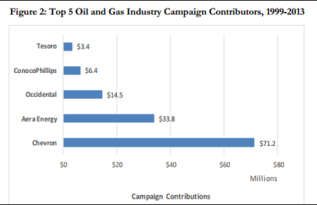
Over the past 15 years, Big Oil spent $123.6 million to lobby Sacramento and $143.3 million on California political candidates and campaigns. I wouldn’t know from experience but I’d bet you can make a lot of friends with that much money dropping out of your pockets, year after year.

These friends might attach more importance to Big Oil’s concerns about over-regulation than they would to a resident who might not have the funds to contribute to anyone’s campaign fund.

A recent report by the Alliance of Californians for Community Empowerment Institute (ACCE) and Common Cause, “Big Oil Floods the Capitol: How California’s Oil Companies Funnel Funds into the Legislature,” speaks to the extreme power of the Oil and Gas Lobby, as well as the Western States Petroleum Association (WSPA) in Sacramento.

Dan Bacher, California Central Valley reporter for IndyBay, in his review of the report, noted that the

“fact that the oil industry is the largest corporate lobby in California, one that dominates environmental politics like no other industry“ makes California “much closer to Louisiana and Florida in its domination by corporate interests.”

Another way oil companies grease the wheels of influence is through their charitable giving in local oil and gas lobbycommunities. Where I live in Martinez, the yellow Shell refinery logo is on virtually all city events including our local Earth Day celebration located at the historic home of iconic environmentalist John Muir.  In Richmond, Chevron ladles out millions of dollars to local social services nonprofits working with low-income Richmond residents while simultaneously polluting their community.

These kinds of donations seem  to  reduce  short term costs for the local government, but there is a very real long term cost as well.

And one of the most insidious dynamics is that city budgets are structurally reliant on tax revenue from refineries.   According to the Contra Costa Times, “tens of millions in Chevron tax revenue bolster the [Richmond] city budget, providing police and other services that similarly sized cities in Contra Costa County can only dream about.”

It certainly seems like Big Oil has a stranglehold on California politics and regulatory agencies. Recently, the Bay Area Air Quality Management District (BAAQMD) came out in favor of Chevron’s expansion project.  After being advised by members of the Stationary Source committee that the appropriate behavior would be to merely answer questions at the Richmond meetings, BAAQMD Chief Air Pollution Control Officer, Jack Broadbent, chose to sign up as a speaker at both Richmond public meetings. He spoke in favor of the Chevron project and formally stated that there was no scientifically feasible way to mitigate condensable particulate matter for the Chevron project. This kind of emission from refineries is composed of carcinogenic particles about 1 micron in width that can lodge deep down in your lungs – see reference below.

microns

Prior to the two Richmond meetings, it had been clearly spelled out for the BAAQMD Stationary Source committee by multiple experts (with Broadbent present) that there was a mitigation technique (SCAQMD FEA Rule 1105.1) that would lessen pollution in Richmond by some 56 tons of the worst stuff you can breathe per year. And it has been mitigated since 2003 in the South Coast Air Quality Management District. So, choosing not to mitigate the really dangerous stuff pouring out of Chevron, like cancer-causing condensable particulate matter, is an impossible conclusion to reach by the authority charged with air quality control. Especially when you know otherwise. This is a 56 ton stain on the BAAQMD board and staff. And 56 tons of micron sized particles are unnecessarily heading for the lungs of the men, women, children, and animals that live or work in Richmond over the next year.

Is anyone at these BAAQMD meetings pushing for cleaner air except the community rights advocates?  What influence removes the teeth from the bill, waters down the regulation at the last minute, and causes people to lose their most basic moral compass?  A healthy community and environment should always be the priority.  And nothing should influence you to believe otherwise.

-Tom Griffith, Martinez Environmental Group, August 14, 2014.

Canada may require new electronically controlled brakes (and other measures) for oil trains … by 2020

Repost from the Globe and Mail, Ottawa, Canada
[Editor: Significant quote: “Electronically controlled air brakes are favoured by some rail-safety advocates because they allow an engineer to apply the brakes on all of a train’s cars at the same time – regardless of how close they are to the locomotive.  In contrast, traditional air brakes rely on a signal that begins from the locomotive and moves car by car toward the back of the train. On longer unit trains such as those typically used to haul crude oil, rail cars near the back of the train won’t receive the signal as quickly, increasing the risk of a derailment when the brakes are applied suddenly.”  – RS]

Putting the brakes on train derailment

By Kim Mackrael, Aug. 15 2014

The federal government is mulling a plan to require new electronically controlled air brakes for rail cars that haul dangerous goods such as crude oil and ethanol after a series of explosive oil-train derailments in Canada and the United States.

A consultation document sent to the railway transportation industry last month laid out Transport Canada’s proposal for a new class of tank car, including the new air brake system and full head shields to prevent punctures. Older-model DOT-111 tank cars have been heavily criticized as prone to puncture and corrosion.

Electronically controlled air brakes are favoured by some rail-safety advocates because they allow an engineer to apply the brakes on all of a train’s cars at the same time – regardless of how close they are to the locomotive.

In contrast, traditional air brakes rely on a signal that begins from the locomotive and moves car by car toward the back of the train. On longer unit trains such as those typically used to haul crude oil, rail cars near the back of the train won’t receive the signal as quickly, increasing the risk of a derailment when the brakes are applied suddenly.

Don Ross, who led the Transportation Safety Board’s investigation into last year’s rail disaster in Lac-Mégantic, Que., said the agency generally supports the use of the electronically controlled brakes because they can improve rail safety, particularly on longer trains. “It’s encouraging, now, that they’ve got out for discussion a very good standard,” Mr. Ross said in a recent interview.

“We would be very happy to see the industry adopt that.”

Transport Minister Lisa Raitt told The Globe and Mail on Friday that she had already begun consultations on the matter, but has so far heard that the industry does not believe electronically controlled air brakes are necessary. “The ones that I’ve been speaking to say it’s too difficult to implement in the North American market,” Ms. Raitt said, adding, “That’s the consultation so far, but we’re still gathering information right now.”

One concern with electronically controlled brakes is that the system would need to be installed on all of a train’s cars for it to function properly, a factor that would limit railways’ flexibility in assembling longer or mixed trains.

In addition to the new air brake system, the proposed new standard includes full head shields to prevent puncture, improved top-fitting protection for the pressure release valve, mandatory thermal jackets to prevent overheating, and new standards for bottom outlet valves to prevent leaks during an accident.

The standard goes beyond requirements announced in April for a three-year phaseout or retrofit of pre-2011 tank cars used to haul crude oil. Those rules included half-head shields, top-fitting protection and thicker steel.

The new proposal would give industry until May, 2020, to start using the next-generation cars to move the most dangerous flammable liquids, classified as Packing Group 1. New or retrofitted cars would be required for moderately dangerous flammable liquids by May, 2022, and for all flammable liquids by May, 2025.

A spokesperson for Canadian Pacific said on Friday that the company is evaluating Transport Canada’s proposal, but did not comment on any specific aspect of the proposed change. Canadian National said it is reviewing the proposal and would provide comments to the regulator as part of the consultation process.

Last month, U.S. regulators issued three possible requirements for next-generation DOT-111 tank cars.

The toughest standards proposed by the U.S. are similar to the Transport Canada proposal and include electronically controlled air brakes.

Lynne Nittler of Davis, CA: Take Action!

Repost from The Davis Enterprise

Exercise the power of public comment

by Lynne Nittler, August 10, 2014
oil train
Oil tanker cars travel by rail through Davis on a recent evening. Valero oil refinery in Benicia wants to expand its oil shipments to 100 tank cars per day. Jean Jackman/Courtesy photo

The story of crude-by-rail in California is not a done deal. As new developments unfold almost daily in this remarkable drama, it is clear that public input can make a significant impact.

For example, last January, fierce community opposition — plus a letter from state Attorney General Kamala Harris urging further scrutiny on air quality and the risk of accidental spills — led city leaders in Pittsburg to reopen the public comment period on its draft environmental documents.

The WesPac Petroleum project had called for an average of 242,000 barrels of crude — the equivalent of 3.5 trains per day — to be unloaded daily and stored in 16 tanks before being piped to the five Bay Area refineries. Now, it appears WesPac may never reapply. An alert public can bring about change.

Valero in Benicia is a long way from giving up on the rail terminal that will allow it to import 100 tank cars of crude by rail daily, most likely from the tar sands of Alberta, Canada, and the Bakken Crude shale of North Dakota. These two extreme forms of crude — Bakken crude is highly volatile and proven explosive and tar sands bitumen is toxic and impossible to clean up in a spill (Kalamazoo spill, July 2010) — are already being processed in some Bay Area refineries.

The California Energy Commission predicts within two years that California will receive 25 percent of its crude by rail, mostly from these two extreme crudes that emergency workers currently are not prepared to deal with in the event of a spill or accident. For the Sacramento region, that will mean five to six trains of 100 cars per day by the end of 2016!

Your input now may make a significant difference. The draft environmental impact report for the Valero proposal is open for public review until Sept. 15. A printed copy is at the Stephens Branch Library, 315 E. 14th St. in Davis, and is available online at www.benindy.wpengine.com. Every letter submitted becomes part of the public record and must be addressed in the final EIR.

Frankly, the draft EIR focuses on impacts to Benicia, and just glances at uprail communities like Davis. But two 50-car trains coming across the Yolo Causeway and the protected Yolo Basin Wildlife Area; passing high-tech businesses along Second Street; rolling into town through residential neighborhoods, where the vibrations will be felt from each heavy car; following the unusual and therefore dangerous 10 mph crossover just before the train station; passing through the train station, putting the entire downtown within the blast zone; and skirting the edge of UC Davis, including the Mondavi Center for the Performing Arts; puts many people at serious risk.

If you have concerns such as whether the tank cars are safe enough, whether the volatility of the Bakken crude should be reduced before it is loaded into tank cars, who is liable in the event of an accident, whether the trains will be equipped with positive train control to improve braking, how Valero plans to mitigate the increased air and noise pollution, how Valero can claim that accidents happen only once in 111 years, etc., then you can help.

While our city of Davis, Yolo County, Sacramento, Roseville, Fairfield, the Sacramento Area Council of Governments and the Sierra Club Yolano Group are writing their own responses to the Valero draft EIR, letters from private citizens are equally powerful.

Public workshops are planned in August and September to help residents craft their letters. They workshops will provide background on the oil train situation, discuss the California Environmental Quality Act and EIR process and offer helpful resource materials. Participants will find topics, gather evidence, write their letters and then share drafts for feedback.

Workshops are planned from 10 a.m. to noon Saturday, Aug. 9; 7 to 9 p.m. Thursday, Aug. 21; and 2 to 4 p.m. Sunday, Sept. 7. All will take place in the Blanchard Room at the Stephens Branch Library, 315 E. 14th St. in Davis. The room is accessible to people with disabilities.

The draft EIR and mailing directions are posted at www.benindy.wpengine.com. For more information, contact me at lnittler@sbcgloball.net or 530-756-8110.

Bring a friend! Every letter adds to the impact!

— Lynne Nittler is a Davis resident.

Ca-ching: Oil-by-rail surge to benefit three commercial sectors

Repost from Benzinga
[Editor: Quick & dirty on the 3 sectors: Freight Car Designers And Refitters, Insurance Providers, and Emergency Services And Safety Training.  UNLESS … if we stop crude by rail in its tracks, the only CA-CHING will be in the alternative energy fields.  – RS] 

3 Sectors Expected To Benefit From The Oil-By-Rail Surge

Bruce Kennedy, Benzinga Staff Writer, August 11, 2014

It’s been just over a year since a freight train carrying crude oil from the Bakken shale fields in North Dakota derailed and exploded in a Quebec town near the U.S.-Canadian border, killing 47 people.

That accident, along with several others in its wake, drew attention to the enormous increase in shale oil now being transported from North Dakota and Canada by rail – and the vulnerabilities of that form of transport.

“More crude oil is being shipped by rail than ever before, with much of it being transported out of North Dakota’s Bakken Shale Formation,” Department of Transportation Secretary Anthony Fox pointed out in a press conference last month. “In 2008, producers shipped 9,500 rail-carloads of oil in the U.S.; by just last year, that number skyrocketed to 415,000 rail-carloads — a jump of more than 4,300 percent.”

At that same press conference, Fox announced a rule-making proposal to improve the safe transportation of large quantities of flammable materials by rail – crude oil and ethanol in particular.

The increase in oil being transported by rail, as well as the new safety measures, might also be a windfall for companies in some related fields.

Freight Car Designers And Refitters

The proposed new safety rules for oil freight cars means a potential bonanza for firms like The Greenbrier Companies (NYSE: GBX). The Oregon-based group is a leading manufacturer and marketer of railroad freight car equipment in both North America and Europe.

Along with retro-fitting existing oil rail cars, Greenbrier is also designing a new genreration “Tank Car of the Future,”  with a thicker tank and bigger welds to ensure greater safety.

The new design, according to the Rigzone oil and gas industry web site, is “intended to meet anticipated new industry and government standards for tank cars transporting certain hazardous material.”

Insurance Providers

The Wall Street Journal reports that most, big North American railroads usually carry about $1.5 billion in liability insurance – but notes that accidents like last year’s deadly derailment and explosion in Lac-Mégantic, Quebec, can end up costing billions of dollars more in cost, especially if that accident happens in a populated area.

“Even if it happens outside of town, the massive damage to property and the environment — you’re stymied when you have these kind of crude oil fires burning hot and big for days,” Karen Darch, president of Barrington, Illinois, told the newspaper.

This could lead to an increase in the need for insurance.

“With experts predicting that oil spill derailments may increase in frequency over the next decade, the insurance industry must be prepared to address this new coverage threat,” says the law industry tracker web site Law360 earlier this year, “including the coverage issues and potential exposure which may arise from these disasters.”

Emergency Services And Safety Training

Earlier this year, Minnesota’s state legislature passed an oil transport law. The measure, reportedly worth more than $6 million, took fees generated in part from oil and railroad companies and put that funding towards tanker and pipeline disaster training, as well as more state transportation safety inspectors.

As former National Transportation Safety Board Chairwoman Deborah Hersman pointed out in a letter written this past January to the head of the Federal Railroad Administration, there is no mandate for the railroads to come up with comprehensive disaster response plans for oil train derailments

This means the rail carriers “have effectively placed the burden of remediating the environmental consequences of an accident on local communities along their routes,” the letter said.

According to the Association of American Railroads, the industry is providing $5 million to develop and fund specialized training for first responders handling a crude-by-rail accident, as well as developing “an inventory of emergency response resources and equipment for responding to the release of large amounts of crude oil along routes over which trains with 20 or more cars of crude oil operate.”