
Tag Archives: San Francisco Bay Area

Getting grandma out of the care facility… build her a backyard cottage?

Bay Area backyard cottages boom as elderly parents and college students flee coronavirus

San Francisco Chronicle, by J.K. Dineen, July 4, 2020
Omar Abi-Chachine (right), son of the homeowner, stands next to the foundation for the Abodu accessory dwelling unit before it was installed in Millbrae.
Omar Abi-Chachine (right), son of the homeowner, stands next to the foundation for the Abodu accessory dwelling unit before it was installed in Millbrae. Photo: Lea Suzuki / The Chronicle

Bay Area companies that specialize in backyard cottages are seeing a surge in interest from homeowners who suddenly need to create additional living space for elderly parents or adult children displaced because of the coronavirus.

Some families are scrambling to move their parents out of assisted-living facilities, where the risks of contracting the coronavirus are high. Other erstwhile empty-nesters find themselves crowded as their young adult kids return from shuttered college campuses or look to escape small apartments in expensive cities like San Francisco or New York.

After California lawmakers embraced a series of statewide bills in 2017 to streamline building backyard cottages — also called accessory dwelling units or ADUs — the number of new units approved exploded to more than 7,000 in 2018, 50% higher than 2017. For many suburban residents, the backyard homes were seen as a more palatable answer to the housing crisis than large apartment buildings. But in a state that should build millions of homes to keep up with demand, critics said the cottages are a distraction from the need to build multiunit buildings at scale.

Abodu, a San Jose firm that makes ADUs, estimates that 10,000 will be permitted in California in 2020, based on a survey of city permits.

Adobu has seen orders for modular cottages more than double since the pandemic began, according to CEO John Geary. The units start at about $199,000, and with finishes, most come in at about $220,000.
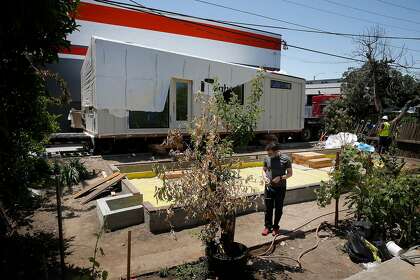
Omar Abi-Chachine (center), son of the homeowner, stands next to the foundation for the Abodu accessory dwelling unit before it was installed in Millbrae.
Omar Abi-Chachine (center), son of the homeowner, stands next to the foundation for the Abodu accessory dwelling unit before it was installed in Millbrae. Photo: Lea Suzuki / The Chronicle

Another manufacturer, Sonderpods of Novato, had 3,000 visits to its website in the 90 days before the shelter-in-place order in March, but has seen that number jump to 25,000 over the last 90 days. Within a few weeks of the health order, the company had signed seven contracts to deliver backyard cottages and was negotiating an additional 92 deals. Sonderpods average about $139,000.

“We are sprinting to keep up with things,” said Edward Stevenson, CEO of Sonderpods.

Hank Hernandez, who owns Alameda Tiny Homes, said he has been flooded with inquiries.

“I get calls all day, every day,” he said. “The basic request is, ‘I want to put my parents in my backyard as quickly as possible.’”

Before coronavirus, Redwood City resident Jen Parsons was exploring options for her widowed mom, who was looking to downsize from her longtime home. She was exploring nearby retirement communities and possibly buying a bigger house that could accommodate three generations when the pandemic hit. Suddenly there was a pressing need. With two young kids, Parsons didn’t feel safe moving to an unfamiliar neighborhood in the middle of a pandemic and was not keen on moving her mom to a senior housing complex.

“You hear all these stories about retirement communities being on lockdown — you can’t even take your elderly parent to lunch or dinner, only to doctors appointments,” she said.

Instead, they decided to purchase an Abodu AD unit, which will arrive in August or September.

“Having an ADU unit back there for my mom will feel like a safe and peaceful environment at a time when there is a lot of stress because of COVID-19,” she said. “We can meet her in the patio and have snacks.”
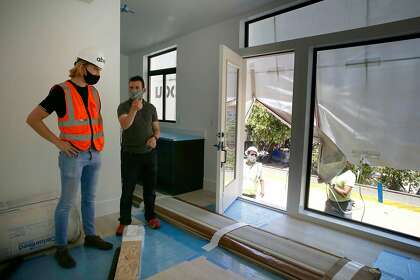
Eric McInerney (left), Abodu co-founder, talks with Omar Abi-Chachine, the son of the homeowner, inside the accessory dwelling unit after it was installed in Millbrae.
Eric McInerney (left), Abodu co-founder, talks with Omar Abi-Chachine, the son of the homeowner, inside the accessory dwelling unit after it was installed in Millbrae. Photo: Lea Suzuki / The Chronicle

Faysal Abi, a retired police officer and yoga teacher in Redwood City, also ordered an Abodu. He said that the unit will provide housing for a friend who needs a place to live.

“A friend fell on hard times, and the Bay Area isn’t exactly cheap,” he said. “I feel like community is something we are lacking, especially since coronavirus. There is more isolation. One way to heal the world right now is through more community and knowing your neighbors and staying connected. I feel this will help accomplish that.”

Abi also persuaded his mother, Rabina Abi-Chahine, a 62-year-old social worker, to buy her own backyard cottage for her home in Millbrae. Abi-Chahine said she was motivated both by a desire to create some income as she approaches retirement and having a spot for her own father some day.

Geary said another client, a Palo Alto woman, had two children away at college suddenly return, joining two other teenagers at home, which immediately made the house feel crowded.

Stevenson, the CEO of Sonderpods, said that 70% of customers are older than 55 and 70% are women building units on their kids’ properties.

“A lot of it is Baby Boomers selling the family home and moving in into their kids’ backyards. People are re-evaluating what is important and trying to bring the family closer together,” he said. “We are not seeing a lot of people who are straight-up looking to make income.”

Thanks to a series of state and local bills, ADUs can be built relatively quickly with limited bureaucratic hassle in some cities. San Jose, which has been aggressive in encouraging the tiny homes, has seen permitted ADUs jump to 691 last year from 24 in 2014. So far this year, 321 applications have been filed.

The Abodu was the first ADU manufacturer preapproved by the city of San Jose — which cut multiple inspections and red tape. From the day the permit is pulled, Abodu can have the unit installed within 12 weeks.

Hernandez of Alameda Tiny Homes said that while his business has been steady for the past few years, clients’ motivation has changed. It used to be that most homeowners were looking for extra income. Now it’s to meet family needs.

Confused about what’s re-opened in Solano County? Here’s the SF Chron on what’s open, what’s not

California’s reopening: See what’s open and what’s still shut down by county

San Francisco Chronicle, by CHRONICLE DIGITAL TEAM | LAST UPDATED:  June 24, 2020 9:36 AM

California developed a four-stage approach to reopening from shelter-in-place orders designed to slow the coronavirus outbreak. The state as a whole is in Stage 2, but most counties have filed attestations to overall preparedness and have been approved for advanced reopening though some are being monitored by the state as cases are surging again. Gov. Gavin Newsom has even said reopening could be reversed if the surge continues. Those counties with permission to move at their own pace into Stage 3 can open higher-risk businesses depending on local conditions. Only four counties — San Francisco, Alameda and Santa Clara in the Bay Area plus Imperial in Southern California — have not been approved to move forward.

How shelter-in-place orders are loosening

All Bay Area counties have relaxed some restrictions and moved at least into limited Stage 2 reopening. Contra Costa, San Mateo, Marin, Napa, Solano and Sonoma have been approved for advanced reopening, though Contra Costa is taking a more gradual approach. Marin will open some Stage 3 businesses on June 29 with more guidance coming soon. San Francisco officials set a series of dates, beginning June 1, as targets to reopen and recently moved up the target date by two weeks for several businesses.


Where Bay Area counties stand:

Solano County

WHEN DO SHELTER-IN-PLACE ORDERS EXPIRE?

Effective until further notice

ARE FACE COVERINGS REQUIRED IN PUBLIC?

No, but recommended when outside the home

WHAT IS OPEN:

    • Low-risk activities that allow for social distancing or physical barriers
    • Essential businesses like health care, grocery stores, pharmacies, banks
    • Dine-in restaurants
    • Destination retail, including clothing stores, shopping malls and swap meets
    • Personal services such as barbershops, hair salons, nail salons and tattoo parlors
    • Bars, wineries and breweries
    • Gyms and fitness centers
    • Places of worship with attendance limited to 25% of building capacity up to 100 people
    • Family entertainment centers, including movie theaters
    • Office-based business operations
    • Essential travel
    • Outdoor activities like walking and biking
    • Construction, real estate transactions and other outdoor businesses
    • Child care, day camps and educational programs with groups limited in size to 10 children
    • Manufacturing
    • Outdoor facilities such as skate parks, athletic fields, golf courses and local parks
    • Zoos, museums and galleries
    • Hotels, lodging and short-term rentals
    • Racetracks and satellite wagering facilities
    • Professional sports without spectators
    • Campgrounds and RV parks, though Lake Solano Park and Sandy Beach Park remain closed except for boat launching
    • Other boat ramps and launches
    • Schools can reopen, but will wait until late summer or fall

WHAT IS NOT OPEN:

    • Vehicle access, parking and camping at state parks
    • Outdoor recreational areas and playgrounds with high-touch equipment
    • Sports that require shared equipment or physical contact
    • Entertainment and concert venues
    • Community centers
    • Nightclubs
    • Live sports and festivals
READ THE COUNTY’S FULL ORDER HERE

Is the Bay Area reaching its goals?

Officials for six Bay Area counties established their own set of indicators they are using to help decide when to ease shelter-in-place orders (this is an evolving checklist and the criteria are subject to change). All six report they are doing well in terms of hospitalization rates and hospital capacity. A recent spike in coronavirus cases across the Bay Area led four of the six counties to change their status to currently not meeting goals for flat or decreasing new cases. Testing remains a hurdle, with only two of the counties currently reaching their goal of 200 daily tests per 100,000 residents.

Cases by county during reopening

The 5-day trailing average of daily confirmed cases per 100,000 residents and a marker indicating when these Bay Area counties moved into a new stage of reopening.

Checklist: How Bay Area counties are measuring progress

This chart will be updated weekly with information reported by the county officials. Last updated June 19, 2020 10:30 a.m. [BenIndy Editor: unfortunately, Solano County is not included in this “Bay Area counties” chart.  This is not the first time Solano has been overlooked.]


For more information on new cases and trends, visit The Chronicle’s virus tracker

Sources: California Department of Public Health, county public health departments, exclusive Chronicle reporting(1) Numbers of cases: The total number of cases in the community and the number of hospitalizations must flatten or decrease. County officials determine whether this goal is being met. (2) Hospitalizations: Number must flatten or decrease for 14 consecutive days. (3) Hospital capacity: For at least a week, no more than 50% of patients in staffed hospital beds not added as part of pandemic-surge planning can be coronavirus-positive. In the above chart, hospitalizations represent all confirmed COVID-19 patients, including those in ICU, on a given day. (4) Testing: At least 200 coronavirus-detection tests must be conducted per 100,000 residents per day. In the above chart, tests per 100,000 people is the average daily tests reported for the previous week, due to reporting delays. (5) Investigation and contact tracing: Public officials must be able to design a system that reaches at least 90% of confirmed cases and identifies their contacts; ensures that 90% of the cases reached can safely isolate; reaches at least 90% of all contacts identified; and ensures that at least 90% of identified contacts can safely quarantine. (6) Personal protective equipment: All acute care hospitals, outpatient clinics, skilled nursing facilities, and medical first responders must have a 30-day supply of PPE on hand.* San Mateo is using the state standard of a 14-day supply of PPE on hand, not the 30-day supply used by the other Bay Area counties, to determine if it is meeting that goal.

Many counties moving more quickly

Nearly every county has filed attestation papers and has been approved for advanced reopening. Those counties can determine when they’re ready to allow higher-risk activities in Stage 3. Most counties allowed all businesses with state guidance to open June 12 or earlier, though some like Del Notre, Contra Costa, San Joaquin, Fresno and Los Angeles are opening Stage 3 businesses and activities in phases.

Early Stage 2

WHAT IS OPEN, WITH MODIFICATIONS

Curbside retail and dining pickups or deliveries   •   individual counties may approve in-store shopping   •   some manufacturing   •   child care for those outside the essential workforce   •   office-based business though telework is still encouraged   •   services like car washes, pet grooming and landscaping   •   outdoor public spaces like museums and galleries   •   places of worship with attendance limited to 25% of building capacity up to 100 people, pending approval from individual counties.

WHAT IS NOT OPEN

Indoor gatherings, including retail and eat-in dining in some counties   •   personal services such as nail salons, tattoo parlors, gyms and fitness studios   •   many state parks   •   schools.

Advanced Stage 2

WHAT EXTRA IS OPEN, WITH COUNTY-SPECIFIC MODIFICATIONS

Dine-in restaurants and other facilities offering food service with social distancing   •   barbershops and hair salons with safety measures   •   schools.

WHAT STILL IS NOT OPEN

Bars, wineries, tasting rooms and gaming areas that do not offer sit-down meals   •   entertainment venues like movie theaters and arcades   •   indoor museums, gallery spaces and libraries   •   zoos   •   community centers and public pools, playgrounds and picnic areas   •   limited-capacity indoor ceremonies   •   nightclubs   •   concert venues   •   live sports   •   festivals   •   theme parks   •   gyms and other personal services   •   hotels for nonessential travel   •   higher education.

Stage 3

WHAT EXTRA IS OPEN

Restaurants, bars, wineries and tasting rooms   •   gyms and fitness centers   •   personal service businesses like nail salons and tattoo shops   •   sports without spectators   •   larger in-person gatherings such as church services and weddings   •   RV parks and campsites, though playgrounds, conference spaces, meeting rooms and outdoor spaces intended for group functions are to remain closed   •   casinos, cardrooms, satellite wagering facilities and racetracks (without spectators)   •   entertainment centers such as movie theaters, bowling alleys, miniature golf, arcades and batting cages   •   fitness facilities, including swimming pools   •   hotel, lodging and short-term rentals but can only rent unoccupied units and cannot rent rooms or spaces within an occupied residence   •   museums, galleries, zoos, botanical gardens, aquariums and similar spaces

WHAT STILL IS NOT OPEN

Concerts, convention centers and live-audience sports   •   entertainment venues where social distancing is harder, like ice rinks, roller rinks, laser tag arenas, theme parks, amusement parks or water parks   •   saunas, steam rooms and hot tubs


Dr. Matyas: “Every weekend we’re having these get-togethers, and seven to 10 days later we start getting the cases.”

With Father’s Day and summer BBQs coming up, is there a safe way to socialize?

San Francisco Chronicle, by Erin Allday, June 19, 2020
Friends and family socially distance as they party for Addie McLaughlin’s sixth birthday Saturday at Golden Gate Park.
Friends and family socially distance as they party for Addie McLaughlin’s sixth birthday Saturday at Golden Gate Park. Photo: Jessica Christian / The Chronicle

As the Bay Area emerges from a season of dreary pandemic isolation into an unfairly beautiful June and all the potential of a sun-drenched and hard-earned summer, the temptation is becoming unbearable. People want to go outside, and they want to see each other again.

Father’s Day barbecues, Fourth of July picnics, family reunions in Tahoe, and Stinson Beach weekends with friends are surely starting to make it onto social calendars. But here’s the hard truth: The coronavirus doesn’t care if people are tired of sheltering in place.

Recent surges in cases across the Bay Area already have been tied to social gatherings, first Mother’s Day and then Memorial Day. A few clusters are associated with graduation parties, and public health officials expect to see more in the coming weeks.

“The pace of family gatherings has not slowed down. I think it started on Mother’s Day and it hasn’t stopped,” Bela Matyas, the Solano County health officer, said in a recent interview. “Every weekend we’re having these get-togethers, and seven to 10 days later we start getting the cases.”

California reported a one-day record of new cases this week — more than 4,000 on Wednesday — and it’s impossible to blame that surge on any one factor. The state has dramatically increased testing over the past month and counties have been steadily easing shelter-in-place restrictions, so more people are returning to work and interacting with others.

Plus, thousands of people have joined Black Lives Matter protests that will almost certainly result in some new cases, public health experts have said.

But throughout this pandemic, it’s become clear that the riskiest situations involve close, lengthy contact with others. That’s why clusters often form around people in a shared household. Parties with close friends and family are similarly perilous.

Small social gatherings are allowed, if not necessarily encouraged, as state and local shelter-in-place directives begin to ease up. San Francisco formally permitted them as of Saturday, but only outdoors and in groups of up to 12 people — six if there’s a shared meal.

The U.S. Centers for Disease Control and Prevention offered guidance last week on how people should come together as the coronavirus continues to circulate. Alameda County earlier this month endorsed “social bubbles” — groups of up to 12 people who may meet outside for friendly hangouts.

Though these gatherings will always come with some risk, public health experts say there are ways to make them safer, and by now most people should be familiar with the advice: Wear face coverings, meet outside instead of inside, keep 6 feet apart, don’t shake hands or hug or kiss, don’t share food or utensils or anything else.

Friends and family socially distance as they gather to celebrate Addie McLaughlin's sixth birthday.
Friends and family socially distance as they gather to celebrate Addie McLaughlin’s sixth birthday. Photo: Jessica Christian / The Chronicle

Charles McLaughlin’s family was abiding by those principles at Golden Gate Park last Saturday, when they gathered with two other families to celebrate his daughter’s sixth birthday. The families spread picnic blankets more than 6 feet apart and brought their own food. Everyone had face coverings.

Even the children were doing their best to maintain social distancing, riding bikes across the grass and chasing each other around a field beside the Conservatory of Flowers.

“We’ve been locked up for a while. It feels good to be outside,” McLaughlin said as Addie, the birthday girl in a pink tutu, took off on her bike. As recently as last month, McLaughlin and his wife had thought that Addie would have to celebrate with just her immediate family, with some friends invited to drive by with their well wishes.

The McLaughlins and another family at the party share a nanny for their four children, but they only started socializing again a couple of weeks ago. It was tough on the children to be separated, said Ryan Keerns, whose two sons are friends with McLaughlin’s daughters.

“The older kids have known each other since they were 6 months old. They have the same nanny, they go to school together,” Keerns said. “To just go cold turkey with not seeing each other is hard.”

But Keerns said they were all cognizant of the hazards of spending time together.

“We’ve stayed in our apartment since the beginning of all this,” he said.

In fact, as infectious disease experts learn more about the new coronavirus, it’s become increasingly obvious that close, extended contact is the most common avenue of transmission — making social gatherings especially risky as people resume some kind of normal life after sheltering in place, public health officials say.

Santa Cruz County reported several clusters of cases tied to Mother’s Day celebrations. Three Bay Area health officers said they saw a notable uptick in local cases after Memorial Day, and some were connected directly to social events that occurred over the holiday.

Earlier, the CDC reported clusters that were associated with funerals and birthday parties.

Those gatherings are sure to happen more often in the coming weeks with summer celebrations on the horizon, public health experts acknowledge. That’s especially true after people have been sheltering in place for three months, and as more of the economy opens up and people begin to venture outside their homes anyway.

“People are just darned tired of being cooped up, locked up in their homes, not being able to go out and see other people,” said Warner Greene, an infectious disease expert with the Gladstone Institutes in San Francisco. “We are basically social beings.”

Greene and his wife are starting to socialize more, he said. A couple of weeks ago, they organized a weekend retreat with their adult children and the grandchildren. They’re thinking of inviting a pair of friends over for dinner.

He noted that large gatherings are still profoundly unwise. He said he cringed at images of people crowding beaches over Memorial Day and he’s worried about Fourth of July festivities.

Solano County leads Bay Area with highest unemployment at 5% – How to get help

Bureau of Labor statistics comparing March to February

San Francisco sees biggest increase: 31%

KQED News, by Nina Sparling, May 9, 2020
Restaurant and retail workers have been hard hit during the pandemic. (Getty Images)

Gary Darst lost his job at Pläj in late March. The Scandinavian restaurant in Hayes Valley in San Francisco depends on nearby institutions like the opera, symphony and SFJAZZ Center for much of its business. When those venues went dark in early March, Darst started to worry.

“The thing about the restaurant industry is that you’ve always got a job,” he said. “It’s relatively safe. At least it used to be.”

First, the restaurant furloughed Darst for a few weeks in mid-March. Not long after, all 20 employees were laid off. Darst filed for unemployment insurance immediately — one of hundreds of thousands of Bay Area workers to do so.

But county-level unemployment data show the pandemic is impacting each Bay Area county in a unique way. Those with the lowest unemployment rates have also seen the highest increase in unemployment insurance claim filings — and vice versa.

San Francisco, for instance, has a high percentage of professional and white-collar workers, many of whom continue to work from home and receive a paycheck. The unemployment rate in the county was 3% at the end of March, on the lower end for the Bay Area, according to a KQED and Associated Press analysis of Bureau of Labor Statistics data.

“It could be driven by the fact that you have white-collar jobs that have kept their jobs, kept their pay, and other workers who haven’t,” Sylvia Allegretto an economist at the Institute for Research on Labor and Employment at UC Berkeley said.

Many Bay Area workers have lost their jobs, but the region as a whole is faring much better than the national average. The unemployment rate for the Bay Area as a whole was 3.5% in March compared to 4.5% nationally at the same time. New data from the Bureau of Labor Statistics puts the April national unemployment rate at 14.7%, the highest since 1948.

While that number is alarming, Allegretto emphasizes the context behind the numbers. “We came together as a nation collectively to shut down the economy as we start to try to deal with a pandemic,” she said. “If I didn’t see high rates of unemployment I’d wonder why are all these people working.”

San Francisco saw a 31% increase in how many unemployment claims were filed in March compared to February. That could reflect the large numbers of restaurants and bars in San Francisco, which were among the first businesses to shutter after the Bay Area-wide shelter-in-place order on March 16, Allegretto says.

“It can hold both ways,” Allegretto said.

Meanwhile, the eastern Bay Area counties show the opposite trend: higher rates of unemployment, but lower increases in unemployment insurance claim filings from February to March.

Solano and Sonoma counties have the highest percentage of workers in construction and retail, industries that have been heavily impacted by COVID-19.

The Bureau of Labor Statistics numbers are not seasonally adjusted, meaning they don’t account for expected increases around the busy holiday season for retail workers or seasonal fluctuations in construction.

Allegretto warns that it’s early yet to draw definitive conclusions. The April report reflects unemployment insurance filings through the end of March, just when the economy started to wind down. The full implications of COVID-19 on the workforce have only grown more acute.

April saw furloughs at Bay Area oil refineries. Tech companies like Uber and Airbnb announced layoffs in early May. City and county budgets are suffering, too. California cities project losses of $6.7 billion in the two years, and Bay Area cities know layoffs might be in the future.

Darst, the restaurant manager, first started working in restaurants at age 14. But he isn’t counting on being able to return to work in the industry any time soon.

“It’s a disaster,” he said. “It’s really bad.”

Below are various KQED resource guides that can help those who have lost their jobs and income due to the pandemic:

How to File for Unemployment in California During the Coronavirus Pandemic

Californians who are missing work because of the novel coronavirus can access benefits, including unemployment. Benefits are not only for people who have been laid off, they also apply to caregivers, those who are quarantined and workers whose hours have been reduced.

Emergency Funds for Freelancers, Creatives Losing Income During Coronavirus

Some self-employed people will not qualify for unemployment insurance, particularly artists who rely on informal, direct cash payments or practice without a business license. With those challenges in mind, KQED compiled a list of mutual aid funds that distribute emergency grants to artists, creative professionals and freelancers facing financial hardships.

Here’s What’s Available to Help Small Businesses Survive the Coronavirus

From restaurants and bookstores to dry cleaners and hair salons, small businesses are a big deal in the U.S., employing nearly half of the nation’s workforce. Most of these institutions, which were already operating on razor-thin margins, have been hit particularly hard by the coronavirus pandemic. And without major assistance, many simply won’t be able to weather their economic losses. This guide lists some of the lifelines Bay Area businesses can try to take advantage of.

A Guide to Bay Area Eviction Moratoriums During the Coronavirus Crisis

Some of who’ve lost their jobs might be worried about paying their rent. This guide has some answers to common questions about renters and tenants protections in the Bay Area.