Category Archives: Benicia CA

‘Our Voices’ – Overcoming racial bias


BENICIA BLACK LIVES MATTER
…OUR VOICES…

From BeniciaBlackLivesMatter.com
[See also: About BBLM]

“A friendship based on hard work and personal truth is worth the effort.” This story is not about racism, but about overcoming racial bias.

May 21, 2021

White woman
Age 60
Benicia resident for 8 years

Like most white people, in my age group, racism was an integral part of my childhood. I lived in the Midwest with my grandparents. My grandmother who, although never used disparaging language in front of me, clearly felt superior to people of other races and cultures. Grandma occasionally made negative comments about the Black family across the street or the Catholic family on the corner but only very quietly so she couldn’t be overheard. Our Black housekeeper, whom I adored, was “good enough” to watch over me when they went out of town, but not good enough to invite to dinner or a party. And when I asked my grandmother why our housekeeper was never included in family events when she was definitely part of our family, she dismissed my question with, “It’s just not done that way.”

When I moved in with my mother at age 7, everything changed. We lived in an integrated apartment complex far away from my grandparents’ community– and it was great! There were lots of children from all backgrounds, and we all played together. The families watched out for one another. In hindsight, my social life suddenly became uncomplicated and unhindered. I didn’t have to worry about what Grandma or anyone else thought about my friends. My best friend was a Black girl, and she and I did everything together for the three years I lived there – sleepovers, family dinners, trips to the zoo, etc. My mother socialized with wide variety of people and never discouraged me from making friends with whomever I chose. It was a very different experience than my earlier years. I felt culturally liberated.

I tried to live my life using the model I had learned from my mother. Then, in 2002 while attending graduate school, I had a life changing experience involving racial relations. I was in an educational psychology program and part of a cohort of about 60 individuals. We were carefully screened for our potential to be change agents within a school system. The program was very racially and socially integrated. Much of the curriculum was focused on racial justice, cultural awareness and sensitivity, and appropriate interpersonal interaction. The class was divided into two groups, and I took most or all of my classes with the same 30 people. We were further divided into two groups for our counseling internship. This smaller group of fifteen grad students met twice a week to discuss personal challenges in our fieldwork and our lives.

One of the Black women in my group fascinated me. She was frequently rushing into class at the last moment or shortly after class began. She seemed scattered and harried. But no sooner did the professor ask the class a question, she offer a response with a calmness and a wisdom that was completely different than the manner in which she had arrived to class. Clearly, this woman was possessed with a deep intelligence and the ability to focus her intent without pausing for breath. She was also one of the fifteen in my internship class. Unlike in the others in the classes, she didn’t share much. She seemed uncomfortable talking about her personal life. Instead, she would sit quietly, curled up in one of the armchairs, only speaking when prompted, and then as little as possible. I couldn’t wait to get to know her.

I finally had my chance when we were alone in an elevator on our way to class one day. It happened to be my birthday and someone had given me flowers. She commented on them, and I shared the reason I had them. “Oh – It’s my son’s birthday, too.” Okay, I thought, she’s a mother. We have that in common. “How old is he?” I asked. She told me, and I asked if she had other children. She told me she had two boys, the other one younger. I told her I had a son, too, and gave his age. And then I asked her if she was a single mom. The tentative friendliness she had extended at my encouragement immediately evaporated. I didn’t quite understand why, but I was sensitive enough to realize she had a lot of feelings around her marital status. I didn’t want to pry, so we finished our ride in silence.

About two weeks later, the students in my internship class were discussing racially based micro-aggressions, when the woman I was wanting to meet uncharacteristically spoke up. She said that someone in the cohort had used a micro-aggression against her. Without revealing any identities, she shared the story of being in the elevator with a white woman, ending with the white woman’s “assumption” that all Black mothers are unmarried. There was a long, shocked silence in the room. I took a deep breath and drummed up my courage. “That was me. And I’m sorry you feel upset. Help me understand what happened.”

She was angry – really angry. She saw this as a typical attack against the integrity of Black women from a white person who was coming from a place of superiority. She passionately argued her point while I tried to explain where I was coming from. The class sat there witnessing this exchange in silence. I felt the discomfort growing as the conversation continued for the better part of 10 to 15 minutes. I finally blurted out, “Any woman can be a single mother. I have been a single mother. And I’m now going through a rough patch in my second marriage which may well put me there again.” I have to add that this was very hard for me to admit at that point in time. I continued, “I noticed that you regularly arrive to class like you have way too much on your plate. It just struck me that you being single was a possibility, once I learned that you are a mother, too.” I paused, “I just wanted to get to know you!” The other woman looked stunned, and a silence fell between us.

The professor took this momentary break as a good time to end the discussion. “We can talk more about this next time,” he said as he dismissed the class. Meanwhile, I was trying to maintain my equanimity. I fervently hope the discussion wouldn’t have to be continued at all. I felt depleted, troubled, and embarrassed all at once. I concentrated on gathering my things in preparation to go home. As I turned around, my contender was standing there. “I’m so sorry…” I started to say, but was cut short as she gathered me into one of the biggest hugs I have ever experienced.

Nearly 20 years later, this woman and I are still close friends. We’ve travelled together, celebrated together, laughed till we peed our pants, and held each other while we cried. She was there for me when I did eventually go through a second divorce. My son took her boys under his wing. We now live several states apart, and I miss her. And now that pandemic related travel warnings have been lifted, I need to visit her – or her me.

I wanted to share this story because it contains some very valuable points about getting to know others outside of your regular social group.

● My white perspective may not be the same as someone from another culture or ethnic group.
● Although I didn’t intend my question to be a micro or any kind of aggression, it was perceived that way.
● The other woman’s experiences of racism deeply colored her ability to accept me until we had the opportunity to hash it out.
● One is never finished learning, no matter how much they think they know about other groups of people.

And although my experience (and probably my friend’s as well) was uncomfortable and challenging, we got through it, and it was worth it. I am profoundly grateful that my friend had the courage to express what she felt. And even though her anger frightened me, I stayed with it, and I learned from her side of the story. So did the rest of the class. I am proud of myself that I had the strength and the tenacity to really listen without judgment, without letting emotion get in the way; to be authentic; and not to shift the compassion of our witnesses to me by breaking down and crying. This is an example of how to bridge the gap despite ethnic and cultural barriers.


Previous ‘Our Voices’ stories here on the BenIndy at
Benicia Black Lives Matter – Our Voices
     or on the BBLM website at
beniciablacklivesmatter.weebly.com/ourvoices

Solano County remains in red tier again – detailed data sheet

[BenIndy editor: This report does not mention Solano County, but it does provide a link to a fascinating, extensive and detailed spreadsheet:  “updated data from the California Department of Public Health”.  Clearly the State did NOT advance Solano out of the RED tier today.  – R.S.]

Amador County moves to yellow tier; Yolo County advances closer to least restrictive tier

This week Amador, Orange, Santa Clara and Santa Cruz counties moved to the yellow tier.

ABC10 News, by Chelsea Shannon, May 18, 2021

SACRAMENTO, Calif. — As California moves closer to reopening on June 15, five counties have been allowed to loosen their coronavirus restrictions.

This week Amador, Orange, Santa Clara and Santa Cruz counties moved to the yellow tier, according to updated data from the California Department of Public Health. Tehama also moved to the orange tier in the same update.

As counties move to less restrictive tiers, businesses and activities within those areas can resume operations and allow more people to be inside the business or participate in the activity.

With the most recent data update, five counties saw case rates and positivity rates that put them in a position to move next week if their numbers remain low:

  • Placer County could move to the orange tier.
  • Yolo County to move to the yellow tier.
  • Plumas County to move to the yellow tier.
  • Inyo County to move to the yellow tier.
  • Merced County could move to the orange tier.

Yuba and Tuolumne county were in a position to move to a less restrictive tier last week, but their case rates rose to a point where they were ineligible to move this week.

Counties need to meet the next tiers metrics requirements for two consecutive weeks before moving tiers. There are only three more weeks of tier changes until June 15, when the state plans to retire the tier system. So, there still is enough time for more counties down one more tier before there are no more tiers.

Benicia cancels July 4 parade & fireworks, announces vaccine events

By Roger Straw, May 17, 2021

From City Manager Erik Upson’s weekly newsletter, May 17, 2021.
(subscribe)

“The decision, as you will read below, to cancel the 3rd of July parade and 4th of July fireworks show was extremely difficult for all involved. After discussion with Benicia Main Street (who host the events), thoughtful consideration of the current situation, as well as the uncertainty over what will transpire in June, we collaboratively made this difficult decision. In good conscience, we simply cannot bring 20-30,000 people into close contact as close as we are to the finish line. It is our sincere hope that neighborhoods and neighbors will use this opportunity to come together, host small neighborhood events that help bring us closer together and build upon what makes Benicia so special.”

Cancellation of 4th of July Events
In an abundance of caution, the City will forgo hosting the 3rd of July parade and the fireworks show on the evening of July 4th due to the ongoing COVID-19 pandemic.
The traditional Torchlight Parade on July 3rd and the Picnic in the Park and Fireworks Display on July 4th are events cosponsored by the City of Benicia and Benicia Main Street.
Unfortunately, Solano County remains one of the few counties still in the more restrictive Red Tier. Governor Newsom has announced plans to relax regulations and remove the tier system on June 15th. However, mass gatherings are currently not allowed, and the State has provided no indication that mass gatherings will be permitted with the forthcoming changes. Mass gatherings are of concern because Benicia’s Torchlight Parade and Fireworks Display each draw upwards of 20,000 spectators.
The City and Benicia Main Street have been waiting for guidance from the Governor’s Office to make a final determination but due to the need to have begun planning some time ago and the lack of specific details from the Governor’s Office, the City wants to give families time to prepare for other celebrations.
“Those communities that have announced plans to host 4th of July festivities are able to do so because they have venues, such as amphitheaters or other spaces, where attendance can be limited and controlled. In Benicia, we don’t have the facilities that would allow to limit the size of mass gatherings,” said Erik Upson, City Manager. “The safety of our community remains our top priority. We have the end of this pandemic in sight and can look forward to celebrating again as a community next year.”
Smaller neighborhood celebrations are encouraged. The City’s Parks and Community Services Department will soon announce exciting details of fun 4th of July activities to bring neighborhoods together.
COVID Vaccine Update
The Centers for Disease Control (CDC) has approved Pfizer’s COVID-19 vaccine for 12-15-year-old adolescents. Solano County Public Health has expanded vaccine eligibility to Solano County residents 12-15 years of age. Starting last Thursday, families can now schedule an appointment for their 12 to 15-year-old to receive the Pfizer COVID-19 vaccine. Parents must accompany their children to the vaccine clinic as consent is required.
For individuals age 16-17 years old, they can also receive receive the Pfizer vaccine and must be accompanied by a parent or guardian to their appointment, or have a parent/guardian that can contact by phone during the appointment.
Public Health has several vaccine clinics scheduled. Click here for details. For scheduling assistance, call the vaccine line at 707.784.8655. Homebound or need transportation to get to a vaccine clinic? Call the vaccine line at 707.784.8655.

COVID-19 in Solano County: 4 new hospitalizations today, 21 new cases


By Roger Straw, Friday, May 14, 2021

Solano reports 21 new cases today, 4 hospitalized, no new deaths.  Stay safe, and remember: People with mild COVID can have long-term health problems

Solano County COVID report on Friday, May 14.
[Source: see far below.  See also my ARCHIVE spreadsheet of daily Solano COVID updates.]
Solano County COVID-19 Dashboard – SUMMARY:

On May 14, Solano County reported 21 new COVID cases.  Our hearts go out to those 21 and their families and friends.  RECENTLY: We saw 1,288 new cases in April, an average of 43 per day.  In the first 14 days of May, Solano reported 497 new cases, an average of 36 per day.  Reports are that our red-tier Solano County will not be joining all other Bay Area counties in opening to less restrictive tiers anytime soon.

We learned of 4 new hospitalizations today, all persons over 65 years of age.  Solano’s Active cases fell today from 296 to 276.  Our percent positivity rate also fell today from 7.4% to 6.9%, our first day under 7% since May 3rd, but still much higher than recent months.  We have not seen rates this high since Feb. 22.

Cases among children and youth have increased alarmingly
Percent of today’s new cases, age groups, May 14, 2021
Date New Cases
0-17 years
New Cases
18-49 years
New Cases
50-64 years
New Cases
65+ years
TOTAL
14-May 7 10 2 2 21
14-May 33% 48% 10% 10% 100%

Compare TODAY (above) with percentages since LAST SUMMER (below).  Note especially children and youth 0-17 years:

Percent of  ALL CASES SINCE JUNE 2020, age groups as of May 14, 2021
Date Cases
% 0-17
Cases
% 18-49
Cases
% 50-64
Cases
% 65+
6/5/20 5.8% 45.2% 25.6% 23.3%
7/1/20 9.0% 57.5% 20.1% 13.4%
8/31/20 11.0% 60.6% 19.2% 9.2%
5/14/21 12.2% 55.4% 20.5% 11.8%
Hospitalizations – new information today…

The Solano County COVID dashboard Summary tab only shows active hospitalizations for the current day (16 today – 3 more than yesterday).  This number represents the total currently hospitalized after yesterday’s admissions and discharges.  Little can be learned from this about the accumulated total of hospitalizations since the outbreak began.

Solano County Hospitalizations by Age Group.  See Solano Dashboard DEMOGRAPHICS TAB for details.

But on the Demographics tab of the County dashboard, the County “occasionally” updates the accumulated total of hospitalizations by age group.  These numbers were updated earlier this week and again today.  Today the County reported 4 new hospitalizations, all persons age 65+.   On Monday this week, the County reported 3 new hospitalizations since early April, and added another 6 on Tuesday.  The 5-day increase of 13 hospitalizations includes 1 person age 18-49, 1 person 50-64 and 11 persons age 65+.   We’ll keep an eye on this for more “occasional” updates.

Solano County Total COVID Hospitalizations by AGE GROUPS as of May 14
Hospitalizations
Age 0-17
Hospitalizations
Age 18-49
Hospitalizations
Age 50-64
Hospitalizations
Age 65+
    26     324     332     602

>> The virus is still on the move here.  Stay safe, get vaccinated, wear a mask and social distance!  We will get through this together.

Cases by City on Friday, May 14:

  • Benicia remained steady today, total of 983 cases since the outbreak began.  Benicia averaged 2 cases/day in April.
  • Dixon added 1 new case today, total of 1,899 cases.
  • Fairfield added 6 new cases today, total of 8,966 cases.
  • Rio Vista remained steady today, total of 370 cases.
  • Suisun City remained steady today, total of 2,262 cases.
  • Vacaville added 4 new cases today, total of 8,610 cases.
  • Vallejo added 10 new cases today, total of 9,781 cases.
  • Unincorporated areas remained steady today, total of 103 cases.

COMPARE: Screenshots from Solano County COVID Dashboard on Thursday, May 13:


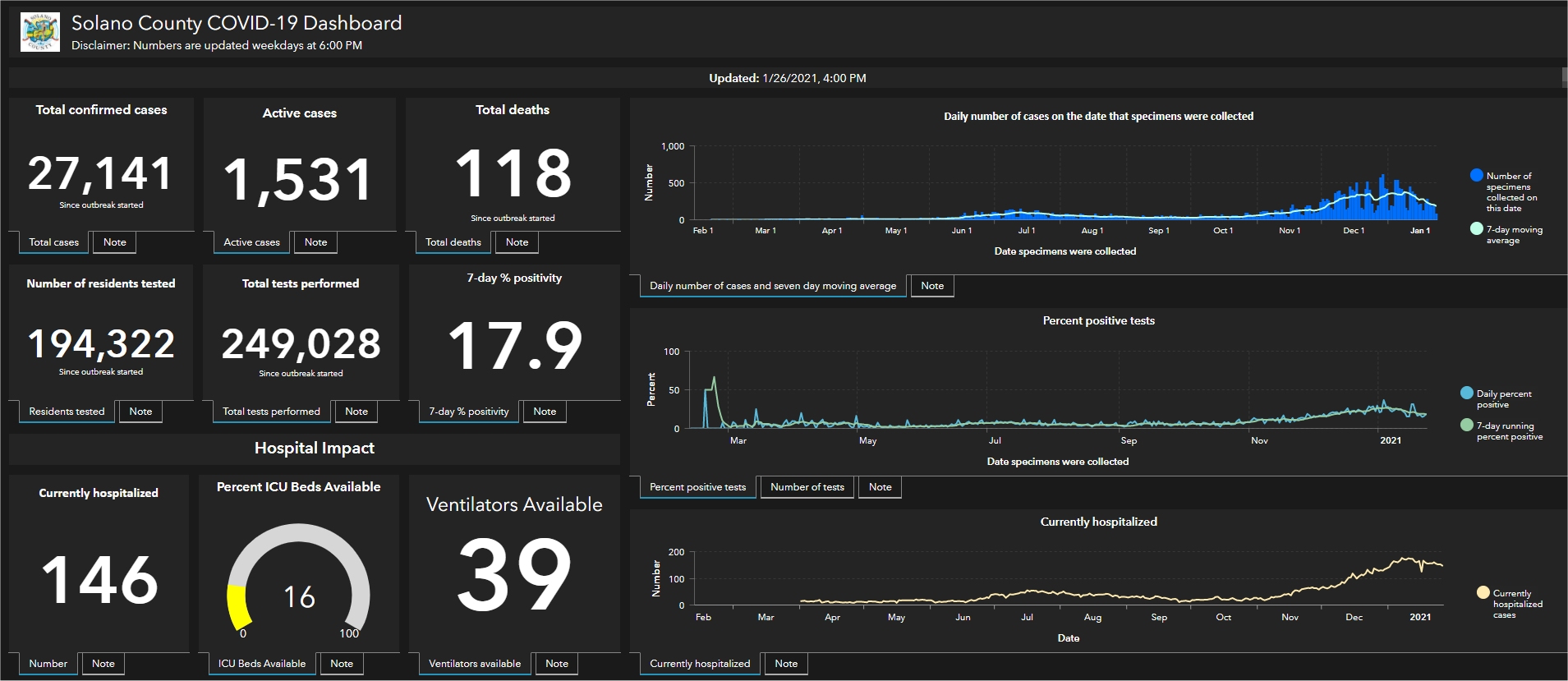
The data on this page is from today’s and the previous Solano County COVID-19 Dashboard.  The Dashboard is full of much more information and updated weekdays around 4 or 5pm.  On the County’s dashboard, you can hover a mouse or click on an item for more information.  Note the tabs at top for SummaryDemographics and Vaccines.  Click here to go to today’s Solano County Dashboard.[sta_anchor id=”sources” /]


Sources