Repost from the Chicago Tribune
Area poorly prepared for crude-oil train fires
Stocks of firefighting foam few and far between
By Richard Wronski, Tribune reporter | May 25, 2014
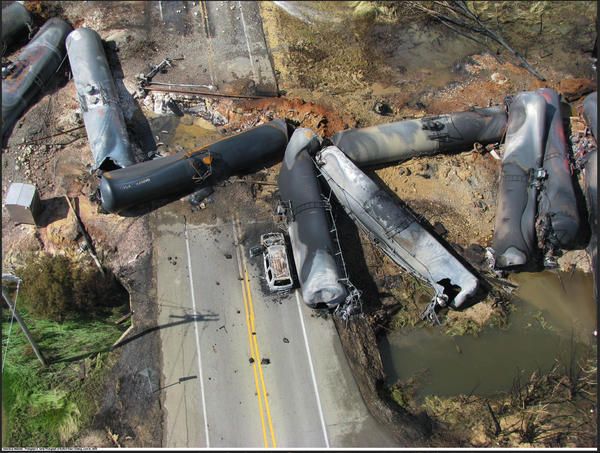 In 2009, a Canadian National freight train hauling 75 tank cars with ethanol derailed and erupted into a massive fireball in Cherry Valley, near Rockford. Although firefighters had about 400 gallons of foam on hand and more on the way, they concluded it wasn’t enough to put out the fire. (National Transportation Safety Board / June 19, 2009)
Few Chicago-area fire departments have enough firefighting foam and equipment to respond effectively to the roaring infernos seen near Rockford and elsewhere in recent years when multiple railroad tank cars carrying flammable liquids derail and explode, the Tribune has found.
So-called unit trains, rolling pipelines with more than a hundred tank cars hauling millions of gallons of crude oil, have become game changers for emergency responders, posing new threats and requiring updated safety strategies, experts say.
Such trains have become a common sight in the Chicago area, the nation’s busiest rail hub. Each day, one-fourth of U.S. freight traffic — nearly 500 freight trains and 37,500 rail cars — passes through the city and suburbs, experts say, although it’s unknown exactly how much of this traffic is crude oil.
Yet, the majority of communities lack the thousands of gallons of foam and equipment — like airport “crash trucks” — to respond immediately and effectively to smother flames fueled by one or more railroad tank cars, officials say.
Most fire departments stock only enough 5-gallon containers of foam to extinguish fires involving vehicles and tanker trucks. Larger incidents, involving train loads of flammable liquids, would overwhelm individual departments, officials say.
“We couldn’t carry enough 5-gallon drums and couldn’t switch them out fast enough to get that kind of foam on a tank car or any fire like that,” said Jim Arie, Barrington’s fire chief. “That requires very specialized equipment and personnel.
“It’s truly the worst-case scenario for a fire department, and it’s not the kind of thing you can staff for or have enough equipment for.”
These days, tank-car trains run frequently through scores of suburbs on the tracks that Canadian National Railway Co. acquired in 2009 from the Elgin, Joliet & Eastern Railway, Arie said.
“We may be two years, five years or 12 years before we have an incident. We can’t staff up for that every day, day in, day out, knowing that it may be way down the road before something happens,” Arie said.
In Aurora, which has nine fire engines and 195 firefighters, including a 27-member hazardous-materials team, a fiery derailment would result in a “major disaster,” said Chief John Lehman. Both the Canadian National and the BNSF Railway Co. run tank-car trains through Aurora.
“We could do all the training in the world and have all the equipment in the world, but if one of those (trains) comes off the rails and creates an issue in a very densely populated area, our exposure would be very significant,” Lehman said. “Our ability to deal with an incident of that magnitude would be very taxing.”
Nationwide, crude shipments have grown from 9,500 carloads in 2008 to more than 400,000 in 2013, according to the Association of American Railroads.
The industry stands by its performance, saying more than 99.9 percent of its shipments arrive safely, according to the railroad association.
To deal with any large-scale emergency, nearly all of the state’s 1,200 fire departments depend on each other for help as part of the Mutual Aid Box Alarm System, or MABAS. Besides responding to major events like fires and natural disasters, MABAS also has 42 specialized operations teams for hazardous materials.
MABAS mobilized crews and equipment from several departments June 19, 2009, when a Canadian National freight train hauling 75 tank cars with ethanol derailed and erupted into a massive fireball in Cherry Valley, near Rockford.
Although firefighters had about 400 gallons of foam on hand and more on the way, they concluded it wasn’t enough to put out the roaring fire, which eventually spread to 13 tank cars, said Steve Pearson, who was then chief of the North Park Fire Protection District in Machesney Park.
Unable to get close enough to attack the intense flames, which rose hundreds of feet high, firefighters could do little but let the blaze burn itself out and go into a “defensive position” a half-mile away, Pearson told the National Transportation Safety Board forum on railroad safety last month.
“Even if we had an endless amount of foam, it could not have been safely applied to this incident,” he said.
But firefighters stress the importance of responding to such incidents as swiftly as possible with ample foam before they get out of control.
Although some people were rescued, a 44-year-old woman in a car stopped at the train crossing was fatally burned and several others were injured. Her pregnant 19-year-old daughter lost her baby.
It wasn’t until 5 p.m. the next day, nearly nine hours after the derailment, that all fires were extinguished and residents could return to about 600 homes that were evacuated, Pearson said.
Increased risks
The roster of fiery derailments has steadily grown along with the flow of volatile crude oil from the booming Bakken fields of North Dakota, Montana and Canada.
Nine oil train derailments have occurred in the U.S. and Canada since March 2013, several resulting in intense fires and evacuations, according to the NTSB.
By far the worst occurred when a runaway oil train derailed and exploded July 3, 2013, in Lac-Megantic, Quebec. Sixty-three tank cars spilled more than 1.3 million gallons of oil. Forty-seven people were killed and 30 buildings destroyed, officials said.
Earlier this month, Canadian officials charged the railroad — which was then owned by Rosemont-based Rail World Inc. — and three of its employees with criminal negligence in connection with the incident.
Reacting to the spate of incidents, the NTSB convened a two-day forum last month in Washington to address the safety of shipping crude oil and ethanol by rail. More than 20 fire officials, federal administrators, railroad and tank car industry representatives, and other experts testified.
One focus was the crash-worthiness of the tank cars. The NTSB has warned for decades that older-model cars like those involved in the Cherry Valley incident, known as DOT-111s, are prone to rupture in a derailment.
The Canadian government has ordered a phaseout of the DOT-111s over the next three years unless they’re retrofitted with better protection in case of derailment. So far, the U.S. Department of Transportation has only recommended that shippers avoid using the DOT-111s “to the extent possible.”
The U.S. is being “extremely lethargic and to some extent irresponsible” in not dealing with the DOT-111s, said Aurora Mayor Tom Weisner, who, with Barrington Village President Karen Darch, is co-chairman of a coalition of communities pushing for more tank-car safety measures.
“The bureaucracy of it all is literally costing people’s lives, and the potential catastrophe before us, unless something is done, is scary,” Weisner said.
Officials at the NTSB forum called for greater community awareness, enhanced planning and preparedness, and improved training for emergency responders.
“While most fire-service personnel are generally familiar with flammable and combustible liquid emergencies, we know from recent catastrophic events that the amount of product being transported via unit trains exceeds our current response capabilities,” Richard Edinger, vice chairman of the International Association of Fire Chiefs, told the forum.
One strategy would be to establish stockpiles of foam at key locations along rail lines where crude oil and other hazardous materials are shipped. Currently, such supplies are few and far between and would probably arrive too late to quell an inferno, experts say.
Increasing supplies of foam would require fire departments, organizations like MABAS and the Illinois Emergency Management Agency to evaluate their current equipment supplies, officials say.
Although the state agency would coordinate the statewide response to a large-scale emergency, it maintains no inventory or list of foam stockpiles, a spokeswoman said.
The agency, however, is considering the possibility of contracting with foam manufacturers to provide the product on short notice, she said.
Combined with water, foam works by smothering combustible liquid fires, suppressing vapors and cooling the fuel and other surfaces. Applying water alone to a crude oil or ethanol fire will spread the flames.
Generally, only refineries, chemical plants and airports have extensive supplies of firefighting foam and special tanker trucks to spray it quickly, experts say.
The Chicago Fire Department has several crash trucks with foam on hand at O’Hare International and Midway airports. Whether the trucks have sufficient foam to respond to a fiery derailment and could be sent elsewhere in the city or suburbs is unclear.
Despite several requests from the Tribune, the city of Chicago and the Chicago Fire Department did not respond to questions about the city’s foam capability.
Canadian National doesn’t stock foam along its routes, but it is “aware of significant foam locations along (the) system which could be called upon during an incident,” a spokesman said.
As evidenced by Cherry Valley, however, it’s questionable whether those stocks could get to the scene of a crude oil disaster quickly enough.
‘Skin in the game’
One community with a significant store of foam is the village of Bedford Park. Close to Midway, the village is the site of several chemical plants, liquid bulk-storage terminals and a large railroad switching yard.
Chief Sean Maloy said his village is a MABAS division headquarters and is well-equipped and trained to deal with most hazmat situations. It has several hundred gallons of foam — much of it stored on a trailer — that could be offered to other communities in an emergency.
“We’ve got a lot of foam available to us. It’s a matter of getting it there quickly,” he said. “It comes down to how much foam you can bring at one time.”
Some experts and public officials have suggested that companies benefiting from the boom in crude oil such as oil producers, tank-car owners and railroads pay a per-gallon fee to help fund training and programs to prepare for emergencies.
Such a fee was proposed in January by Chicago Mayor Rahm Emanuel before a meeting of the U.S. Conference of Mayors in Washington.
On Tuesday, Minnesota Gov. Mark Dayton signed a law to collect $2.5 million annually from railroad and oil pipeline companies to help first responders get ready for derailments and spills involving oil and other hazardous substances.
Jay Reardon, the head of Illinois’ MABAS, said that the risk posed by crude oil shipments should prompt local municipal officials to re-evaluate the ability of their fire departments to provide adequate mutual aid responses.
If Illinois were to set such a fee, Reardon said, the money could fund groups like MABAS to stockpile foam and provide additional hazmat training.
“If there are companies who are making money on this, then don’t they have skin in the game?” Reardon asked. “Shouldn’t they be charged a minute portion, and that money go into a pool to fund risk mitigation?”



 Chris Philpot
 Tank cars carrying crude oil derailed in Lac-Mégantic, Quebec, in July 2013, killing 47 people. AP Photo/The Canadian Press, Paul Chiasson


You must be logged in to post a comment.