

All posts by Roger Straw

BENICIA – Solar Energy versus Open Space – pros and cons…
By Roger Straw, July 6, 2020
 BENICIA CA – The arguments for and against a proposed Lake Herman Road Solar Project are persuasive. The good and the bad have caused an unusual divide, if not an ugly one.
Actually, the debate has been civil and constructive.
It all comes to a head tomorrow. Benicia City Council will hear the case and take a vote at it’s virtual meeting Tuesday, July 7. Our Planning Commission denied the project in May, but that decision was appealed to the City Council by the project sponsor, Renewable Properties.
Here are two well reasoned opinions. You decide, and let the City Council know what you think.
Support, by Larnie Fox
 Proposed Lake Herman Road Solar Project
Council Members ~
I’m writing to ask you to vote to approve the proposed 35 acre solar array on Lake Herman Road.
As you all know, climate change is a serious and growing threat to all people, so we all have a responsibility to help counter it. When people say “think globally, act locally” this is exactly the sort of action they are talking about. While no one wants to lose open space, obtaining enough clean energy for 1,700 Benicia households is a big step in the right direction.
My wife and I walked to the area in question. It is not useful for recreation. The livestock currently grazing there will still have access to 54 acres of the 89 acre parcel after the solar panels are installed. We were glad to see that the plans call for planting native trees and plants that will mostly screen the site from view. They also call for creating a pollinator plant meadow which will increase local biodiversity. Personally, I like seeing solar panels because I know the good they are doing.
It would be preferable to install solar panels on homes and businesses, over parking lots and even over roads. However – we are clearly not there yet, and we need to take action now. Waiting a year or two is not acceptable.
There is a concern that approval of this project will create an open door for other, less desirable, development in our designated open space areas ~ so I hope Council will take care to ensure that no such loopholes are created as you approve this important project.
I’d like the City to take a more proactive and visionary leadership approach to opportunities like this. For example, could the City identify asphalt-covered terrain, roofs in the Industrial Park, or other possible mixed-use sites where responsible companies like Renewable Properties could install solar arrays? Could the City actively facilitate partnerships between solar or wind energy providers and local businesses to encourage clean energy development?
For now, I feel that the imperative to address the climate crisis and lower our carbon footprint needs to take precedence over protecting this small parcel of open space.
Let’s not make the perfect be the enemy of the good.
Larnie Fox
Benicia resident
Opposition, by Don Dean
 I see that the Lake Herman solar project is on the agenda for next week’s City Council meeting. I haven’t changed my stance on the project; I still think it’s a good project in the wrong location, and that the Planning Commission did the right thing in denying it. I’m all for solar power and fighting climate change, and so is everybody I know. But that doesn’t mean that every solar project is a good one. There are three issues here.
The first issue is designated Open Space and how we value it–or we don’t. Notice I capitalized Open Space. This is an official City designation. The solar project is proposed on City-designated Open Space land. So it’s not just undeveloped land waiting for an acceptable use to come along; in this case it’s specifically designated in Benicia’s General Plan to remain open for agricultural or recreational uses. The State of California considers Open Space important enough that it mandates an Open Space element be included in each city’s General Plan. With the pandemic we’re all involved in, open space has become more important than ever for our exercise, recreation, and sanity. With options for travel limited now, I find I drive Lake Herman Road more than ever and appreciate the vistas more than ever.
Second, this is about more than just one project on Lake Herman Road. The proposed zoning change necessary for the project would apply to about 159 parcels (2,000+acres) spread throughout Benicia. There has been no real analysis of how many other solar facilities could be constructed or where those might occur. The City has relied on a study by the applicant that asserts the number of solar-developable parcels would be very small. But that analysis doesn’t seem to have been independently verified. If the City is serious about solar development in Open Space areas, let’s have a community discussion about how and where solar is appropriate rather than make the decision based on approving one project.
Third, this is an industrial-scale solar project. It will blanket 35 acres with wall-to-wall panels. It belongs in an industrial area. The Benicia Climate Action Plan calls for solar development at large parking lot sites belonging to Amports, Valero, and the City. As far as I know, no one has approached Amports or Valero about adding solar arrays to their property. Not only would this generate power, but it would reduce the heat island effect from acres of asphalt. Shouldn’t we be looking for solar in these already developed areas rather than converting our Open Space to industrial uses and building outside the Urban Growth Boundary? Isn’t planning about being proactive for the future and protecting our existing resources?
I understand the urgency some people feel about getting a major solar facility to combat climate change, but this issue of solar development versus Open Space is a false choice. I don’t see why we need to sacrifice one to gain the other. Bottom line—I think this is a good project in the wrong place. I don’t think the project should be approved.
You already have my letter to the Planning Commission that lays out some of the more technical points of the discussion. Feel free to share this email.
Thanks,
Don Dean
Benicia resident
Vacaville opinion on local police reform – good questions for all Solano cities
[BenIndy editor: “Defunding” police can mean different things to different people. I don’t necessarily agree with Mr. Hunt’s opening statement here, but he goes on to raise important questions that should be addressed here in Benicia. – R.S.]
Solano Voices: Time to discuss police priorities

We cannot and should not defund police departments. Defunding the police department will have dangerous consequences and can harm communities.
But, we can and should have serious conversations about police reform, militarization and training of officers and the influence public safety unions have on local elections and city councils. We can and should have a discussion about the role of police in combating social issues.
First, we need to challenge the concept that “hiring more police will reduce crime.” Comprehensive crime reduction has three components: prevention, intervention and suppression.
Second, we can and should have a discussion on the influence of public safety unions on local councils. The public safety unions are very powerful locally and in Sacramento. They offer local candidates campaign support both financially and more importantly with “boots on the ground.” I ran two successful campaigns, one with their support and one without. The one with their support was more enjoyable.
Third, we can and should have a conversation on skyrocketing costs. Some city budgets contribute up to 80% of their total revenue to police and fire departments. The Sacramento police chief recently commented, “We are down 100 cops.“ The follow up question then becomes, “Why is your budget two times higher than it was five years ago?”
Pension benefits, retired health care and incentive pays are exceeding the revenue-generation capacities of local governments. We are paying more and getting less. This is not sustainable.
Increased pension, health care and salaries prevent cities from hiring more personnel. It is time to ask some serious questions. We need to have an open, respectful conversation.
Fourth, we should have a conversation about the local sales taxes. Promises made, promises broken. Measure M and Measure P pay salary and benefits for police and fire. When Measure M was passed, the first expense was to hire 11 more police officers at end of budget hearings. At this point cities really have no choice. Cites need to use the local sales tax revenue to fund the personnel. Vacaville will defer capital projects, but the results will be the same as these are all ongoing cost.
We can and should have a conversation about increasing the funding for the prevention and intervention aspect of public safety. We should consider a reduction of salary and benefits, and instead support prevention programs. We should consider supporting PAL, The Leaven, The Boys and Girls Club and other evidence-based after-school programs. We need to increase the Parks and Recreation budget to have affordable after-school programs for working parents. We should target gang prevention efforts, mentoring programs. We should look at job development job — training programs operated in challenging neighborhoods. Cities might explore incentives for local businesses to accept training positions.
I know the police officers are empathetic and compassionate in their effort to address homelessness. But they are not selected, trained or educated in that area. We should have a multidisciplinary team with only one officer and the remaining positions filled with social workers, VA specialists, mental health workers and housing specialists. We should explore the increased use of family support workers for domestic violence. We should use community service officers for more routine calls.
I know this is not an easy conversation. When you bring this up, you get, “You are either with us, or you are against us” as a response. Mere mention of any discussion would result in “Man, you don’t like cops.” That approach to the issue didn’t work. We need to heal and the only way to do that is start with an open and honest dialogue.
Don’t defund! Talk and make a plan for a more inclusive, comprehensive approach with prevention and intervention strategies.
Curtis Hunt worked for 15 years as a probation officer and provided counseling for delinquent offenders. He finished his career at Solano County managing a countywide prevention program. He severed six years on the Community Services Commission and 12 years on the Vacaville City Council.
Getting grandma out of the care facility… build her a backyard cottage?
Bay Area backyard cottages boom as elderly parents and college students flee coronavirus
San Francisco Chronicle, by J.K. Dineen, July 4, 2020
Bay Area companies that specialize in backyard cottages are seeing a surge in interest from homeowners who suddenly need to create additional living space for elderly parents or adult children displaced because of the coronavirus.
Some families are scrambling to move their parents out of assisted-living facilities, where the risks of contracting the coronavirus are high. Other erstwhile empty-nesters find themselves crowded as their young adult kids return from shuttered college campuses or look to escape small apartments in expensive cities like San Francisco or New York.
After California lawmakers embraced a series of statewide bills in 2017 to streamline building backyard cottages — also called accessory dwelling units or ADUs — the number of new units approved exploded to more than 7,000 in 2018, 50% higher than 2017. For many suburban residents, the backyard homes were seen as a more palatable answer to the housing crisis than large apartment buildings. But in a state that should build millions of homes to keep up with demand, critics said the cottages are a distraction from the need to build multiunit buildings at scale.
Abodu, a San Jose firm that makes ADUs, estimates that 10,000 will be permitted in California in 2020, based on a survey of city permits.
Adobu has seen orders for modular cottages more than double since the pandemic began, according to CEO John Geary. The units start at about $199,000, and with finishes, most come in at about $220,000.
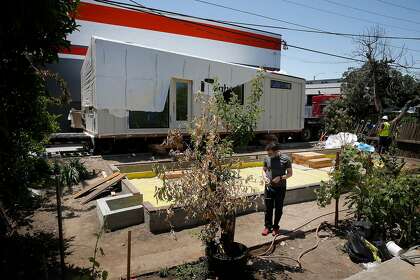
Another manufacturer, Sonderpods of Novato, had 3,000 visits to its website in the 90 days before the shelter-in-place order in March, but has seen that number jump to 25,000 over the last 90 days. Within a few weeks of the health order, the company had signed seven contracts to deliver backyard cottages and was negotiating an additional 92 deals. Sonderpods average about $139,000.
“We are sprinting to keep up with things,” said Edward Stevenson, CEO of Sonderpods.
Hank Hernandez, who owns Alameda Tiny Homes, said he has been flooded with inquiries.
“I get calls all day, every day,” he said. “The basic request is, ‘I want to put my parents in my backyard as quickly as possible.’”
Before coronavirus, Redwood City resident Jen Parsons was exploring options for her widowed mom, who was looking to downsize from her longtime home. She was exploring nearby retirement communities and possibly buying a bigger house that could accommodate three generations when the pandemic hit. Suddenly there was a pressing need. With two young kids, Parsons didn’t feel safe moving to an unfamiliar neighborhood in the middle of a pandemic and was not keen on moving her mom to a senior housing complex.
“You hear all these stories about retirement communities being on lockdown — you can’t even take your elderly parent to lunch or dinner, only to doctors appointments,” she said.
Instead, they decided to purchase an Abodu AD unit, which will arrive in August or September.
“Having an ADU unit back there for my mom will feel like a safe and peaceful environment at a time when there is a lot of stress because of COVID-19,” she said. “We can meet her in the patio and have snacks.”
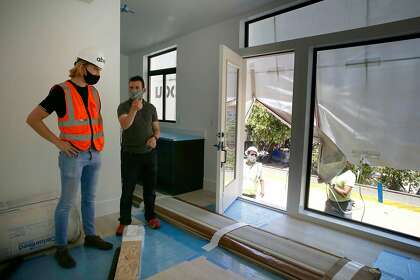
Faysal Abi, a retired police officer and yoga teacher in Redwood City, also ordered an Abodu. He said that the unit will provide housing for a friend who needs a place to live.
“A friend fell on hard times, and the Bay Area isn’t exactly cheap,” he said. “I feel like community is something we are lacking, especially since coronavirus. There is more isolation. One way to heal the world right now is through more community and knowing your neighbors and staying connected. I feel this will help accomplish that.”
Abi also persuaded his mother, Rabina Abi-Chahine, a 62-year-old social worker, to buy her own backyard cottage for her home in Millbrae. Abi-Chahine said she was motivated both by a desire to create some income as she approaches retirement and having a spot for her own father some day.
Geary said another client, a Palo Alto woman, had two children away at college suddenly return, joining two other teenagers at home, which immediately made the house feel crowded.
Stevenson, the CEO of Sonderpods, said that 70% of customers are older than 55 and 70% are women building units on their kids’ properties.
“A lot of it is Baby Boomers selling the family home and moving in into their kids’ backyards. People are re-evaluating what is important and trying to bring the family closer together,” he said. “We are not seeing a lot of people who are straight-up looking to make income.”
Thanks to a series of state and local bills, ADUs can be built relatively quickly with limited bureaucratic hassle in some cities. San Jose, which has been aggressive in encouraging the tiny homes, has seen permitted ADUs jump to 691 last year from 24 in 2014. So far this year, 321 applications have been filed.
The Abodu was the first ADU manufacturer preapproved by the city of San Jose — which cut multiple inspections and red tape. From the day the permit is pulled, Abodu can have the unit installed within 12 weeks.
Hernandez of Alameda Tiny Homes said that while his business has been steady for the past few years, clients’ motivation has changed. It used to be that most homeowners were looking for extra income. Now it’s to meet family needs.
You must be logged in to post a comment.