
All posts by Roger Straw

Editor, owner, publisher of The Benicia Independent

U.S. petroleum product exports set record high in 2018

Annual average now at 5.6 million barrels per day (b/d), an increase of 366,000 b/d from 2017 levels

Principle contributor Matt French, Today In Energy (US Energy Information Administration), April 23, 2019
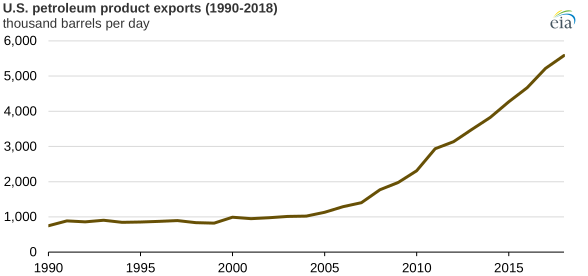
U.S. petroleum product exports
Source: U.S. Energy Information Administration, Petroleum Supply Monthly

U.S. exports of total petroleum products set a record high in 2018, reaching an annual average of 5.6 million barrels per day (b/d), an increase of 366,000 b/d from 2017 levels. The three largest petroleum product exports from the United States in 2018 were distillate, propane, and motor gasoline. U.S. exports of motor gasoline (including blending components) and propane reached record highs in 2018, and exports of distillate reached their second-highest volume on record, following the high set in 2017.

Total U.S. petroleum product exports set a record high in 2018 for the 16th consecutive year. From 2009 to 2013, distillate exports contributed the most to annual growth. However, from 2014 to 2018, exports of hydrocarbon gas liquids, which include propane, drove U.S. petroleum product export growth.

As U.S. crude oil production increased over the past decade, gross inputs into refineries also increased. Petroleum products can be used domestically, exported, or put into inventory. In 2018, record-high levels of U.S. crude oil production and refinery runs helped refiners export large volumes of petroleum products, even with high levels of domestic demand.
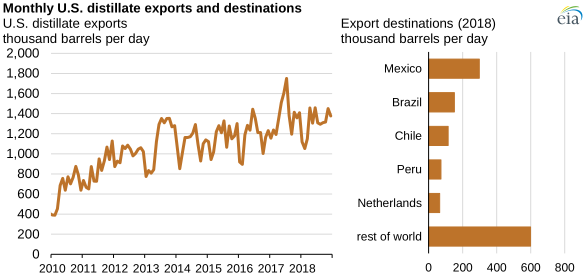
monthly U.S. distillate exports and destinations
Source: U.S. Energy Information Administration, Petroleum Supply Monthly

Despite an 80,000 b/d decrease in exports in 2018 from 2017, distillate remained the most exported petroleum product in 2018, averaging 1.3 million b/d, or approximately 25% of U.S. refinery net production. Distillate exports were still more than 100,000 b/d higher than the previous five-year average (2013–2017). The United States exported distillate to 64 destinations in 2018, with the largest volumes destined for Mexico.

Mexico received an average of 298,000 b/d, or 23% of U.S. distillate exports, increasing 42,000 b/d from 2017. Mexico’s increasing exports were likely driven by the country’s refineries that continued to operate below capacity in 2018, as reported by trade press. Brazil received the second-largest share of distillate exported from the United States, averaging 151,000 b/d (12% of U.S. distillate exports), down by 57,000 b/d from 2017. Chile, Peru, and the Netherlands comprise the remainder of the top five recipients of U.S. distillate exports.
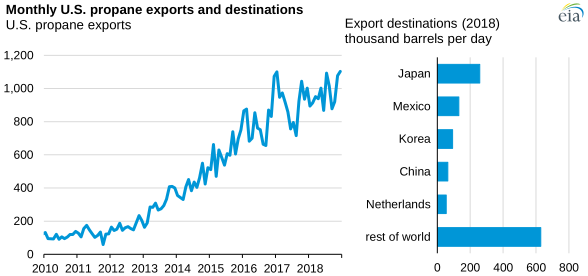
monthly U.S. propane exports and destinations
Source: U.S. Energy Information Administration, Petroleum Supply Monthly

U.S. propane exports reached a record high of 972,000 b/d in 2018, surpassing the previous record of 914,000 b/d set in 2017. Propane exports in 2018 were greater than motor gasoline exports for the third consecutive year, and propane remained the second-largest U.S. petroleum product export. Unlike other U.S. petroleum product exports, which tend to stay in the Western Hemisphere, significant volumes of U.S. propane often reach Asian markets. Three of the top five destinations are in Asia. Propane is used in many Asian countries as a feedstock for producing ethylene and propylene, which are building blocks for chemical and plastic manufacturing.

Japan received the largest share of U.S. propane exports, more than 258,000 b/d (or 7%) of total U.S. propane exports, an increase of 48,000 b/d from 2017 volumes. Exports to Korea and the Netherlands increased by 25,000 b/d and 21,000 b/d, respectively. However, exports to China fell by 62,000 b/d, a 49% year-over-year decline. Mexico received the second-largest share of U.S. propane exports in 2018 at an average of 131,000 b/d, which was down 7,000 b/d from 2017 levels.
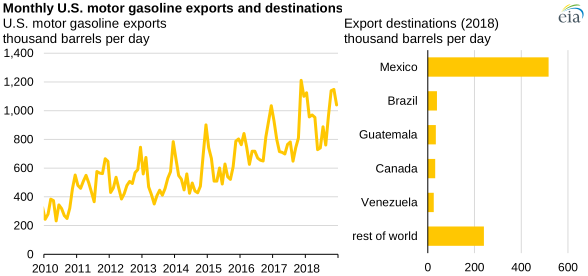
monthly U.S. motor gas exports and destinations
Source: U.S. Energy Information Administration, Petroleum Supply Monthly

U.S. exports of motor gasoline (including blending components) reached 44 destinations in 2018 and set a record high of 951,000 b/d, up 126,000 b/d from 2017 levels. This increase in exports came despite high levels of domestic gasoline consumption, averaging 9.3 million b/d in 2018, only slightly lower than the record-high level set in 2017.

U.S. refiner and blender net production of finished motor gasoline increased more than 100,000 b/d to 10.1 million b/d in 2018, a record high, and helped contribute to the simultaneous high levels of domestic consumption and export volumes. The five largest shares of U.S. gasoline exports were all in the Americas. In 2018, Mexico received 529,000 b/d of U.S. gasoline exports, or 56% of total U.S. gasoline exports, which was 60,000 b/d more than in 2017. Exports to Canada increased by 25,000 b/d, to average 62,000 b/d, or 6% of U.S. gasoline exports in 2018.

Principal contributor: Matt French

Emissions at four Alberta tar sands mines 64% higher than previously reported

Oilsands CO2 emissions may be far higher than companies report, scientists say

By Mitchell Beer, The Energy Mix, April 23, 2019 | Full Story: Canadian Broadcasting Corporation @CBCNews

Carbon pollution from four major tar sands/oil sands mines in northern Alberta is 64% higher than their owners reported using the United Nations’ standard emissions measurement framework, according to a study released this morning in the journal Nature Communications.

“The researchers, mainly from Environment Canada, calculated emissions rates for four major oilsands surface mining operations using air samples collected in 2013 on 17 airplane flights over the area,” CBC reports. The study found gaps from 13 to 123% between reported and actual emissions at the four facilities, a finding that “could have profound consequences for government climate change strategies”.

As for the fossils that submitted the data, “they’re just doing exactly what they’ve been told to do,” said John Liggio, an aerosol chemist at Environment and Climate Change Canada. “They’re not doing anything on purpose.”

But that doesn’t make the research finding any less significant. Accurate numbers on carbon pollution “inform national and international climate policies,” the study states. “Such anthropogenic GHG emission data ultimately underpin carbon pricing and trading policies.”

“The bottom line is we still have more work to do in terms of really determining how much is being emitted,” Liggio told CBC.

The findings of this one study place Canada’s total greenhouse gas emissions about 2.3 higher than they were previously believed to be, CBC notes. “If research eventually shows that other oilsands sites are subject to similar underreporting issues, Canada’s overall greenhouse gas emissions could be as much as 6% more than thought—throwing a wrench into the calculations that underpin government emissions strategies.”

On CBC, Liggio explained the standard, “bottom-up” method by which fossils are required to report their production emissions is fraught with uncertainty, factoring in everything from the carbon intensity of the fuels they use to whether plant maintenance activities may have driven a temporary spike in emissions.

With their flyovers, Liggio and his colleagues took “a ‘top-down’ approach involving hundreds of air samples taken during more than 80 hours of flights over four major surface mining operations in northern Alberta: Syncrude Canada’s Mildred Lake facility, Suncor’s Millennium and North Steepbank site, Canadian Natural Resources Ltd.’s Horizon mine, and what was then Shell’s Albian Jackpine operation, now majority owned by Canadian Natural,” CBC explains.

“Left out of the study, notably, are emissions from all oilsands operations that use in-situ extraction, pumping steam into the ground to get the petroleum out. About 80% of oilsands reserves, and the majority of current production, require in-situ extraction,” which means “the overall amount of underreported greenhouse gas emissions could be significantly higher.”

Portland Police Arrest Protesters Blocking Oil Train Tracks With a Garden

The arrests came on Earth Day

By Allison Place, Willamette Week, April 22 at 5:19 PM
Portland police arrest an environmental protester at Zenith Energy on 4/22/19. (Allison Place)

Portland Police officers arrested 11 protesters this afternoon who were sitting on railroad tracks to protest Zenith Energy’s rapidly expanding import of Alberta tar sands oil.

Two dozen officers arrived around 3:30 pm today—Earth Day—to remove protesters from the train tracks at Zenith’s facility in Industrial Northwest Portland.

Before that, protestors spent much of the day sitting on the railroad tracks, chatting and munching on Ritz crackers. Yesterday, they had dumped a load of topsoil and planted a garden over the tracks.

“This is our second day. We came here to launch Extinction Rebellion, which is part of an international movement,” said protestor Ken Ward, who became famous in 2016 for turning off a valve to shut off the crude-oil pipeline that runs from the Alberta tar sands to Washington State for refining.

“[Zenith] is a poster child for government being unable to take effective steps on climate,” Ward added. “We have a company trying to triple the [amount] of Canadian tar sands oil sent through Portland when Portland doesn’t want to be expanding it’s fossil fuel infrastructure—and yet nobody seems to be able to do anything about it.”

City Council voted in 2015 to block further expansion of fossil fuels in Portland. Zenith’s oil shipments have grown rapidly since then, calling into question what the city will do about the energy plant.

Ward has been arrested 3 times previously for his activism, and he was among those arrested today.

Leah Francis, an organizer with Extinction Rebellion PDX, said she’d only slept two hours over the last two days while protesting Zenith.

“We need to move on to tactics that actually demand something of power,” said Francis. “If you’re an environmentalist in Mexico, you can end up with your head cut off in a ditch. Getting arrested in Multnomah County where we’ll be released without bail with a minor misdemeanor charge seems like a non-issue to me.”

Protestors sang “Let it Be” by John Lennon while awaiting arrest.

Vallejo council tentatively set to resume Orcem/VMT hearing in May

Public Hearing on May 30 – unclear whether staff report will recommend denial of appeal

By JOHN GLIDDEN, Vallejo Times Herald, April 22, 2019 at 6:13 pm

The site of the Vallejo Marine Terminal/Orcem Americas project proposed for South Vallejo is shown. (Times-Herald file photo)

Almost two years after the Vallejo City Council directed staff to complete an environmental report for the proposed Orcem/VMT project, councilors are tentatively scheduled to meet on May 30 and make an official decision on the project, City Hall confirmed on Monday.

Vallejo spokeswoman Lyan Pernala said the public hearing will be a continuation of the council meeting from June 1, 2017 in which a heavily divided city council directed staff to bring back a Final Environmental Impact Report (FEIR) for the Vallejo Marine Terminal (VMT) and Orcem Americas project.

Councilmembers Pippin Dew-Costa, Hermie Sunga, Rozzana Verder-Aliga, and former Vallejo Councilman Jess Malgapo all said in 2017 that they wished to see the final report to help them decide on the appeal filed by VMT and Orcem.

Just recently, City Hall released a new draft FEIR, although staff said the document is not ready to be presented to the council for certification and possible project approval under the California Environmental Quality Act (CEQA). Staff cite the lack of necessary information and cooperation from the VMT applicants for the draft status of the report.

Prior to the 2017 hearings, staff and the applicants went back and forth regarding the need for a FEIR. Orcem and VMT argued certification would allow councilors to have full information about the project before deciding the project’s fate. Meanwhile, City Hall at the time argued such a certification is not needed if a recommendation to reject the project is being offered by staff.

Staff originally said the project will have a negative effect on the neighborhood, impact traffic around the area and is inconsistent with the city’s waterfront development policy. The project also has a degrading visual appearance of the waterfront.

Pernala didn’t confirm if City Hall will once again recommend a denial of the appeal for the May hearing.

“Staff is preparing a staff report to the City Council with their recommendation and that will be available prior to the meeting date,” she wrote in an email to the Times-Herald on Monday.

The companies submitted the appeal after Vallejo’s Planning Commission rejected the project in March 2017 by a 6-1 vote.

Pernala also said the May 30 hearing will include a public comment period. She further said the hearing might not meet in the council chambers.

“We anticipate that there are a lot of people interested in this meeting and are looking at the best venue to have as many people be able to attend,” she wrote.