San Francisco Chronicle, by Alejandro Serrano , Anna Bauman , Rita Beamish and Brett Simpson, updated June 18, 2020
7:58 p.m. June 17, 2020 – Solano County case spike reflects ‘preliminarily positive’ data, official says: Solano County reporting 105 new confirmed coronavirus cases Wednesday reflects a change in data reporting and a local outbreak among vineyard workers, county public health administrator Jayleen Richards wrote in an email. The new cases marked a 15.2% increase in Solano County’s total. Richards wrote the county has experienced “significant” delays in confirming results from two state-run test sites and has begun considering preliminary positive tests as positive cases in order to begin case investigations. “The data jump should be a one-time event since we started to include the preliminary data today,” Richards wrote. Wednesday’s case total also includes an outbreak among vineyard workers housed in Solano County and working in other counties who were recently tested for the virus, Richards wrote.
12:12 p.m. June 18, 2020 – Californians must wear masks outside home under new state order: People must immediately begin wearing masks outside the home when they cannot safely distance from other people to help prevent the spread of the coronavirus, state health officials ordered Thursday, a day after reporting the largest number of new cases in a single day. The Chronicle’s Alexei Koseff reports.
June 18, 2020 1:35 p.m. – Kids and teenagers appear to be less likely to get the coronavirus and get sick than adults: A study recently published in Nature found that those under 20 are half as susceptible to infection as those that age or older, and only one in five between the ages of 10 and 19 show symptoms. The Centers for Disease Control and Prevention puts the figure of coronavirus-infected kids younger than 18 at more than 90,000, or around 4% of those with the disease. [BenIndy Editor:Compare at 6.6% in Solano County as of June 17.] See our detailed FAQ on the coronavirus and children for more.
Californians must now wear face coverings in public spaces, no matter the county you live in.
Gov. Gavin Newsom now says face coverings are mandatory in the state of California.Patch, by Renee Schiavone, June 18, 2020
CALIFORNIA — The debate at the county level about whether face coverings should be mandatory or not appears to be over for now, as California officials announced Thursday that the masks are now required in all public places. The requirement is effective immediately.
Click to view the 18 June 2020 CA Guidance order requiring Face Coverings
“Californians are now required to wear face coverings in public spaces – particularly indoors or when physical distancing is not possible,” the governor’s office said in a tweet.
The state’s health and human services agency said cloth face coverings “help reduce the spread of coronavirus especially when combined with physical distancing and frequent hand washing.”
There are some exemptions, including for those under 2 years old, those who need to communicate via sign language and those seated at a restaurant.
The state’s 58 counties had previously been allowed to make the decision on face covering requirements locally. Orange County had been in the headlines most recently, downgrading their requirement to a “recommendation.” Other counties in the Bay Area have had a face covering mandate in place for months.
The state’s 58 counties had previously been allowed to make the decision on face covering requirements locally. Orange County had been in the headlines most recently, downgrading their requirement to a “recommendation.” Other counties in the Bay Area have had a face covering mandate in place for months. [Editor: CORRECTION – Solano County is the one Bay Area County that does NOT have a mandatory face covering order. – R.S.]
NEW: Californians are now required to wear face coverings in public spaces – particularly indoors or when physical distancing is not possible. ????
— Office of the Governor of California (@CAgovernor) June 18, 2020
The state listed certain “high risk” situations where the coverings are mandatory:
Inside of, or in line to enter, any indoor public space;
Obtaining services from the healthcare sector in settings including, but not limited to, a hospital, pharmacy, medical clinic, laboratory, physician or dental office, veterinary clinic, or blood bank;
Waiting for or riding on public transportation or paratransit or while in a taxi, private car service, or ride-sharing vehicle;
Engaged in work, whether at the workplace or performing work off-site, when:
Interacting in-person with any member of the public;
Working in any space visited by members of the public, regardless of whether anyone from the public is present at the time;
Working in any space where food is prepared or packaged for sale or distribution to others;
Working in or walking through common areas, such as hallways, stairways, elevators, and parking facilities;
In any room or enclosed area where other people (except for members of the person’s own household or residence) are present when unable to physically distance.
Driving or operating any public transportation or paratransit vehicle, taxi, or private car service or ride-sharing vehicle when passengers are present. When no passengers are present, face coverings are strongly recommended.
While outdoors in public spaces when maintaining a physical distance of six feet from persons who are not members of the same household or residence is not feasible.
The following individuals are exempt from wearing a face covering, according to the state:
Children aged two and under;
Persons with a medical, mental health, or developmental disability that prevents wearing a face covering;
Persons who are hearing impaired, or communicating with a person who is hearing impaired, where the ability to see the mouth is essential for communication;
Persons for whom wearing a face covering would create a risk to the person related to their work, as determined by local, state, or federal regulators or workplace safety guidelines.
Persons who are obtaining a service involving the nose or face for which temporary removal of the face covering is necessary to perform the service;
Persons who are seated at a restaurant or other establishment that offers food or beverage service, while they are eating or drinking, provided that they are able to maintain a distance of at least six feet away from persons who are not members of the same household or residence;
Persons who are engaged in outdoor work or recreation such as swimming, walking, hiking, bicycling, or running, when alone or with household members, and when they are able to maintain a distance of at least six feet from others;
Persons who are incarcerated. Prisons and jails, as part of their mitigation plans, will have specific guidance on the wearing of face coverings of masks for both inmates and staff.
While much of the nine-county Bay Area has seen fairly steady and minimal growth in the cumulative number of confirmed cases of COVID-19, Solano County just recorded its single biggest one-day jump in cases.
Solano County Health Officer Dr. Bela MatyasSFiST, by Jay Barmann, June 18, 2020
On Wednesday, Solano County added 105 new cases to its tally, a rise of 15 percent for a cumulative total of 792. The county’s Daily Republic newspaper spoke to Health Officer Dr. Bela Matyas explains that the jump reflects a backlog of suspected cases under investigation which he decided to add to the total yesterday. And he suggests that while there is “no evidence” to suggest that the reopening of restaurants and other businesses is to blame for the uptick, he betrays a bit of trepidation about how the public is handling the reopening in the county.
“When I drive around town, I get the sense that it is pre-COVID,” he tells the paper, noting that he sees a lot of social gatherings happening without precautions.
Matyas blames those gatherings along with recent protest marches and a group of cases that originated in vineyards across the county line in Napa for the uptick in confirmed cases.
46 of the new cases were found in Fairfield — where, according to Matyas, many of the infected vineyard workers live — and 34 cases were found in Vallejo, where a week of sometimes violent protests rocked the city two weeks ago. Overall, Vallejo has been home to nearly half of all the county’s confirmed cases to date — 371 in total.
Matyas was one of the early naysayers about region-wide lockdowns that occurred in March, and was notably the last of the nine Bay Area health officers to institute strict shelter-in-place orders. When he did, he called it a “stay-at-home” order, and he still expressed skepticism that workplaces with cubicles were at all dangerous for the spread of the coronavirus.
Here he is on March 17:
Solano County opened its restaurants for indoor dining back on May 21, two months ahead of the current date set for indoor dining in San Francisco, which is July 13.
The total number of hospitalizations from COVID-19 in Solano County has remained low — it went down to 10 last week from 14, and has remained there since — with 97 people hospitalized since the pandemic began. The county has also seen one of the lowest number of deaths in the Bay Area, with 23, though Napa and Sonoma Counties are tied for the lowest, with four apiece.
San Francisco Chronicle, by Joe Garofoli, June 18, 2020
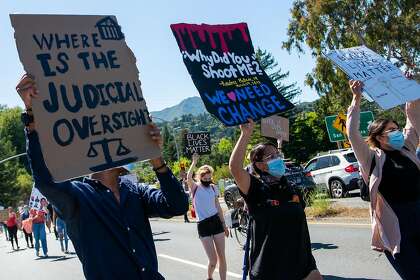
Demonstrators take a knee in an intersection, blocking traffic, and have a moment of silence for 8 minutes and 46 seconds during a protest organized by a group of young people to support Black Lives Matter on June 16, 2020 in Mill Valley, Calif. Photo: Kate Munsch / Special to The Chronicle
While three of California’s biggest local police unions are taking out full-page newspaper ads promising to back reforms, other law enforcement organizations have pumped more than $2 million into a November ballot measure that would partially overturn laws that some call models for reforming the criminal justice system.
Police unions have contributed more than half the nearly $4 million raised for the Reducing Crime and Keeping California Safe Act campaign. The ballot initiative would roll back provisions in three measures that were aimed at reducing the state’s prison population, including Proposition 47, a voter-approved 2014 initiative that reclassified several felony crimes as misdemeanors.
The measure would change Prop. 47 by allowing prosecutors to charge a defendant with a felony for a third offense of stealing something worth more than $250. Prop. 47 raised the felony threshold for theft to $950 from $450.
“It is a measured approach to correct the problems we had with Prop. 47,” said Brian Marvel, president of the Peace Officers Research Association of California, the state’s largest law enforcement labor organization, representing more than 77,000 public safety workers.
The ballot measure would also change parts of AB109, a 2011 law that transferred the responsibility for many nonviolent felons from state prisons to county jails. It would require the Board of Parole Hearings to consider an inmate’s whole criminal history when deciding on parole, not just the person’s most recent crime.
The initiative would also alter Proposition 57, a 2016 ballot measure that made it easier for nonviolent felons to win parole. It would expand the list of crimes that would not be eligible for early parole to include felony domestic violence and other violations.
“There were some good pieces in Prop. 47 and 57, but it was overly broad,” Marvel said.
Prop. 47 and the other two measures were part of the response to a 2011 federal court order that California cut the number of inmates in its overcrowded prisons by 34,000 within two years.
In this photo taken Friday, Feb. 13, 2015, Assemblyman Adam Gray, D-Merced talks with Assemblywoman Melissa Melendez, R-Lake Elsinore, at the Capitol in Sacramento, Calif. Four months after California voters approved Proposition 47, which reduced penalties for certain crimes, state lawmakers and law enforcement officials are lining up to repeal portions they say went too far. Gray and Melendez have introduced legislation that would restore the felony charge for stealing guns, if the measure is approved by the Legislature and by voters next year. (AP Photo/Rich Pedroncelli)
Prop. 47 has also helped to steer money away from incarceration. The law required that the state spend the money it saved by not imprisoning more nonviolent felons on social and educational programs — an example of “defund the police” initiatives that many reformers are calling for now. This year, the state will redirect nearly $103 million in this way, according to the California Department of Finance.
Reform advocates say the November ballot measure would be difficult to square economically with a state budget that has plunged into the red with the coronavirus pandemic. A report to be released Thursday by the Center on Juvenile and Criminal Justice, a nonpartisan organization in San Francisco that works to reduce reliance on incarceration, found that the changes proposed by the ballot measure could cost California “hundreds of millions of dollars in new annual costs” to take care of more people in prison and monitor more felons on probation.
In San Francisco, the measure could mean up to $7.5 million in additional annual costs, and Alameda County’s total could rise by $26 million, the study found.
“It’s a prison spending scam at a time when we are actively closing prisons and reallocating funds toward what’s needed in communities,” said Dan Newman, a political strategist who is working on the opposition campaign. “They’re doubling down on solidifying their places on the wrong side of history at a critical moment.”
Demonstrators march onto a Hwy 101 overpass during a protest organized by a group of young people to support Black Lives Matter on June 16, 2020 in Mill Valley, Calif. Photo: Kate Munsch / Special to The Chronicle
The ballot measure’s supporters started the initiative campaign long before the Minneapolis police killing of George Floyd touched off anti-brutality protests across the country, and they’re not changing their approach now.
“Why should we? We just want reform, too” said Kelli Reid, a consultant to the campaign.
The campaign’s website says the past decade’s changes have led to “an explosion of serial theft and an inability of law enforcement to prosecute these crimes effectively.” The initiative’s proponents say they want to change parole rules because “parolees who repeatedly violate the terms of their parole currently face few consequences, allowing them to remain on the street.”
“If I stab you or beat you with a baseball bat, those are considered nonviolent crimes under the penal code (now),” said Assemblyman Jim Cooper, D-Elk Grove (Sacramento County), a former Sacramento County sheriff’s captain who supports the measure. “These are not crazy things we’re proposing.”
A 2018 study by the Public Policy Institute of California, however, found “no evidence that violent crime increased as a result of Proposition 47.” The report did find that “it may have contributed to a rise in larceny thefts, which increased by roughly 9 percent” from 2014 to 2016.
Some leading Prop. 47 advocates see a contrast between the ballot measure and promises by local police unions to back changes in law enforcement.



You must be logged in to post a comment.