US crude has negative value for first time in history as stockpiles overwhelm storage facilities
The Guardian, by Jillian Ambrose and Martin Farrer, April 20, 2020
A record 160m barrels of oil are currently being stored in oil tankers outside the world’s shipping ports. Photograph: US Department of Energy/EPA
US oil prices turned negative for the first time on record on Monday as North America’s oil producers run out of space to store an unprecedented oversupply of crude left by the coronavirus crisis.
The price of US crude oil collapsed from $18 a barrel to -$38 in a matter of hours, forcing oil producers to pay buyers to take the glut of crude which they cannot store, as rising stockpiles of crude threaten to overwhelm oil storage facilities.
“The problem of the global supply-demand imbalance has started to really manifest itself in prices,” said Bjornar Tonhaugen, head of oil at research firm Rystad Energy. “As production continues relatively unscathed, storages are filling up by the day. The world is using less and less oil and producers now feel how this translates.”
The Guardian reported over the weekend that a record 160m barrels of oil was being stored in “supergiant” oil tankers outside the world’s largest shipping ports, including the US Gulf, following the deepest fall in oil demand in 25 years because of the coronavirus pandemic.
The last time floating storage reached levels close to this was in the depths of the financial crisis in 2009, when traders stored more than 100m barrels at sea before offloading stocks when the economy began to recover.
The price collapse in US oil market – known in the industry as the West Texas Intermediate price – accelerated because it is the last day oil producers can trade barrels that are scheduled for delivery next month, when oil storage is expected to reach capacity.
The US price for oil delivered in June, which will become the default oil price from tomorrow, is also falling due to the economic gloom caused by the coronavirus, but has managed to remain above $20 a barrel. On Monday the price for brent crude, the most widely used benchmark, fell 8% to $25.79.
Global oil prices are expected to begin recovering over the second half of the year as tight restrictions on travel to help curb the spread of the virus are lifted, raising demand for fuels and oil.
Cailin Birch, global economist at the Economist Intelligence Unit, said: “US crude oil production has begun to fall in the last two weeks, and will continue to fall in the coming months as already heavily indebted shale firms scale back activity or are forced into bankruptcy or consolidation.”
Despite the historic production cuts, most analysts believe that oil prices will fail to reach the same price levels recorded at the beginning of the year before the outbreak. The global oil price, under the brent crude measure, reached highs of almost $69 a barrel in January before plummeting to less than $23 a barrel at the end of March.
Last week’s EPA decision adds insult to injury for our already vulnerable communities.
Perhaps you missed it. There’s a lot going on right now. But amidst all the COVID-19 headlines last week, the EPA decided that it is not “appropriate and necessary” for the government to limit emissions of mercury and other hazardous air pollutants from power plants.
Source: Pixabay
This is not a roll-back of a regulation. It’s more nuanced than that. It’s a high-stakes procedural move with two important implications:
First, it scraps the legal basis for the Mercury and Air Toxics Standards (MATS) which limit hazardous air pollution from coal and oil-fired power plants. Having knocked the legal foundations out from under this important regulation, I think there’s a real risk that power plants will find ways to dial back on compliance in the future.
Second, it sets a dangerous precedent for how the benefits and costs of federal environmental regulations are assessed. The ruling removes significant health benefits from cost-benefit consideration on the grounds that they are not directly targeted by MATS.
This announcement comes at a time when the country is reeling from the global coronavirus pandemic. Protecting public health is top of mind. We’ve all become keenly aware of how actions we take can indirectly protect the health of the most vulnerable among us. With these benefits in mind, we are taking action.
Meanwhile, the EPA has decided that the indirect health benefits of pollution reductions should not be considered in regulatory cost-benefit analysis. This decision departs recklessly from standard practices for responsible public decision-making.
Some colleagues and I recently published this paper (based on our longer report) which points out deep flaws in this EPA decision. The agency’s own Science Advisory Board released a reportcalling for a “do-over”. Hundreds of thousands of public comments raise concerns. Even the electricity sector stands in opposition. The Trump EPA response: To hell with it. We are pushing ahead.
To understand what this means, we need to remember how we got here.
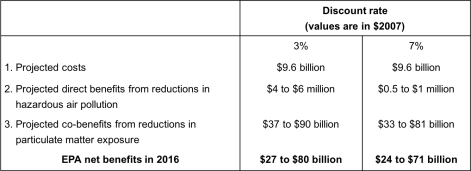
The Mercury and Air Toxics Standards limits the emissions of mercury and other hazardous air pollutants (HAPs) from power plants. To justify the rule, the EPA must demonstrate that it is appropriate and necessary. Back in 2011, the EPA supported this argument with a detailed analysis that projected big public health benefits from the power plant emissions reductions expected under the regulation. The table below, taken from the 2011 analysis, shows monetized benefits far exceeding the costs.
Summary of the quantified benefits and costs in the 2011 RIA for the MATS rule. These are projected for the year 2016. The data reported in this table are from Table ES-1 of EPA (2011).
There were some serious bumps on the road to implementation. But power plants began complying in 2016. The industry has since invested billions to install pollution abatement equipment in order to meet MATS requirements.
Last year, the Trump EPA started working to reverse the appropriate and necessary finding. The agency issued this six-page memo that re-interprets the 2011 cost-benefit analysis. There’s no new information here. The big change is that the “co-benefits” – health benefits that result indirectly from MATS compliance—have been wiped off the cost-benefit board. If we ignore these benefits (row 3 in the table above), MATS appears to fail the cost-benefit test.
There are many reasons to be concerned about this maneuver. Let me unpack three:
Co-benefits are real benefits
When power plants reduce mercury emissions, they also reduce emissions of precursors to harmful particulate matter (PM). Reducing exposure to small particulates saves lives. These benefits are referred to as “co-benefits” because they are caused by – but not directly targeted by – the regulation.
If a policy will generate big health benefits, directly or indirectly, these should be counted. Federal agencies are under Executive Order to weigh the available evidence on all significant costs and benefits in their regulatory assessments. This is also required under the EPA’s own guidelines for economic analysis.
An official decision that eliminates or reduces consideration of co-benefits sets a troubling precedent for future regulatory decisions. If this approach becomes standard, it becomes much more difficult for the EPA to justify socially beneficial regulations. Greenhouse gas emissions regulations- which can deliver significant reductions in local air pollution- are one important example.
Direct benefits estimates are outdated and incomplete
The 2011 direct benefit projections that serve as a basis for last week’s decision reflect only one health benefit from reducing mercury emissions: improvements in the IQs of children whose families catch and eat freshwater fish. This narrow focus explains why those 2011 direct benefits estimates are so small.
A decade later, we know a lot more about how power-plant mercury accumulates in commercial seafood consumed by many Americans. In addition, recent research suggests that mercury exposure could cause cardiovascular problems. If these additional health impacts were accounted for, the direct benefits of HAP reductions would look quite different. But the 2020 EPA decision is still referencing outdated and incomplete 2011 benefits numbers.
Costs are largely in the past
To comply with MATS, billions have been invested in equipment that scrubs harmful pollution out of power plant emissions. In other words, the investment costs that comprise the majority of the 2011 cost projections have already been incurred. Going forward, the costs we need to consider are the costs of operating this pollution abatement equipment. Estimates I’ve seen range from $1.80/MWh to as high as $7.92/MWh (a non-trivial increase in coal-fired electricity generation costs).
Flue gas desulfurization is one of the technologies used to comply with MATS (Source)
By dismissing the legal basis for the rule, MATS is left wide open to the challenge that the pollution controls are no longer legally required. If I were a coal plant operator, I might read between the lines of this decision and conclude that the EPA is not so concerned about enforcing MATS going forward.
Coal plants across the U.S. are struggling to compete with natural gas and renewables. If MATS requirements are not there to keep pollution controls switched on, plants in competitive electricity markets will have an incentive to turn this equipment off to save a few dollars/MWh. If this happens, downwind communities will pay a hefty health price.
Adding insult to injury
You would think that a high-stakes regulatory decision like this would merit an analysis update given that almost a decade has passed since the original assessment was done. The reams of data and scientific evidence that have accumulated since 2011 could provide a much more accurate evaluation of the rule’s benefits and costs, in addition to a more informed basis for re-evaluating the appropriate and necessary finding. Instead, this EPA has dusted off a stale 2011 analysis, deleted the co-benefits, and declared the rule unnecessary and/or inappropriate.
The timing of this decision feels particularly callous because the communities that have historically been most exposed to high levels of air pollution are the ones being hit hardest by the COVID-19 crisis. This recent study suggests that even small increases in long-term exposure to particulate matter significantly increase COVID-19 fatality risk.
The Trump administration assures us it is putting “safety first” during this COVID-19 epidemic. But in the background, Trump appointees have been doing quite the opposite with decision after decision after decision. This MATS reversal has the potential to do real damage. But if there is good news to be found in this story, it’s that it will take time to play out. One more reason to work hard to course correct in November.
Keep up with Energy Institute blogs, research, and events on Twitter @energyathaas
By Roger Straw, April 20, 2020
Gateway Care & Rehabilitation Center, Hayward CA | KTVU.com
In light of news reports of serious regional [SF Chron] and national [Washington Post] outbreaks of COVID-19 in long term care facilities, we have been listening intently for information about Solano County nursing homes and congregate retirement facilities, without much luck.
On Friday, April 17, the California Department of Public Health (CDPH) released a “snapshot” listing of all known skilled nursing facilities reporting COVID-19 among staff or residents. The list did not include any facilities in Solano County. No news is good news, presumably.
However, according to the CDPH, the data is incomplete. “The data is comprised of a point in time snapshot of the 86% of SNFs [skilled nursing facilities] who reported their data within the last 24 hours.”
It is possible that Solano facilities are among the 14% of California facilities who did not report during that time frame.
There are 1224 skilled nursing facilities in California. In Friday’s CDPH listing, 258 reported having one or more COVID-19 case.
In an April 17 newsletter, Solano County Public Health stated “Solano Public Health staff is checking in with long-term care facilities and skilled nursing homes to ensure that these agencies are prepared to handle outbreaks and that seniors continue to be protected.” It is not clear whether County officials plan to share publicly what they find.
California Advocates for Nursing Home Reform (CANHR) does an excellent job of describing the missing elements in the State’s report:
Excerpt:
“It is critical that California start treating outbreaks in long term care facilities with the same urgency it does for wildfires. The state should deploy multi-agency strike teams that have command of all available public and private resources to every facility with an outbreak and appoint commanders to lead efforts to save residents lives and to keep the public well informed about their actions and outcomes on a daily basis.
“Beyond containing tragedies, California officials must do much more to prevent them. […continued]
Californians finally got a partial glimpse of COVID-19’s epidemic impact within the state’s nursing homes on April 17th when state officials released an incomplete list of nursing homes that have residents or staff who are infected with the virus. Released on a Friday evening, the list identifies 261 nursing homes that have reported COVID-19 infections involving either a resident or a staff member. In total, those facilities reported that 1,740 residents and 1,290 workers have tested positive for COVID-19.
Most likely, many nursing homes with COVID-19 outbreaks are not included on the state’s list. Some facilities are in the dark about the presence of the virus due to lack of testing. Other nursing homes are not on the list because they have failed to report outbreaks. California has no system to ensure that nursing homes are reporting outbreaks as required. Even Magnolia Rehabilitation and Nursing Center, the Riverside nursing home that had all 83 of its residents evacuated last week due to a major outbreak, is not on the list.
The state’s reporting system has other gaping holes. The newly published list gives no information on the rapidly escalating death toll in California nursing homes, no information on outbreaks in assisted living facilities and no information on any facilities in Kern, Fresno and other counties.
What Does the List Tell Us about the Safety of California Nursing Home Residents?
California nursing home residents are in grave danger right now. Despite its limitations, the state’s list identifies nearly 50 California nursing homes that have between 11 and 91 residents who are infected with the virus. Many nursing homes are woefully unprepared to keep residents safe due to their lack of leadership, staff, testing, attention to infection control protocols, personal protective equipment and other resources.
Actions Needed Now to Save Residents’ Lives in California
Public health officials throughout the world have expressed alarm that COVID-19 spreads like wildfire in long term care facilities. It is critical that California start treating outbreaks in long term care facilities with the same urgency it does for wildfires. The state should deploy multi-agency strike teams that have command of all available public and private resources to every facility with an outbreak and appoint commanders to lead efforts to save residents lives and to keep the public well informed about their actions and outcomes on a daily basis.
Beyond containing tragedies, California officials must do much more to prevent them. First and foremost, the state should order long term care facilities without COVID-19 patients not to admit outside patients with infectious COVID-19. Equally important, the state should assign a CDPH surveyor to conduct daily onsite monitoring visits at each facility with residents or staff who have COVID-19 and at each facility with a history of poor care to ensure infection control practices and staffing levels are safe and to sound the alarm on the need for immediate intervention if they are not. CANHR’s Emergency Action Plan to Save Lives of Residents of California Long Term Care Facilities gives other critically important recommendations.






You must be logged in to post a comment.