
Tag Archives: Derailment

Latest derailment: Coal ash spill in Alberta near Banff National Park

Repost from Shale Plays Media
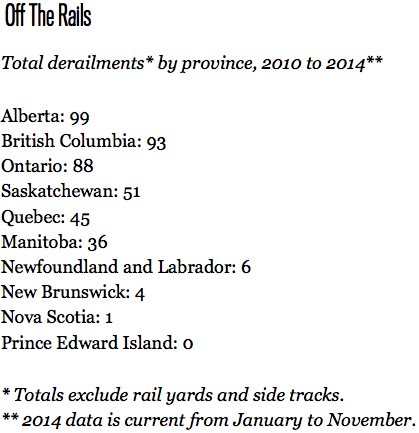
[Editor: Significant quote: “In the last five years, 99 trains have derailed in Alberta alone, and Canada has collectively seen over 400 in the same period.”  See chart below with details for all Canadian provinces.  – RS]

Train derailment near Banff spills coal ash into creek

Photo: Mary Schimke/Shale Plays Media

A train derailed in Canada over the holiday weekend, pushing seven rail cars into a nearby creek. Although there was no volatile cargo to cause a flashback to Lac-Megantic, the train was carrying coal ash, which was spilled into the surrounding area.

The Canadian Pacific train derailed on December 26 at about 2 a.m. in Alberta near Banff National Park. A total of fifteen cars exited the track, seven of which were pushed into nearby 40 Mile Creek. Six cars were carrying fly ash, which is a byproduct of coal-fired power plants and an ingredient in cement. The train was also carrying lentils. Both the fly ash and the Mediterranean grain were spilled into 40 Mile Creek.

View image on Twitter
BreakngVancouverNews, @iVancouverNews Ash spilled in train derailment could harm fish in Banff creek http://bit.ly/173sTTZ #Vancouver #BC #News

Repair efforts for the track are already underway, as well as an investigation by the Transportation Safety Board. Officials are unsure what caused the derailment, and workers were quick to the scene in attempts to minimalize its environmental impact. After the spill, workers observed that the creek, which is usually clear, was ruddy and brown. Although officials have stated that the stream is currently unharmed by the spill, ThinkProgress reports that it could be more impactful than it seems.

The creek is downstream of Banff’s Bow River, but so far, officials say the spill isn’t affecting the river. However, the fly ash could ultimately alter the pH of the water and can create piles of sediment in the creek. It could also threaten the health of the creek’s fish, according to University of Alberta ecology professor David Schindler, because of the traces of metals it contains.

Environmentalists are concerned that these sediments could interfere with spawning habitats, even though the substance isn’t classified as dangerous under Canada’s Dangerous Goods Act. According to CBC News, large amounts of sediment in the water could prevent fish eggs from getting the proper amount of oxygen and the creek bed.

The lentils could also have a negative impact on the region. According to the Calgary Herald, the grain could draw bears into an unsafe territory. However, because most bears are in hibernation this time of year, experts say the immediate risk is minimal. The bigger concern is cleaning the lentils up before the bears in the area come out of hibernation to ensure it doesn’t draw them into danger.

The derailment has raised the already heightened concern that transporting certain goods by rail is dangerous. Rail is the primary means of transporting crude oil when pipelines are unavailable, and everyone fears more catastrophes like the explosion in Lac-Megantic, Quebec, which killed some 30 people, and the disaster in Casselton, North Dakota, which brought the dangers of oil-by-rail close to home for many in the state. In the last five years, 99 trains have derailed in Alberta alone, and Canada has collectively seen over 400 in the same period. Across North America, citizens hope to avoid another calamity while officials work to come up with a viable solution.
View image on Twitter

KCBS 740AM PART III: Emergency Plans Stall Out For Trains Transporting Bakken Crude Oil In The Bay Area

Repost from CBS SF Bay Area 740AM (Part 3 of 3)
[Editor: Important coverage of bridge and infrastructure safety issues by Bay Area radio station KCBS 740AM.  See and listen also to Part I, Aging Railway Infrastructure Raises Safety Concerns As Bay Area Readies To Receive Dramatic Increase Of Bakken Crude Oil AND Part II, Safety Info For Alhambra Trestle In Martinez And Other Bridges Kept By The Railroads.  – RS]

Emergency Plans Stall Out For Trains Transporting Bakken Crude Oil In The Bay Area

The Alhambra Trestle in Martinez. (Jeffrey Schaub/CBS)

KCBS Cover Story Special, Part 3 of 3, Produced by Giancarlo RulliDecember 31, 2014.  KCBS reporter Jeffrey Shaub and producer Giancarlo Rulli investigate the Bay Area’s aging railway bridges that will carry increasing loads of highly volatile Bakken crude oil from North Dakota in this three-part KCBS Cover Story Special.

MARTINEZ (KCBS) – In May, U.S. transportation officials ordered the nation’s rail companies to disclose information to emergency responders on the routes and number of trains carrying a highly volatile crude oil through the Bay Area and elsewhere.

But some Bay Area and California officials claim the railroads are dragging their feet, stalling efforts to come with an emergency plan in case of a major disaster on the tracks.

According to the BNSF Railway, every 7-10 days, a 100-car long train carrying Bakken crude oil make sits way through Contra Costa County over the Alhambra trestle in Martinez.

Residents Bill Nichols and Jim Neu are among the many who have serious concerns. “The scary thing about the crude, it already has a proven track record of catastrophic accidents,” said Nichols. “These are ticking time bombs waiting to go off. If there was ever a derailment, it would affect the town with major casualties,” Neu said.

Contra Costa County Fire Protection District Marshal Robert Marshall worries about a train derailing from that height. “If you drop something from that height, it’s going to create a lot of damage.”

Marshall said he’s been working to create an emergency response plan, but needs to know how many trains are coming and when. But he said the state Office of Emergency Services can’t tell him. State OES Deputy Director Kelly Huston said that’s because the railroads haven’t provided him with that information.

“We’d love to be able to look it up online like an Amtrak schedule and be able to tell specifically when a terrain is coming through, where it’s going and give that direct access to local first responders,” Huston said.

KCBS has learned that BNSF sent a confidential letter to the Office of Emergency Services in September, informing them that Contra Costa County will see at least a 25 percent increase in Bakken fuel trains. But BNSF refused to say exactly how many and when, citing federal regulations and that they consider the information to be a confidential trade secret.

Bay Area Congressman John Garamendi disagrees. “It must be made available to the local emergency response agencies,” Garamendi said.

BNSF spokesperson Lena Kent said the company’s track record of moving hazardous materials speaks for itself.

“We handle all of our commodities with safety at the forefront. It’s far safer to move hazardous materials over our nation’s railroads then on our nation’s highways,” she said.

But longtime Martinez City Councilman Mark Ross said the railroad needs to be a better partner by being transparent and ensuring public safety. “Why don’t you get ahead of it, let’s work with government, work with the cities and communities that you’re running through, and solve the problem now.”

Hear the entire three-part cover story series.

NPR: Casselton, one year later

Repost from National Public Radio (NPR)
[Editor: This NPR report mentions that recent new North Dakota regulations require “conditioning” the oil.  Note that the new rules fall short of calling for “stabilization” of the oil.  See Ron Schalow’s comment, including “This conditioning lowers the ignition temperature of crude oil—but not by much. It leaves in solution most of the culprit gases, including butane and propane….The only solution for safety is stabilization, which evaporates and re-liquefies nearly all of the petroleum gases for separate delivery to refiners. Stabilization is voluntarily and uniformly practiced in the Eagle Ford formation in Texas…” – RS]

Fiery Accident Spurs Safer Rail Transport For Crude Oil

Morning Edition, December 30, 2014

It’s been one year since an oil train derailment outside Casselton, N.D. Since then, state and federal regulators have taken steps to make it safer to transport crude by rail.

Inspection finds faulty switch, critical rail and tank car safety defects

Repost from The Times Union, Albany NY

Faulty switch slows trains

Speed limit lowered after defect that could cause derailment found
By Brian Nearing | December 15, 2014
Port-of-Albany_650
Oil tanker and freight cars at the Port of Albany are seen from Corning Tower Monday afternoon, Dec. 15, 2014, in Albany, N.Y. Speed limits for trains were lowered on tracks near a large industrial park near Voorheesville that are commonly used by massive trains carrying flammable crude oil after state and federal safety inspectors found a faulty switch that could have caused a derailment. (Will Waldron/Times Union)

Trains were slowed on tracks last week near a large Albany County industrial park — where passing trains routinely carry dozens of tankers filled with flammable crude oil — after state and federal safety inspectors found a faulty switch that could have caused a derailment.

That switch, which feeds trains into the 550-acre Northeast Industrial Park, was examined Dec. 9 as part of the eighth statewide inspection of oil trains and tracks ordered by Gov. Andrew Cuomo in response to safety concerns about a surge of crude oil shipments through New York from the Bakken fields of North Dakota.

The switch is about three miles north of the village of Voorheesville and feeds trains into the park, which itself contains about 15 miles of tracks.

“We have sent inspection crews to check rail tracks and crude oil cars across New York and we continue to find critical safety defects that put New Yorkers at risk,” the governor said in a statement issued Monday. “We will remain vigilant and will continue to use all available resources to ensure that crude oil transporters are held to the highest safety standards.”

In the Capital Region, the speed limit on the CSX-owned track around the switch was lowered from 50 mph to 25 mph last week after inspectors from the state Transportation Department and Federal Railroad Administration found the switch was too narrow by just an eighth of an inch, said DOT spokesman Beau Duffy.

The switch could have been damaged by passing trains, or could cause a train to derail, he said. Duffy said the switch was repaired and higher speed limits have been restored.

The park is owned and managed by the Schenectady-based Galesi Group. A spokeswoman for company Chief Operating Officer David Buicko said the company was not made aware of the switch issue and learned of it from a Times Union reporter.

“We are committed to strong, ongoing and long-term coordination with state and local officials and will continue our aggressive program of inspection and maintenance of the entire CSX network,” said CSX spokesman Rob Doolittle. “Upon being made aware of the defect, CSX implemented a speed reduction in that area. The switch was repaired over the weekend and the speed restriction has been lifted.”

Cuomo’s office announced that state and federal inspectors examined about 95 miles of track — from Schenectady to Selkirk, and from Albany to Whitehall in the Capital Region, as well as from Plattsburgh to the Canadian border in the North Country.

In addition to the faulty switch, inspectors found about 30 violations on tracks, including “critical problems” like missing bolts from a rail joint and an “insecure switch point heel.”

Inspectors at the Canadian Pacific Railway-owned Kenwood yard at the Port of Albany also examined 478 DOT-111 tanker rail cars, which are commonly used to haul Bakken crude. Found were 16 “non-critical defects,” including worn brake shoes, defective wheels and other issues.

Non-critical rail defects must be repaired within 30 days. Non-critical tank car defects must be fixed before the train departs the yard.

Other inspections were done at rail yards and tanker cars in western New York, uncovering another five “critical defects,” including two broken rails at the Dunkirk and Buffalo-Frontier rail yard, and DOT-111s with defective brakes, a cracked weld and missing bolts.