Jon White didn’t catch Gov. Gavin Newsom’s updated COVID- 19 restrictions Wednesday, warning about public gatherings.
Besides, it would have been too late for the 28-year-old Vallejoan.
“One of the areas where we’re seeing an increase of transmission… is on family gatherings,” Newsom said. “I think patriotism, at least in a COVID-19 environment, can be celebrated a little differently.”
Yes, a July 4 party with family is so close, White could almost taste it. That’s if he could taste.
Last Thursday, June 25 — seven days after White, his wife, Kaitlyn, and their 8-month-old baby, Shep, drove to visit Katelyn’s family in Queen Creek, Ariz., White started feeling ill.
“The first thing to hit was the overwhelming fatigue,” he said late Wednesday. “I was exhausted out of nowhere. That moved to body aches and so much more.”
Actually, it wasn’t a huge surprise when White was overcome with COVID-19 symptoms. On June 24, his brother-in-law became ill and tested positive.
“And it turns out our cousin’s girlfriend tested positive on Tuesday” this week, White said. “I believe I got it from her.”
Though Kaitlyn remains seemingly healthy, the baby’s developed a 101-degree fever. White said he “never got a fever,” though his brother-in-law hovered around 101.5.
“The wife is the only one in the house without any symptoms,” White said. “The baby, unfortunately, got it or something. It’s been awful for a few days. He hasn’t slept and you can tell he has the same headache because exposure to light makes his eyes water.”
Though “100 percent sure” he has the virus, it’s been a waiting game to confirm: Eight days after testing, he’s still waiting for the results by Urgent Care San Tan Valley — roughly 45 miles from Phoenix.
“I called them upset already and they are still saying it could be 10 days,” White said Friday morning, adding that they “couldn’t give an answer” why the delay.
A woman at Urgent Care San Tan Valley told the Times-Herald it takes six to 10 days for results.
“By the time I get my results, it won’t even matter,” White said. “I’m going to try to get back home and get tested up in Northern California next week. I need a negative test to come back to work. Because they are taking so long, I am burning through my PTO (paid time off). If they would get me my results, it would switch over to medical leave and I wouldn’t be penalized. This is the only place I have heard of that takes this long to find out.”
White said before catching the virus, “we wear a mask out in public. We have only been with people doing the same and our close family and friends,” he said.
So much for a happy family reunion. And that week stay is now a two-week quarantine. “I honestly thought — like most people in the Bay Area — that I already had it,” he said. “But there was no way I had anything like this.”
Compare it to the “normal” flu? Tough call, because “I don’t think I’ve had the flu,” White said. “But the weirdest symptom is the loss of taste and smell. That one is so crazy and impossible to accurately describe.” As a man of faith, White said “Dear God, please tell me it doesn’t last too long,” referring to the loss of taste and smell. “Two people here
(in Arizona) have lost it and its come back after a week. Fingers crossed.”
With the family on quarantine, White said the trip home scheduled for June 26 is now … well, nobody knows exactly.
“We aren’t planning on leaving anytime before July 5,” he said.”We were told to quarantine.”
Almost forgot. The actual COVID test. White got it last Friday and still awaits the results.
“I’m not sure when it will come back. They said it could be as long as 10 days,” White said.
The test itself? As much fun as juggling broken bottles blindfolded.
“The test was the swab of my brain. It was a very painful experience,” White said.
As for “celebrating” Independence Day, White won’t be banging any pots and pans.
“It’ll be very quiet to avoid worsening the headache,” he said, managing an anguished laugh.
Forget dining inside, going out to bars: California’s new surge restrictions could last for a long while
Cynthia Dizikes and Alexei Koseff July 2, 2020
Megan Keeton (right) sterilizes the patio furniture at the Mare Island Brewing Co. Ferry Taproom in Vallejo.Photo: Photos by Nick Otto / Special to The Chronicle
New state restrictions on bars and restaurants in counties with the worst virus-control numbers are supposed to expire after three weeks. But few public health experts believe the bans on indoor gatherings and outdoor drinking will drop cases low enough for these activities to resume any time soon.
The dramatic move is the state’s attempt to rein in runaway case totals that have inched ever higher since some counties have begun allowing businesses to reopen and people have gathered more at home and outdoors.
But to really lower California’s surge in coronavirus infections — now at 246,735 — people need to curtail gatherings with friends and family and be more vigilant about wearing masks, particularly over the Fourth of July weekend, said UC Berkeley infectious disease expert Dr. John Swartzberg.
“This curve is going up very fast and it is going to take more than a nudge to bring it down again,” Swartzberg said, referring to Gov. Gavin Newsom’s order to shut down several recently reopened sectors that the state has identified as riskiest for transmission of the virus.
The order requires restaurants, wineries, tasting rooms, family entertainment centers, movie theaters, museums, zoos and cardrooms to halt indoor operations for at least three weeks. Outdoor operations, such as restaurant patios, are still allowed. But Newsom also ordered the closure of all bars and breweries in the 19 counties, including those outdoors, unless they also serve sit-down meals. The new restrictions will impact nearly 75% of California’s population of 39.5 million people.
The California Department of Public Health did not respond to questions about what would happen in three weeks and whether counties would be free to reopen all of those businesses.
At his news briefing Thursday, Newsom said he was confident the new restrictions will help keep new cases in check.
“We tempered the growth of the curve,” he said. “We need to do that again.”
Those assurances didn’t make it any easier, however, for businesses that had to roll back reopenings.
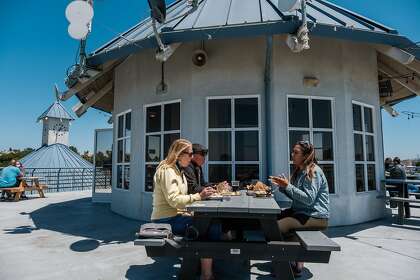
Beth Stine, Art Stine, and Serena Salvan eat lunch on the rooftop patio at Mare Island Brewing Co. Ferry Taproom. Photo: Nick Otto / Special to The Chronicle
At the Mare Island Brewing Co. Ferry Taproom in Vallejo, business was finally returning to some semblance of normal this summer. People had returned to drink and dine indoors and out. Nearly all of the 44-person staff had been rehired.
But then, on Wednesday, co-owner Kent Fortner’s phone lit up with messages: Solano County, where the tap room is, was among the 19 counties in the shutdown order, as were Contra Costa and Santa Clara counties in the Bay Area.
“It was really a kick in the teeth,” Fortner said. “As a business owner I can manage a downturn. It is uncertainty that kills a business. This came with no notice whatsoever, three days before a holiday weekend.”
Short of shutting down, closing bars and banning indoor gatherings in restaurants can be particularly effective as an isolated measure, said Dr. Thomas Tsai, a surgeon and health policy expert at the Harvard T.H. Chan School of Public Health.
Tsai and other researchers at Harvard and Google analyzed anonymized cell phone data from the first part of the year and found that closing bars and restaurants was the best way to keep people from venturing out of their homes — better than bans on large gatherings, school closures and shuttering other nonessential businesses.
“What California is doing makes sense,” Tsai said. “It is not that bars and restaurants are inherently dangerous but the nature of social interactions and socializing that come part and parcel with a restaurant or bar increases opportunities for the virus to spread.”
Coronavirus infections throughout the Bay Area grew to 27,158 Thursday with 590 deaths, county data showed. Single-day spikes in Bay Area counties included 178 new cases in Santa Clara, 228 in Alameda and 78 in Contra Costa.
Across California, the number of infections rose to 246,594 Thursday, with 6,261 deaths.
As of Wednesday, California joined 12 other states classified as “orange” on the risk scale developed by Harvard and a collaboration of scientists. Orange indicates escalating community spread. Stay-at-home orders may be necessary, unless it’s possible to increase testing and tracing. Three states, Arizona, Florida and South Carolina, were classified as “red,” meaning that community spread was unchecked and stay-at-home orders were necessary.
Newsom has pushed back on the notion that the state reopened too quickly. During press briefings, he has repeatedly asserted that his administration merely developed guidelines for how to safely operate different sectors of the economy, leaving it up to counties to determine a timeline for when they would resume based on local conditions.
On Thursday, he said his strategy for the counties that had been forced to toggle back their reopenings was “more targeted education,” rather than punitive measures.
He suggested that the surge in new cases was a failure of individual behavior, not public policy.
“I think the most important thing we’ve learned over the course of the last number of months,” Newsom told reporters, “is so often the conversation and the questions were about when, not how. We need to have a deeper conversation about how to safely reopen.”
The governor pointed to a public awareness campaign that his administration launched Thursday, with ads encouraging people to wear masks set to go up on television, radio, social media and billboards.
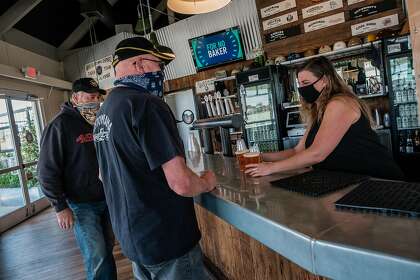
Phil Lang and Steven Morgan collect their beers before heading out onto the patio at Mare Island Brewing Co. Ferry Taproom in Vallejo. Photo: Nick Otto / Special to The Chronicle
The governor’s order applies to counties that have spent at least three consecutive days on a state watch list because of their high rate of new infections, positive tests or increasing hospitalizations. Outside of the Bay Area, the affected counties include Fresno, Glenn, Imperial, Kern, Kings, Los Angeles, Merced, Orange, Riverside, Sacramento, San Bernardino, San Joaquin, Santa Barbara, Stanislaus, Tulare and Ventura.
Some of the counties affected by the governor’s order had not reopened indoor dining or drinking, including Santa Clara.
On Thursday, Santa Clara County issued a new health order allowing some activities to resume, including hair and nail services, gyms, and small gatherings if social distancing protocols are in place. The order also requires employers to immediately report coronavirus cases on their staff for all employees who were at work within two days of having symptoms or of being tested. Employers must report the case within four hours to the public health department.
Also this week, the Contra Costa Health Services department encouraged people to avoid gatherings of friends and family, wear masks, and seek testing even if they had no symptoms.
Solano County had moved more quickly than other counties to reopen, allowing indoor dining in May and reopening retail stores, tattoo parlors, museums and nail salons, among other businesses. The county has drafted a new order to reflect the governor’s restrictions.
However, county health officer Dr. Bela Matyas said Thursday that he was not optimistic the new rules would help drop the rising number of cases in his county. Matyas said that most of the increases can be attributed to people getting together at home with their friends and families. While a handful of outbreaks have been linked to work sites, he said Solano has not seen any cases tied to restaurants or bars.
“We don’t have any evidence that this is how the disease is spreading in our county,” Matyas said. “People find it easy to blame the business sector, but at least in our county, it is what we are doing at home that is causing the spread.”
For now, Fortner has closed the indoor dining area at the taproom, which is also a restaurant. But, he said, he worries about what the future holds for his small business and others.
“I want my kids to go to school in the fall and I want to be part of the solution instead of the problem,” he said. “But the lack of clarity, transparency and advanced notice is very frustrating.”
Cynthia Dizikes and Alexei Koseff are San Francisco Chronicle staff writers.
Wednesday, July 1: 114 new cases today, 1 new death. Since the outbreak started: 1,402 cases, 104 hospitalized, 25 deaths.
Compare with previous report, Tuesday June 30:Summary
Solano County reported 114 new cases today, total of 1,402 cases since the outbreak started. Over the last 7 days, Solano reported 338 new cases, an average of 48 per day.
1 new deaths today, total of 25, 2 more hospitalized, total of 41 currently, 104 since the outbreak started.
Solano reported 98 more ACTIVE cases today, total of 307. This figure has been on a yoyo this week. For whatever reason, 250 last Friday, only 70 on Monday, back up to 209 yesterday and 307 today. An increasing number, no matter how you look at it….
Note the drop in ICU beds Available, from 37% to 32%. Need to keep an eye on this one.
Testing – Solano county reported 831 residents were tested since yesterday. Good progress!
Details and Demographics tab
The County’s new Public Health Dashboard design includes a second tab (panel), “Details and Demographics” (shown here). Note that both tabs are user interactive – hover over a chart (or tap) to get details. On this Details/Demographics tab, most of the small charts have a small additional tab showing the rate per 100,000. Go there and explore the two tabs. (Expand a chart by clicking the small button in its upper right corner.)
SEVEN DAY MOVING AVERAGE
Yesterday’s Seven Day moving average of confirmed cases showed an uptick (see at right). Today’s chart is back to its misleading look, supposedly tracking as a 7-day average the increase of 717 cases (!) we have seen in the last 2 weeks…
Don’t let these “smoothed out” charts fool you – cases are up dramatically here. Masks and social distancing are still required and important! Today’s chart shows a 7-day moving average of 21 new cases per day, supposedly down from 27 in yesterday’s report.
BY AGE GROUP
Youth 17 and under – 15 new cases today, total of 126 cases, only one ever hospitalized. Two weeks ago, there were only 52 cases among this age group – we’ve seen 74 new cases in 14 days!I continue to be alarmed for Solano’s youth. Cases among Solano youth have increased in recent weeks to 9% of the 1,402 total confirmed cases.
Persons 18-49 years of age – 66 new cases today, total of 805 cases. This age group represents 57% of the 1,402 total cases, by far the highest percentage of all age groups. The County reported no new hospitalizations among this age group today, and no new deaths. Total of 27 hospitalized at one time and 2 deaths.
Persons 50-64 years of age – 22 new cases today, total of 282 cases. This age group represents 20% of the 1,402 total cases. No new hospitalizations today, total of 35 hospitalized at one time. No new deaths, total of 3 deaths.
Persons 65 years or older – 11 new cases today, total of 188 cases. This age group represents 13% of the 1,402 total cases. No new hospitalizations, total of 41 hospitalized at one time. 1 new death, total of 20 deaths. In this older age group, 22% were hospitalized at one time, a substantially higher percentage than in the lower age groups. And this group counts for 20 of the 25 deaths, or 80%.
CITY DATA
Vallejoadded 28 new cases today, total of 534.
Fairfield added 39 new cases today, total of 462.
Vacaville added 17 new cases today, total of 200 cases.
Suisun City added 8 new cases today, total of 89 cases.
Benicia added 1 new case today, total of 27 cases.
Dixonadded 19 new case today, total of 70 cases.
Rio Vista was reported greater than 10 cases for the first time today, showing a total of 14 cases. (The other cities added up to 112 of today’s 114 new cases, so… supposedly Rio Vista must have added 2 new cases. Perhaps the County failed to note Rio Vista as >10 yesterday?)
Unincorporated areas – Although the County still still shows Unincorporated at <10 (less than 10), a little math tells the story: Solano’s unincorporated areas must account for the 6 cases unaccounted for in the other City totals. Residents and city officials have long pressured County officials for full and transparent city case counts. Finally we have complete city data for ALL areas of the County!
A “Rate” column shows the rate of positive COVID-19 cases (per 100,000 population) for each city. Benicia is leading the way here, with a rate of only 97.9 cases per 100,000. Compare with other Solano cities in the chart, and note that the CDC reports today’s rate in California at 566 per 100,000 (up from 547 yesterday). Johns Hopkins lists the overall Solano County rate at 252(unchanged, as it reflects incomplete data for yesterday). UPDATE: Johns Hopkins updated its listing for cases per 100,000 in Solano County to 314 (a significant jump, up from 252 on Tuesday).
RACE / ETHNICITY
The County report on race / ethnicity data includes case numbers, hospitalizations, deaths and Solano population statistics. There are also tabs showing a calculated rate per 100,000 by race/ethnicity for each of these boxes. This information is discouragingly similar to national reportsthat indicate worse outcomes among black and brown Americans. As of today:
White Americans are 39% of the population in Solano County, but only account for 24% of cases, 22% of hospitalizations and 21% of deaths.
Black Americans are 14% of Solano’s population, and account for 13% of cases, but 29% of hospitalizations, and 38% of deaths.
Latinx Americans are 26% of Solano’s population, but account for 37% of cases. They account for 25% of hospitalizations, and 17% of deaths.
Asian Americans are 14% of Solano’s population, and account for 11% of cases and 15% of hospitalizations, but 21% of deaths.
Tuesday, June 30: 162 new cases today, no new deaths. Since the outbreak started: 1,288 cases, 104 hospitalized, 24 deaths.
Compare with previous report, Monday June 29:Summary
Solano County reported 162 new cases today (!), total of 1,288 cases since the outbreak started. Over the last 7 days, Solano reported 268 new cases, an average of 38 per day.
No new deaths today, total of 24, 1 more hospitalized, total of 39 currently, 104 since the outbreak started.
Solano reported 139 more ACTIVE cases today, total 209. This figure has been on a yoyo this week. For whatever reason, 250 last Friday, only 70 on Monday, and back up to 209 today. Sorry, I can’t explain this….
Testing – Solano county reported 854 residents were tested since yesterday. Good progress!
Solano’s new Public Health Dashboard design has 2 tabs
The County’s new Public Health Dashboard design includes a second tab (panel), the “Details / Demographics” tab (shown here). Note that both tabs are user interactive – hover over a chart (or tap) to get details. On this Details/Demographics tab, most of the small charts have a small additional tab showing the rate per 100,000. Go there and explore the two tabs. (Expand a chart by clicking the small button in its upper right corner.)
SEVEN DAY MOVING AVERAGE – CORRECTED…
Yesterday’s Seven Day moving average of confirmed cases seemed erroneous and/or misleading – see at right. Today’s chart seems much more realistic, tracking as a 7-day average the increase of 601 cases we have seen in the last 2 weeks:
Cases are up dramatically here. Masks and social distancing are still required and important! Today’s chart shows a 7-day moving average of 27 new cases per day, up from a misleading 5 in yesterday’s report.
BY AGE GROUP
Youth 17 and under – 23 new cases today (!), total of 111 cases, only one ever hospitalized. Two weeks ago, there were only 40 cases among this age group – we’ve seen 71 new cases in 14 days!I continue to be alarmed for Solano’s youth. Cases among Solano youth have increased in recent weeks to over 8.5% of the 1,288 total confirmed cases.
Persons 18-49 years of age – 101 new cases today (!), total of 739 cases. This age group represents 57% of the 1,288 total cases, by far the highest percentage of all age groups. The County reported no new hospitalizations among this age group today, and no new deaths. Total of 27 hospitalized at one time and 2 deaths.
Persons 50-64 years of age – 27 new cases today, total of 260 cases. This age group represents 20% of the 1,288 total cases. No new hospitalizations today, total of 35 hospitalized at one time. No new deaths, total of 3 deaths.
Persons 65 years or older – 11 new cases today, total of 177 cases. This age group represents 14% of the 1,288 total cases. 1 new hospitalization and no new deaths today. Total of 41 hospitalized at one time and 19 deaths. In this older age group, 23% were hospitalized at one time, a substantially higher percentage than in the lower age groups. And this group counts for 19 of the 24 deaths, or 79%.
CITY DATA
Vallejoadded 44 new cases today, total of 506.
Fairfield added 60 new cases today, total of 423.
Vacaville added 31 new cases today, total of 183 cases.
Suisun City added 11 new cases today, total of 81 cases.
Benicia added 1 new case today, total of 26 cases.
Dixonadded 12 new case today, total of 51 cases.
Rio Vista and “Unincorporated” are still not assigned numerical data: today both remain at <10 (less than 10). 3 new caseswere evidently in this group today, unaccounted for among the other city counts. There are 18 cases somewhere among the 2 locations in this category. Residents and city officials have pressured County officials for city case counts. Today’s data is welcome, but remains incomplete for folks in Rio Vista and unincorporated areas of the County.
A “Rate” column shows the rate of positive COVID-19 cases (per 100,000 population) for each city. Benicia is leading the way here, with a rate of only 94 cases per 100,000. Compare with other Solano cities in the chart, and note that the CDC reports today’s rate in California at 547 per 100,000 (up from 534 yesterday). Johns Hopkins lists the overall Solano County rate at 252 (up from 250 yesterday).
RACE / ETHNICITY
The County report on race / ethnicity data includes case numbers, hospitalizations, deaths and Solano population statistics. There are also tabs showing a calculated rate per 100,000 by race/ethnicity for each of these boxes. This information is discouragingly similar to national reportsthat indicate worse outcomes among black and brown Americans. As of today:
White Americans are 39% of the population in Solano County, but only account for 24% of cases, 22% of hospitalizations and 22% of deaths.
Black Americans are 14% of Solano’s population, and account for 13% of cases, but 29% of hospitalizations, and 35% of deaths.
Latinx Americans are 26% of Solano’s population, but account for 37% of cases. They account for 25% of hospitalizations, and 17% of deaths.
Asian Americans are 14% of Solano’s population, and account for 12% of cases and 15% of hospitalizations, but 22% of deaths.
You must be logged in to post a comment.