BENINDY: We will continue to live in hope and in righteous anger, with courage, with long-and short-range planning and with a persistence faithful to the constitution, to those we love and to our moral convictions…
The BENICIA Independent calls on everyone to PROTEST in Benicia today, Monday 2/17 at noon, City Park Gazebo.
FAIRFIELD protest is today, Monday 2/17 at 12:30pm, at the County Building, 675 Texas St.
VALLEJO protest is today, Monday 2/17 at 5:30pm, at City Hall, 555 Santa Clara St.
PREVIOUS POSTING FOR BENICIA…
This upcoming Presidents Day, it’s important to show the US, the government, Benicia and the world, that Trump is NOT the people’s president.
Meet at THE GAZEBO in Benicia City Park on Monday from Noon to 1pm, to peacefully protest in support of the nationwide event. (Map)
Bring your own sign, noisemakers, bullhorns and a great attitude. Please help everyone follow the rules, keep it peaceful and do not block the sidewalk to other pedestrians. Do NOT go into the street.
Donald Trump is a threat not only to the US but to democracy, peace and lives. His unpopular, harmful and dangerous policies and presidential orders have already sent shockwaves through the United States and the world. His actions have real consequences and is coming at the cost of the lives and health of trans people, Queer people, women, Black & Brown people, immigrants, poor people, and anyone who’s not considered important to him. If he is allowed to continue this path of destruction unopposed, he can and will end millions of lives. Donald Trump does not care about anyone else but his billionaire friends, and is steamrolling the rights of US citizens DAILY, as well as breaking constitutional rights constantly without much pushback.
Note from the NorCal ACLU – Solano Chapter, co-led by Kris Oyota Kelley and Vallejo mayoral candidate Andrea Sorce:
This morning, California Attorney General Rob Bonta held a press conference to announce a stipulated judgment (consent decree) with the Vallejo Police Department.
This agreement compels the City of Vallejo to implement long-overdue reforms and establishes an independent court-supervised monitor to ensure progress. It will not solve all of our police accountability issues, but it is a major step in the right direction for public safety in Vallejo.
We appreciate everyone who signed the petition and will keep you updated as our efforts progress. The ACLU NorCal Criminal Justice team will be investing significant resources in Vallejo going forward, and we will continue to push for the remainder of our petition demands.
[Note from BenIndy: There is still a lot of work to do – please sign the petition by clicking this link. ]
Attorney General Bonta Announces Stipulated Judgment with the Vallejo Police Department to Strengthen Accountability, Police Policies and Practices
Click the image to view the document. You will be redirected to the website of the Office of the Attorney General.
Sunday, October 15, 2023
[Images added by BenIndy]
VALLEJO – California Attorney General Rob Bonta today announced that the California Department of Justice (DOJ) has entered into a stipulated judgment with the city of Vallejo and the Vallejo Police Department (VPD) regarding reforms to VPD’s policies and practices. The stipulated judgment continues and expands upon the reform work started under a Memorandum of Understanding (MOU) between the DOJ and VPD. The agreement announced today resolves DOJ’s complaint alleging the VPD engaged in a pattern and practice of unconstitutional conduct. As part of the agreement, the city of Vallejo and VPD will undertake a comprehensive set of actions — to be led by an Oversight and Reform Evaluator — to promote public safety, reduce unlawful uses of force, eliminate racial and identity disparities, strengthen accountability systems, continue to increase support for officers, and protect the statutory and constitutional rights of the people of Vallejo.
“Maintaining trust between our law enforcement and the communities they serve is a foundational part of public safety,” said Attorney General Bonta. “Today’s agreement with the city of Vallejo and its police department is another important step toward correcting injustices, building trust, and enhancing public safety for the people of Vallejo. We cannot afford to be complacent. The reforms laid out in the agreement are needed and necessary to continue healing the relationship between law enforcement and the community. It’s past time the people of Vallejo have a police department that listens and guarantees that their civil rights are protected. My office is committed to staying engaged, working collaboratively with VPD and the city and ensuring a fair, thorough, and transparent process.”
Heather Skinner, Ronell Foster’s mother-in-law, speaks about transparency during a press conference held by the office of lawyer John Burris in front of City Hall in Vallejo. Ronell Foster was killed by VPD in 2018. | Chris Riley / Times-Herald.
“The City of Vallejo is encouraged by the progress made to date by our staff and the Department. We are optimistic about the continuation of our collaboration with the California Department of Justice and its team in the next phase of this important work,” said Vallejo Mayor Robert McConnell. “We have made significant progress but there is still more to do. The City Council is unanimously committed to seeing our efforts through to conclusion. It is the goal of the City of Vallejo and the VPD to continue to build on the progress made to date, to strengthen our relationships and advance our efforts to build trust with the community.”
“The Vallejo Police Department is committed to the completion of the remaining original recommendations and the additional recommendations under the new Agreement,” said Vallejo Police Department Interim Chief Jason Ta. “Improvements will be made to new and existing policies and procedures, which we are confident will increase accountability, efficiency, transparency, and community partnerships while at the same time improving relationships with the public and building mutual trust and respect from the community we serve.”
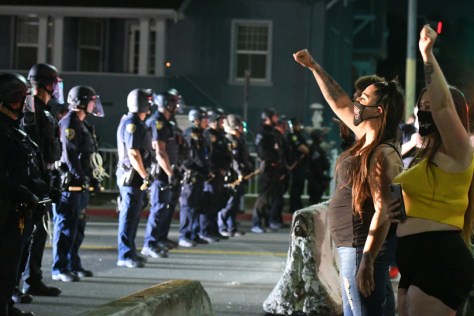
Protesters face off against police officers during a peaceful march over the killing of Sean Monterrosa, the 22-year-old San Francisco man, who was shot and killed by a Vallejo Police officer in 2020. | Chris Riley / Times-Herald.
“This Agreement is a continuation of the reform process Vallejo Police Department started three years ago,” said Vallejo City Manager Michael Malone. “City management and Vallejo Police Department are committed to engaging the community and dedicating the resources needed to ensure this ongoing effort is successful within the terms of our new Agreement.”
“During the past 3 years of the City’s collaborative agreement with the California Department of Justice we have fostered a positive working relationship that has produced significant results,” said Vallejo City Attorney Veronica Nebb. “Our work is not complete and we look forward to continuing our joint efforts with the California Department of Justice for the benefit of the community, the Department and the City.”
On June 5, 2020, DOJ, the city of Vallejo, and VPD entered into a MOU for VPD to institute a comprehensive modernized policing plan that included implementing 45 reform recommendations made by VPD’s expert consultants, as well as additional review from DOJ to expand upon and add any additional recommendations needed to modernize VPD’s current policies and practices, assist with implementation of the recommendations, and independently evaluate VPD’s compliance with the recommendations. The California Department of Justice’s (DOJ) decision to enter into an MOU with VPD to reform its policing came in light of several high-profile uses of force, including a number of officer-involved shootings.
Alicia Saddler speaks outside City Hall at a rally addressing police shootings in Vallejo, Calif., on Feb. 28, 2019. Saddler’s brother, Angel Ramos, was killed by VPD in 2017. | Brock Stoneham / NBC News.
When the MOU expired on June 5, 2023, VPD had achieved substantial compliance with 20 out of the 45 agreed-upon recommendations. During the review of VPD’s systems and practices under the MOU, DOJ concluded that VPD failed to uniformly and adequately enforce the law, based in part, because of defective or inadequate policies, practices, and procedures. DOJ is currently seeking a judgment with court oversight requiring VPD and the city of Vallejo to implement the remaining reforms, and to implement additional reforms addressing civilian complaints, bias-free policing, stops, searches, seizures and arrest, and ongoing oversight of these reforms.
The parties have agreed on a comprehensive five-year plan to address the numerous areas that need improvement and modernization to bring VPD into alignment with contemporary best practices and ensure constitutional policing. VPD will implement the remaining recommendations that have not been completed from the 45 Recommendations contained in the May 2020 report titled “Vallejo Police Department: Independent Assessment of Operations, Internal Review Systems and Agency Culture” (“2020 Recommendations”). Additionally, under the agreement VPD will implement additional recommendations, including to:
Address unreasonable force by holding officers and supervisors accountable for not identifying, adequately investigating, or addressing force that is unreasonable or otherwise contrary to VPD policy; and refer uses of force that may violate law or VPD’s use of force policy to their Professional Standards Division (internal affairs) for further investigation or review.
Enhance, promote, and strengthen partnerships within the community, to continue engaging constructively with the community to ensure collaborative problem-solving and bias-free policing, and to increase transparency and community confidence in VPD.
Utilize its Chief’s Advisory Board (CAB) and the Police Oversight and Accountability Commission (POAC), to continue to develop and amend significant policies that impact the community, including to its use of force policies, community-policing strategy and policies, bias-free policing policies, and civilian complaint policies.
Develop a policy that defines and limits the use of pretextual stops.
Enhance and revise training with respect to investigatory stops, reiterating that race, color, ethnicity, national origin, religion, gender, gender identity, disability, or sexual orientation are not to be used as a factor in establishing reasonable suspicion or probable cause, except as part of actual and credible descriptions of a specific suspect.
Prohibit officers from conducting consent searches during consensual encounters. Officers may not conduct a consent search after detaining a subject unless an officer reasonably suspects that the subject has contraband or evidence related to that detention, and the consent must be documented on body camera footage or a signed consent form.
Ensure stops, searches, and seizures comply with the law, as part of an effective overall crime prevention strategy that does not contribute to counterproductive tension with the community.
Commit to providing bias-free services and enforcing laws in a way that is professional, nondiscriminatory, fair, and equitable.
Work with the Evaluator to develop a policy and protocol for responding to calls involving a person in mental health crisis or suffering from a mental health disability. The policy and protocol will include utilizing professional civilian staff, who are trained professionals in responding to mental health crises, to respond when appropriate and available.
Develop and implement policies, guidelines, and training to ensure all supervisors and managers:
Exercise appropriate supervisory oversight
Conduct objective and impartial investigations
Are held accountable for meeting agency standards and expectations
Engage with and listen to community feedback
Incorporate community feedback when able and appropriate
Develop and evaluate policing strategies and tactics reflective of contemporary best community policing practices
Conduct an ongoing audit of incidentswhere an officer points a firearm at a member of the public or brandishes a firearm in the presence of a member of the public to ensure that its officers are not drawing a firearm solely based on the mere existence of a potential risk (e.g., public contact, pedestrian/traffic stop).
A copy of the stipulated judgment is available here, and a copy of the complaint is available here.
Andrea Sorce, an economics professor at Diablo Valley College, who chairs Vallejo’s Surveillance Advisory Board and co-founded and co-led ACLU – Northern California’s Solano County chapter, is running for mayor to bring accountability, transparency, and economic growth to Vallejo. | Image by Askari Sowonde.
The chair of Vallejo’s Surveillance Advisory Board and co-founder of the local American Civil Liberties Union chapter is running for mayor, promising shakeups in the city’s “status quo.”
Andrea Sorce, a frequent attendee at Vallejo City Council meetings and outspoken critic of the Vallejo Police Department, is running on a platform of transparency, accountability and economic growth. She joins Realtor and former Vice Mayor Pippin Dew in the race to fill the seat of Mayor Robert McConnell when his term ends in January 2025.
Vallejo mayoral candidate Andrea Sorce reviews her notes prior to speaking at the May 10, 2023 meeting of the Vallejo City Council, as Chief Assistant City Attorney Randy Risner looks on. | Geoffrey King for Open Vallejo.
“I think for me, it was seeing the community so frustrated with the status quo and seeing what I feel is a lack of leadership,” Sorce said. “I feel like Vallejo deserves better leadership, and the community for years now has just lost trust in City Hall.”
Sorce took aim at what she sees as “a culture of covering up wrongdoing.” She wants to see “a trusted independent investigator” look into former police Chief Shawny Williams’ resignation last November, as well as the unhoused people who died on the city’s watch in Project RoomKey.
“I think when you have a city where people that do the right thing are punished and people that do the wrong thing are promoted, that is going to deter good people from wanting to work for the city,” she said.
Sorce, an economics professor at Diablo Valley College who previously served in the Peace Corps, said she also wants to see more tax dollars “going to the right problems” in Vallejo – issues like the city’s poor roads and insufficient housing. And she wants to help develop more concrete plans for improving the city’s economy.
The candidate accused local leaders of sometimes taking an “us-versus-them” approach to their own community, deterring people from getting more involved in local politics through policies such as limiting physical access to Vallejo City Hall. Moreover, she blamed the city’s current police officer shortage on a “lack of accountability for wrongdoing, and a lack of leadership, and a lack of support for the folks that have tried to take it on.”
The Vallejo Police Officers’ Association has said the recent wave of resignations results from “the city council’s continued disrespect for our officers and the work that we do.” But Sorce argued that the police department’s culture is deterring many officers from wanting to work there.
“The criticism has never been anti-police. It’s been anti-corruption,” she said, referring to her own track record of fiery public comments.
Sorce believes Vallejo has “made some real progress” in recent elections. She said the city has a long way to go, but she has faith that it can get there.
“It’s doable,” she said. “It’s not easy, but it’s doable. I think there’s real cause for optimism.”
While you’re there, consider supporting independent news in Solano County with a subscription. Per the BenIndy’s Editor Emeritus Roger Straw, “the Vallejo Sunis celebrating it’s second anniversary, and has earned my respect with excellent in-depth reporting on police, local government, schools, arts, and local events. Recently, I re-subscribed with a voluntary increase in my annual renewal amount. You can subscribe here.”
You can also read more about Andrea at Open Vallejo. Open Vallejo is an “award-winning, independent, non-partisan, nonprofit newsroom serving the public interest.” It’s tireless work unburdening a city from a history of “police violence, corruption, and neglect” is truly phenomenal and also worthy of your support.
Juneteenth takes off in Solano County with more events than ever before
It’s time to celebrate Juneteenth, and what better way than with this list of events taking place in Solano County. We are tremendously fortunate to bear witness to a long-overdue rise of awareness of and popularity for this once lesser-known, often mischaracterized holiday, which embraces the resilience, vibrancy, joy, artistry, and innovation of African and Black Americans in both our shared and unique histories and cultures.
Attending a local Juneteenth event is your opportunity to engage with true American history – both its traumas and triumphs – through live performances, educational exhibits, kids activities, and more. It’s also an opportunity to learn more about and support local Black-owned businesses as well as artists, poets, historians, performers, educators, nonprofits, faith-based organizations – wait, wait.
Y’know, the list of reasons to attend is too long to get into here, so let’s skip on ahead to the list. We are ridiculously lucky to have so events many to choose from, so get to choosing! And if you can attend more than one event, even better.
(Note: This list is mostly presented by date, then alphabetically by city, so no one can accuse me of favoritism.)
Saturday, June 17
Fairfield
The Solano County Black Chamber of Commerce presents the 2nd Annual Fairfield Juneteenth Celebration, a free event at Solano Annex (601 Texas Street, Fairfield, next to the old courthouse) from 11 am to 7 pm. It looks like the organizers waived the usual vendor fees so 100 vendors could be on hand to sell locally produced artisanal crafts, cosmetics, art, and more — and they ran out of room! So you can expect a lot of great opportunities to check out Black-owned businesses in Solano as well as live music, speakers, kids activities, and dancing. For more information, check out solanoblackchamber.com/event/2023-fairfield-juneteenth-celebration.
Vallejo
The African American Family Reunion Committee presents the 33rd Annual Vallejo Juneteenth Festival and Parade. The parade will start at 9 am on Broadway & Tennessee Street in Vallejo and last until 10:30 am, then you can head over to the festival at Barbara Kondylis Waterfront Green (301 Mare Island Way, Vallejo) from 11 am to 5 pm. This event attracts more than 75 to 100 vendors and exhibitors selling merchandise and food as well as live music to serve about 2,000 visitors. This is the longest-running Juneteenth celebrations in Solano County, and it benefits health care organizations that provide free services. For more information, check out vallejojuneteenth.com.
Suisun City
The Suisun City Family Block Party will host “Honoring the Past, Celebrating the Future: Juneteenth, The Pursuit of the American Dream,” and I’m putting it last in this list despite a promise of alphabetical order because the event is weekend long, happening on both Saturday, June 17 AND Sunday, June 19! Taking place from 10 am to 6 pm right on the Suisun Waterfront (520 Solano Street, Suisun City), the celebration includes live music performances, food and drinks, local artisans and vendors, as well as family-friendly activities. This event supports key initiatives in Suisun City including the Suisun City Youth Commission’s Youth Projects, Economic Development Events (through R.E.A.L. Fairfield) and NAACP Youth Scholarships. Check out juneteenth-suisun.comfor more information.
Sunday, June 18
Benicia Benicia Black Lives Matter presents the 3rd Annual Juneteenth Festival in Benicia, taking place from 12 to 5 pm at Benicia’s Veterans Hall (1150 First Street, Benicia).It looks like there will be live music, food and drinks, kids activities, and vendors on hand to help Benicia celebrate. BBLM has always managed to strike the right balance of age-appropriate education and truth-telling with fun and activities, so this event would be a wonderful way to spend your Father’s Day and support BBLM’s community outreach and support efforts, which include backpack, food, and clothing giveaways. Check out beniciablacklivesmatter.com or their Facebook page for more information.
Monday, June 19
Benicia (again)
This one is a shout-out to my buddies in Benicia who may be able to join Benicia City Council Members, City staff, and community members in a flag-raising ceremony scheduled for 9:30 am on Monday and taking place in front of Benicia City Hall (250 East L Street, Benicia). It’s a short ceremony, and probably one of many flag-raising ceremonies scheduled around the county, but it’s really nice seeing that flag fly over the city I call home.
Note: This list was compiled using Google searches and a heavy lean on the grapevine. If I missed your event, please let me know ASAP and I will update this list to help promote it. I apologize in advance if I missed you and hope to include you as soon as you send me your information.


 Meet at THE GAZEBO in Benicia City Park on Monday from Noon to 1pm, to peacefully protest in support of the nationwide event. (Map)
 Join Us!



You must be logged in to post a comment.