Category Archives: California

Testing chaos undermines California coronavirus response

San Francisco Chronicle Editorial Board, April 7, 2020
A health care worker speaks with a driver at a drive-thru coronavirus testing site in a parking lot of the old California Pacific Medical Center on California Street in San Francisco, Calif. on Thursday, April 2, 2020. The appointment only tests were provided for employees and staff of CPMC and Brown and Toland physicians.
A health care worker speaks with a driver at a drive-thru coronavirus testing site in a parking lot of the old California Pacific Medical Center on California Street in San Francisco, Calif. on Thursday, April 2, 2020. The appointment only tests were provided for employees and staff of CPMC and Brown and Toland physicians. Photo: Paul Chinn / The Chronicle

California has so far escaped an exponential coronavirus outbreak on the order of New York’s thanks to nation-leading social-distancing measures, particularly in the Bay Area. But the state has lagged in testing for the virus, undermining a relatively encouraging trajectory and threatening its ability to combat the contagion over the long term.

While federal failures have plagued coronavirus testing across the country, California’s capacity to identify the disease it’s fighting has been particularly poor. About 126,000 Californians had been tested for the novel coronavirus as of Saturday, Gov. Gavin Newsom said, or 0.3% of the population. That’s only about half the per capita rate nationwide in a country that has been a global underachiever in tracking the pandemic, ranking 42nd among the states according to one analysis. New York, with about half the population, has tested more than 300,000.

Extraordinary delays in processing those tests that have been conducted exacerbated California’s shortfall. At one point last week, results were still pending for more than 60% of tests. Some patients reported waiting well over a week to find out whether they tested positive, defeating any attempt to quickly identify and contain infections.

To Newsom’s credit, he took responsibility for the problem Saturday and vowed to increase testing “exponentially” by forming a testing task force and several diagnostic “hubs,” coordinating the distribution of supplies, and working with UC Davis and UC San Diego. The governor also reported significant progress on the testing backlog, which had fallen from nearly 60,000 awaiting results to around 13,000 as of last weekend.

Federal miscues early on put the entire country at a disadvantage in detecting the pandemic. Although the World Health Organization had distributed hundreds of thousands of working coronavirus tests by early February, the U.S. Centers for Disease Control and Prevention insisted on developing its own test only to discover flaws that made it largely unusable. The government nevertheless took weeks to relax regulations that prevented labs around the country from employing alternatives, finally doing so in late February.

Those difficulties were compounded in California thanks to shortages of testing supplies, a lack of coordination among dozens of public and private labs, and a huge backlog at one of them. Testing capacity has also been reduced by closures of about a quarter of the state’s public health labs over the past two decades.

If California’s relative success in slowing the spread of of the contagion continues, one likely consequence is that more of the population will remain unexposed and therefore vulnerable until a vaccine is developed, a process expected to take more than a year. A coherent testing regime will be that much more crucial to detecting and controlling any resurgence of the pandemic and beginning to restore a semblance of normalcy.

COVID-19 deaths in California expected to peak on April 17

The model for California predicts that COVID-19 deaths per day will peak on April 17

Vallejo Times-Herald, April 7, 2020
The Institute for Health Metrics and Evaluation, an independent research center at the University of Washington, has released COVID-19 projections for all 50 states and for nations around the world.

The models predict “extent and timing of deaths and excess demand for hospital services due to COVID-19,” the institute says.

The model for California, as of April 7, predicted that COVID-19 deaths per day would peak on April 17. Projections assume “full social distancing” through May.

The pulldown box at the top of the graphic allows selection of other states and nations.

Solano County COVID-19 updates – now reporting only on M-F

By Roger Straw, March 29, 2020

UPDATE: See today’s latest information

Even in a declared emergency, County staff gets a much-needed weekend off

Solano County Coronavirus Updates and Resources, March 28, 2020

The Solano County coronavirus page (solanocounty.com/depts/ph/coronavirus.asp) was altered yesterday.

The “Number of cases” button previously read “Updated daily at 4pm.”  Sometime after 4pm on Saturday, March 28, the text below the button was changed to “Updated Monday to Friday at 4pm.”

The County updated the number of cases on Saturday March 21, but starting yesterday, the Solano public will no longer get weekend updates.

The Johns Hopkins interactive map shows no change for Solano County from Friday’s total of 34 cases.  Presumably, that map is dependent on reports from County officials – OR, there was no change on Saturday.

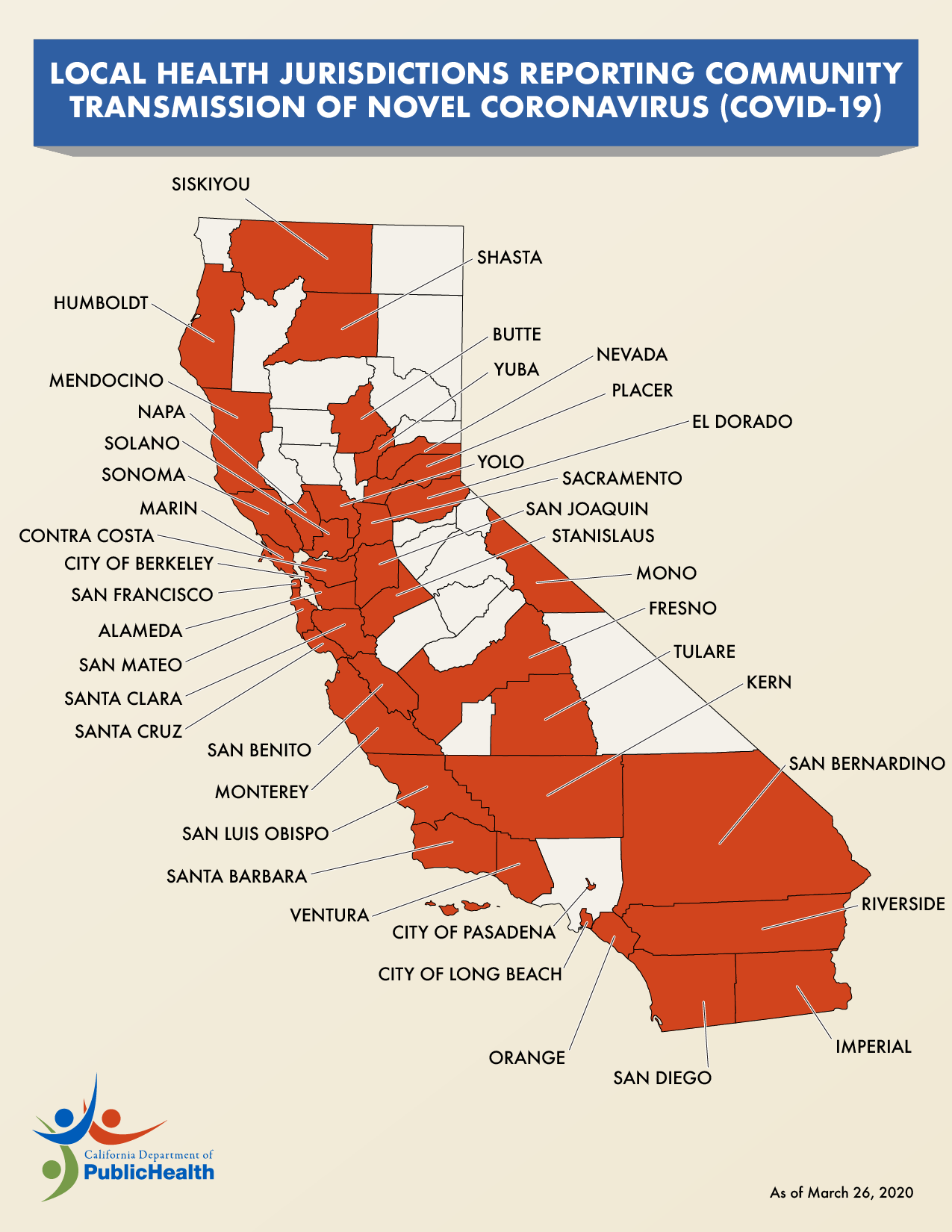
Neither the State of California coronavirus page, nor the California Department of Public Health’s coronavirus page show County numbers .  (Public health offers a Local Health Community Transmission Map.  This map (at right) shades in all counties reporting cases, but does not show any numbers.)

I guess we can all just take a break from the important and frightening details for a few days.  Stay home and stay safe!

8 Military field hospitals coming to California to meet projected need for hospital beds

Fairfield Daily Republic, by Glen Faison, March 22, 2020 at 12:45 am
Gov. Gavin Newsom provides an update on the state’s response to the new coronavirus during a press conference in Sacramento, Saturday, March 21, 2020 (Screen grab from video)

FAIRFIELD — Eight U.S. Army medical field units are on their way to California and will be prepositioned to meet an anticipated need for more hospital beds across the state as the new coronavirus sickens more and more people, the governor said.

Gov. Gavin Newsom thanked both President Donald Trump and Vice President Mike Pence for their role in bringing the medical field units to the state.

“That’s going to provide 2,000-bed capacity for the state of California,” Newsom said.

The announcement came Saturday as Newsom provided an update that touched heavily on the strategic challenges of addressing the spread of the new coronavirus, but also on the human challenges faced by those whose lives have been disrupted.

“This has been a very challenging time,” he said. “At the same time it is a remarkable moment.”

Newsom said a cache of medical supplies has arrived in the state from the federal government and is being distributed – masks, gowns, gloves and the like. Three more similar shipments are expected in the near future. That’s in addition to distributions from the state’s reserve of medical supplies, he said.

Newsom outlined recent actions to enhance the number of hospital beds available throughout the state. And he touched on ways to radically expand the amount of space that can be converted to accommodate additional hospital beds. He gave as examples the conversion of hotel rooms and University of California and California State University dormitories to serve as hospital rooms. He mentioned use of convention centers and county fairgrounds for such purposes.

“I can’t tell you how many sporting leagues, not just owners of teams, in this state have said, you know what? You want our arena? You can have our arena,” the governor said.

The process of testing for exposure to the virus, a process that continues to expand, should be targeted to meet identified objectives, he said.

“The bottom line for us is, we want to know what the spread is. We want to know if we’re bending the curve. We want to know if our stay-at-home orders are effective. That’s fundamentally the point of testing in terms of the broader sample,” Newsom said. “The more specific need for testing is self-evident: to change medical protocols; to address the deep anxieties our seniors have, the people with compromised immune systems. All of them should be prioritized – people that are in the hospitals that have symptoms and most significantly, our caregivers, to make sure they remain healthy throughout this process.”

Newsom advised others, particularly the young, to assume that they have been exposed to the virus and are contagious, even if they do not have symptoms.

“Just use common sense. Be a good neighbor. Be a good citizen,” he said.

Newsom had strong words for young people who are flouting the stay-at-home order and social distancing requirements that are currently in place to help arrest the spread of the virus that causes Covid-19.

“Those young people still out there on the beaches thinking this is a party: Time to grow up. You know, time to wake up,” he said. “Time to recognize it’s not just about ‘the old folks,’ it’s about your impact on their lives. Don’t be selfish. Recognize that you have a responsibility to meet this moment as well.”

The state remains focused on meeting the needs of those who are most vulnerable to the disease, to include seniors and the unsheltered homeless. Part of that is securing motel rooms – up to 51,000 – to house the homeless, and negotiating to secure additional assisted-living beds.

Newsom said the addition of the medical field units as well as agreements to identify and secure almost 1,000 additional hospital beds at specific locations supports the goal to add thousands of beds of capacity to the state’s inventory to meet the projected need.

He said the state has 416 hospitals with a staffed bed capacity of 78,000. Newsom said the state needs 19,500 more beds to meet the state’s midway projections. The hospital system has a surge capacity of a bit more than 10,000 beds, he said.

Newsom said the state will soon turn its focus to the prison system. Solano County is home to California State Prison-Solano and the California Medical Facility, both in Vacaville.

Visitation has already been suspended within the state prison system to help stop the spread of the virus.

“We are working very aggressively to make sure that the folks within that system are getting appropriate support, that those with flu-like symptoms are getting isolated,” he said.

Newsom praised the overall response thus far but said there’s more to do.

“We need more support from the federal government, and I’m very, very encouraged by the conversations we’re having on the USS Mercy, on the conversations we’ve had direct with the president and the vice president on the strategic stockpile and the work that we’re doing not just with HHS but DoD on getting these mobile field hospitals out in the state of California as well.”