
Category Archives: California

Why California gets to write its own auto emissions standards: 5 questions answered

Repost from LEGALPLANET.org – BerkeleyLaw / UCLA LAW

Why California gets to write its own auto emissions standards: 5 questions answered

Authored by Nicholas Bryner and Meredith Hankins, Posted on April 6, 2018 10:02 am by Nick Bryner
Rush hour on the Hollywood Freeway, Los Angeles, September 9, 2016. AP Photo/Richard Vogel

This article was originally published on The Conversation. Read the original article.

Legal Planet editor’s note: On April 2, Environmental Protection Agency Administrator Scott Pruitt announced that the Trump administration plans to revise tailpipe emissions standards negotiated by the Obama administration for motor vehicles built between 2022 and 2025, saying the standards were set “too high.” Pruitt also said the EPA was re-examining California’s historic ability to adopt standards that are more ambitious than the federal government’s. Legal scholars Nicholas Bryner and Meredith Hankins explain why California has this authority – and what may happen if the EPA tries to curb it.

Where does California get this special authority?

The Clean Air Act empowers the EPA to regulate air pollution from motor vehicles. To promote uniformity, the law generally bars states from regulating car emissions.

But when the Clean Air Act was passed, California was already developing innovative laws and standards to address its unique air pollution problems. So Congress carved out an exemption. As long as California’s standards protect public health and welfare at least as strictly as federal law, and are necessary “to meet compelling and extraordinary conditions,” the law requires the EPA to grant California a waiver so it can continue to apply its own regulations. California has received numerous waivers as it has worked to reduce vehicle emissions by enacting ever more stringent standards since the 1960s.

Other states can’t set their own standards, but they can opt to follow California’s motor vehicle emission regulations. Currently, 12 states and the District of Columbia have adopted California’s standards.
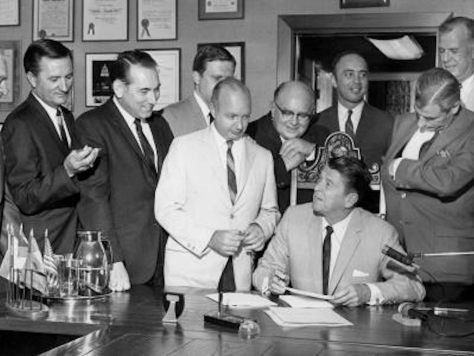
Gov. Ronald Reagan signs legislation establishing the California Air Resources Board to address the state’s air pollution, August 30, 1967. CA ARB
What are the “compelling and extraordinary conditions” that California’s regulations are designed to address?

In the 1950s scientists recognized that the unique combination of enclosed topography, a rapidly growing population and a warm climate in the Los Angeles air basin was a recipe for dangerous smog. Dutch chemist Arie Jan Haagen-Smit discovered in 1952 that worsening Los Angeles smog episodes were caused by photochemical reactions between California’s sunshine and nitrogen oxides and unburned hydrocarbons in motor vehicle exhaust.

California’s Motor Vehicle Pollution Control Board issued regulations mandating use of the nation’s first vehicle emissions control technology in 1961, and developed the nation’s first vehicle emissions standards in 1966. Two years later the EPA adopted standards identical to California’s for model year 1968 cars. UCLA Law scholar Ann Carlson calls this pattern, in which California innovates and federal regulators piggyback on the state’s demonstrated success, “iterative federalism.” This process has continued for decades.

California’s severe air pollution problems have made it a pioneer in air quality research.
California has set ambitious goals for slowing climate change. Is that part of this dispute with the EPA?

Yes. Transportation is now the largest source of greenhouse gas (GHG) emissions in the United States. The tailpipe standards that the Obama EPA put in place were designed to limit GHG emissions from cars by improving average fuel efficiency.

These standards were developed jointly by the EPA, the U.S. Department of Transportation (DOT), and California, which have overlapping legal authority to regulate cars. EPA and California have the responsibility to control motor vehicle emissions of air pollutants, including GHGs. DOT is in charge of regulating fuel economy.

Congress began regulating fuel economy in response to the oil crisis in the 1970s. DOT sets the Corporate Average Fuel Economy (CAFE) standard that each auto manufacturer must meet. Under this program, average fuel economy in the United States improved in the late 1970s but stagnated from the 1980s to the early 2000s as customers shifted to purchasing larger vehicles, including SUVs, minivans and trucks.

In 2007 Congress responded with a new law that required DOT to set a standard of at least 35 miles per gallon by 2020, and the “maximum feasible average fuel economy” after that. That same year, the Supreme Court ruled that the Clean Air Act authorized the EPA to regulate GHG emissions from cars.

The Obama administration’s tailpipe standard brought these overlapping mandates together. EPA’s regulation sets how much carbon dioxide can be emitted per mile, which matches with DOT’s increased standard for average fuel economy. It also includes a “midterm review” to assess progress. Administrator Scott Pruitt’s new EPA review, released on April 2, overturned the Obama administration’s midterm review and concluded that the 2022 to 2025 standard was not feasible.

The EPA now argues that earlier assumptions behind the rule were “optimistic” and can’t be met. However, its review almost entirely ignored the purpose of the standards and the costs of continuing to emit GHGs at high levels. Although the document is 38 pages long, the word “climate” never appears, and “carbon” appears only once.

The EPA’s decision does not yet have any legal impact. It leaves the current standards in place until the EPA and DOT decide on a less-stringent replacement.

U.S. carbon dioxide emissions from transportation exceeded those from electric power generation in 2016 for the first time since the 1970s.  USEIA
Can the Trump administration take away California’s authority to set stricter targets?

The EPA has never attempted to revoke an existing waiver. In 2007, under George W. Bush, the agency denied California’s request for a waiver to regulate motor vehicle GHG emissions. California sued, but the EPA reversed course under President Obama and granted the state a waiver before the case was resolved.

California’s current waiver was approved in 2013 as a part of a “grand bargain” between California, federal agencies and automakers. It covers the state’s Advanced Clean Cars program and includes standards to reduce conventional air pollutants like carbon monoxide, nitrogen oxides and particulate matter, as well as the GHG standards jointly developed with the EPA and DOT.

The Trump administration is threatening to revoke this waiver when it decouples the national GHG vehicle standards from California’s standards. EPA Administrator Pruitt has said that the agency is re-examining the waiver, and that “cooperative federalism doesn’t mean that one state can dictate standards for the rest of the country.” In our view, this statement mischaracterizes how the Clean Air Act works. Other states have voluntarily chosen to follow California’s rules because they see benefits in reducing air pollution.

How would California respond if the EPA revokes its waiver?

Gov. Jerry Brown, Attorney General Xavier Becerra and California Air Resources Board Chair Mary Nichols have all made clear that the state will push back. It’s almost certain that any attempt to revoke or weaken California’s waiver will immediately be challenged in court – and that this would be a major legal battle.


Nicholas Bryner, Emmett/Frankel Fellow in Environmental Law and Policy, University of California, Los Angeles and Meredith Hankins, Shapiro Fellow in Environmental Law and Policy, University of California, Los Angeles

BLOOMBERG: Local opposition to crude by rail is succeeding in California

Repost from Bloomberg
[Editor:  Note 3 mentions of crude by rail, and in the final paragraph a reference to local opposition to CBR in Santa Maria, Pittsburg and Benicia.  – RS]

California Isn’t Feeling U.S. Oil Boom as OPEC Dependence Grows

By Robert Tuttle, May 4, 2016 9:01 PM PDT

• State sourced a record 52% of its crude from overseas in 2015
• Falling in-state and Alaska production is driving imports

BBGThe shale oil boom that cut U.S. crude imports by 32 percent in a decade isn’t being felt out west as California grows increasingly dependent on Middle East supplies.

California brought in a record 52 percent of its crude from abroad last year, up from just 9 percent 20 years earlier, according to California Energy Commission data. The state hasn’t yet released the specific countries that supplied that oil in 2015, but in 2014, about 58 percent came from Saudi Arabia and Iraq, the most recent data show.

Foreign dependence is only expected to grow as supplies from within the state and Alaska diminish and efforts to bring U.S. crude from the Midwest by rail face local opposition.

“Regulatory impediments have kept California isolated from the growing sources of domestic crude production,” John Auers, executive vice president at Turner Mason & Co., said by phone from Dallas. “California refiners won’t be able to take advantage”’ of lower-priced domestic crude.

Growing imports mean that California refiners have some of the highest crude costs in the U.S., which are passed onto consumers in the form of higher gasoline prices, David Hackett, president of Irving, California-based Stillwater Associates, said in a phone interview.

Imported crude is priced off Brent, which was selling at less than a $1 premium to U.S. West Texas Intermediate Wednesday. While the lifting of restrictions on U.S. oil exports has narrowed the gap from as high as $15 a barrel in 2014, the spread between the grades could widen again when oil rises and U.S. shale oil production picks up, Hackett said.

Drivers in Los Angeles paid the highest pump prices in the U.S. for much of last year, exceeding $4 a gallon last summer, according to AAA.

Domestic Supply

Alaska supplied the state with 73,000 barrels a day of crude in 2015, about 12 percent of California’s total supply, state data show. That’s down from as high as 46 percent in the early 1990s and may fall further as Alaska’s production is forecast to drop to 319,100 barrels a day in 2023, down from almost 500,000 barrels a day this year, official datashow.

California itself produced about 225,000 barrels a day in 2015, supplying about 36 percent of its own needs, according to state data. That’s a drop from 240,000 barrels a day in 2014. The decline in the state’s own production came as producers cut output amid falling oil prices and following the shutdown of the Plains All American pipeline near Santa Barbara after a spill curtailed about 38,000 barrels a day of offshore production, Stillwater’s Hackett said.

California could benefit from cheaper Midwestern oil if crude by rail terminals were built. New terminals planned for Santa Maria, Pittsburg and Benicia have been stymied by local opposition and regulatory holdups, Hackett said. In February, for example, Valero Energy Corp’s planned crude-by-rail project was rejected by a city commission.

Half Million California Students Attend School In Oil Train Blast Evacuation Zones

Repost from DeSmogBlog
[Editor:  See the more detailed interactive map of schools by the Center for Biological Diversity.  Note Benicia’s Robert Semple Elementary School on the Center’s map, located just 0.88 miles from a Union Pacific train route which currently carries hazardous materials and is proposed for Valero Refinery’s Crude By Rail project.  Here’s a map of Robert Semple school and the tracks.  – RS] 

Half a Million California Students Attend School In Oil Train Blast Evacuation Zones

By Justin Mikulka, September 7, 2015 – 04:58

A new analysis by the Center for Biological Diversity finds that 500,000 students in California attend schools within a half-mile of rail tracks used by oil trains, and more than another 500,000 are within a mile of the tracks.

“Railroad disasters shouldn’t be one of the ‘three Rs’ on the minds of California school kids and their parents,” said Valerie Love with the Center. “Oil trains have jumped the tracks and exploded in communities across the country. These dangerous bomb trains don’t belong anywhere near California’s schools or our children.”

Click for larger image

Current safety regulations for first responders dealing with oil trains recommend evacuating everyone within a half-mile of any incident with an oil train. This wasn’t much of a problem for the most recent oil train accident in July in Culbertson, Montana because there were only 30 people within the half-mile radius area. However, in populated areas like California, potential scenarios could involve large-scale evacuations and casualties.

In addition to the threat posed to California’s students, the report Crude Injustice on the Rails released earlier this year by ForestEthics and Communities for a Better Environment, pointed out that in California the communities within the half-mile blast zones were also more likely to be low-income minority neighborhoods.

As more communities across the country become aware of the very real risks these oil trains pose, opposition is mounting to new oil-by-rail projects as well as challenges to existing facilities.

This past week in California, the Santa Clara County board of supervisors voted to keep oil trains out, citing an “unacceptable risk to our community.”

In Minnesota, Sen. Al Franken (D-MN) held a hearing on the subject and heard from concerned residents like Catherine Dorr, as reported by the local CBS station.

We’re in the 100 foot blast zone,” Dorr said. “My house and 60 townhouse residents are going to be toast if there’s an explosion.”

In Albany, New York which is the largest oil-by-rail hub on the East coast, this week a coalition of groups announced their intentions to sue the oil company transporting Bakken crude through Albany and challenge the validity of the air quality permit the company received in 2012.

And even in remote places like North Dakota, where much of the oil originates, the U.S. military is concerned about the proximity of the oil train tracks to nuclear missile facilities.

With all of this concern about the dangers of oil trains, a new report by the Associated Press (AP) paints a troubling picture about the preparedness of populated areas to respond to an oil-by-rail incident. The report was based on interviews with emergency management professionals in 12 large cities across the U.S.

It concludes, “The responses show emergency planning remains a work in progress even as crude has become one of the nation’s most common hazardous materials transported by rail.”

As noted on DeSmog, one of the reasons that the oil trains pose such a high risk is that the oil industry refuses to stabilize the oil to make it safe to transport. And the new regulations for oil-by-rail transport released this year allow for older unsafe tank cars to be used for another 8-10 years.

While the regulations require modernized braking systems on oil trains in future years, the rail industry is fighting this and a Senate committee recently voted to remove this from the regulations.

The reality is that unless there are drastic changes made, anyone living within a half mile of these tracks will be at risk for years to come.

And while oil production isn’t increasing in the U.S. right now due to the low price of oil, industry efforts to lift the current ban on exporting crude oil could result in a huge increase in fracked oil production. In turn, that oil will be put on trains that will head to coastal facilities and be loaded on tankers and sent to Asia.

Despite all of the opposition and the years-long process to complete new regulations, as the Associated Press notes, it isn’t like the emergency first responders are comfortable with the current situation.

“There could be a huge loss of life if we have a derailment, spill and fire next to a heavily populated area or event,” said Wayne Senter, executive director of the Washington state association of fire chiefs. “That’s what keeps us up at night.”

And even the federal regulators expect there are going to be catastrophic accidents. As reported by the AP earlier this year, the Department of Transportation expects oil and ethanol trains “will derail an average of 10 times a year over the next two decades, causing more than $4 billion in damage and possibly killing hundreds of people if an accident happens in a densely populated part of the U.S.”

With the known risks and the number of accidents, so far communities in the U.S have avoided disaster. But as Senator Franken pointed out, that has just been a matter of luck.

We’ve been lucky here in Minnesota and North Dakota and Wisconsin that we’ve not seen that kind of fatalities, but we don’t want this to be all about luck,” Sen. Franken said.

As over 1,000,000 students in California start a new school year in schools where they can easily hear the train whistles from the oil trains passing through their communities, let’s all hope we keep this lucky streak going.

Oil Industry Spending Millions on California Lobbying

An email alert from California League of Conservation Voters (EcoVote.org)

Home
EcoVote.org

From: Sarah Rose, Chief Executive Officer,  California League of Conservation Voters
Sent: Saturday, August 15, 2015 8:01 AM
Subject: BREAKING: In California, Oil Industry Spends Millions on State-Level Lobbying

Breaking news:

In a report just released by the California Secretary of State, we can see for the first time just how far the oil industry is willing to go to influence state lawmakers. Here what we know:

  • Oil industry lobbyists spent $6.2 million − in just the first six months of this year – to push their agenda on state-level issues in California.
  • Oil companies are spending more than $1 million per month to stop Californians like us from cleaning up the air we breathe, protecting our drinking water supplies, shifting to renewable energy, and preventing future oil spills.
  • They’re not slowing down. In fact, this week the oil industry’s main lobbying group WSPA (Western States Petroleum Association) launched an all-out attack on climate change bills in the statehouse right now. Under the mask of their front group “California Driver’s Alliance,” WSPA’s deceptive and manipulative ads are now running on television, internet, and radio in several key legislative districts throughout the state.
  • We can beat them, but we need your help. Right now, we’re fighting to pass a historic package of climate change laws that will thrust California back into the forefront of global climate leadership. Here at CLCV, we’ve faced off against WSPA in countless battles over our 40-year history. We’ve beat them enough times to know what works – and it’s you  (yes, you!) persistently contacting your lawmakers, speaking your mind, and personally insisting that your life and your family’s future are more important than the profit margins at Chevron and Shell. Take action and send your message to lawmakers right now. >>

Last year, the oil industry spent a record $20 million in lobbying to try to stop the full implementation of California’s first landmark climate and clean energy law, AB 32 – but they failed, because we fought back. Thousands of us in the California League of Conservation Voters stood side-by-side with our allies and fought back against WSPA’s cynical propaganda. Together, we defeated their pro-pollution agenda, and now transportation fuels (which are responsible for 40% of carbon pollution and 80% of smog-causing pollution produced in CA) are included under the “cap” in cap-and-trade.

I’m proud of our victory last year, but the real story is we won that battle by the skin of our teeth. Things very easily could have gone the other way if we didn’t have so much help from voters like you. Now, the stakes are even higher, and the oil industry is on track to break last year’s spending record to lobby against us. We need your help today: Stand with us now. >>

Sincerely,

Sarah Rose Chief Executive Officer California League of Conservation Voters

P.S. As they attempt to hide from public scrutiny, oil companies funnel most of their California lobbying cash through the industry lobbying group WSPA (Western States Petroleum Association). But one oil company − Chevron – went above and beyond. In addition to their WSPA contributions, Chevron spent $1.5 million lobbying for influence over California laws. That means two spots on California’s top-five list for big-spending lobbyists belong to Big Oil. We can’t let them win. Please, speak out about climate change right now: http://ecovote.org/ActOnClimate >>

Additional background: CLCV supports Senate Bill 32 (Pavley) and Senate Bill 350 (de León) to combat climate change, reduce pollution, create clean energy jobs, and ensure that all California communities are prepared for the future. Specifically, these important bills call for bold but achievable new climate goals:

  • Increase from one-third to 50 percent our electricity derived from renewable sources
  • Reduce today’s petroleum use in cars and trucks by up to 50 percent
  • Double the energy efficiency of existing buildings
  • Reduce greenhouse gas emissions to 80 percent below 1990 levels by 2050

With help from thousands of CLCV supporters like you, these important bills have already passed the State Senate. Now both bills are facing critical votes in the Assembly. Make sure your Assemblymember hears from you: Speak out now!

We need to keep making progress to address the challenges presented by climate change, especially in our hardest-hit communities. Senate pro Tem Kevin de León put it best: “For too long, poor and working class families in California’s most polluted communities do not have the opportunity to invest in clean, efficient transportation … We need to move the state away from fossil fuels, away from the grip of oil … This is common sense climate policy.”

Since 1972, the California League of Conservation Voters (CLCV) has protected our land, air, water, and public health as the non-partisan political arm of the environmental movement. CLCV’s mission is to protect and enhance the environment and the health of all California communities by electing environmental champions, advancing critical priorities, and holding policymakers accountable. You can unsubscribe at any time, but we hope you’ll stay. You make a big difference with CLCV, because our political strength comes from members like you. Thanks for reading, and thank you for everything you do to make California a cleaner, safer, and healthier place to call home.