House rejects N.J. Rep. Garrett’s effort to divert funding to railroad safety
By Jonathan D. Salant, NJ Advance Media for NJ.com The Star-Ledger, June 05, 2015 at 9:33 AM
WASHINGTON — The U.S. House on Thursday rejected an effort by Rep. Scott Garrett to use some money earmarked for new transit projects to improve safety on existing lines instead.
By a vote of 266-160, the House defeated Garrett’s attempt to amend the transportation spending bill and transfer $17 million to the Federal Railroad Administration’s safety account from the funds earmarked for new construction.
“You wouldn’t put an addition on your house if the roof was caving in,” said Garrett (R-5th Dist.). “So why are we prioritizing new transit projects before funding the safety of our existing lines?”
Garrett’s amendment was supposed by three other members of the state’s congressional delegation, Reps. Tom MacArthur (R-3rd Dist.), Leonard Lance (R-7th Dist.) and Rodney Frelinghuysen (R-11th Dist.). The other eight House members from New Jersey voted no.
“Just this year we have seen two oil train derailments and over a dozen Amtrak-related accidents, including the tragic crash in Philadelphia that claimed eight lives and injured dozens more,” Garrett said. “I am disappointed that the House ignored the call of our constituents by voting against this common-sense amendment.”
The transportation spending bill for the fiscal year beginning Oct. 1 cuts Amtrak funding by $251 million to $1.14 billion. President Obama sought $2.45 billion.
The measure passed the Republican-led House Appropriations Committee one day after the May 12 Amtrak derailment in Philadelphia that killed eight people and injured more than 200.
Repost from The Blade, Toledo, Ohio [Editor: Significant quote by Josh Mogerman, spokesman for the Natural Resources Defense Council’s Great Lakes regional office in Chicago: “Welcome to the Bomb Train Capital of America…. Of all the suite of issues I work on for the NRDC, this is the scariest…. These are moving targets going through very, very densely populated areas.“
RISKY CARGO ON MIDWEST OIL TRAINS
Amid fracking boom, cities fear explosive safety risk it can carry
BY TOM HENRY , BLADE STAFF WRITER, June 1, 2015
CHICAGO — While the global fracking boom has stabilized North America’s energy prices, Chicago — America’s third largest city and the busiest crossroads of the nation’s railroad network — has become ground zero for the debate over heavy crude moved by oil trains.
With the Windy City experiencing a 4,000 percent increase in oil-train traffic since 2008, Chicago and its many densely populated suburbs have become a focal point as Congress considers a number of safety reforms this year.
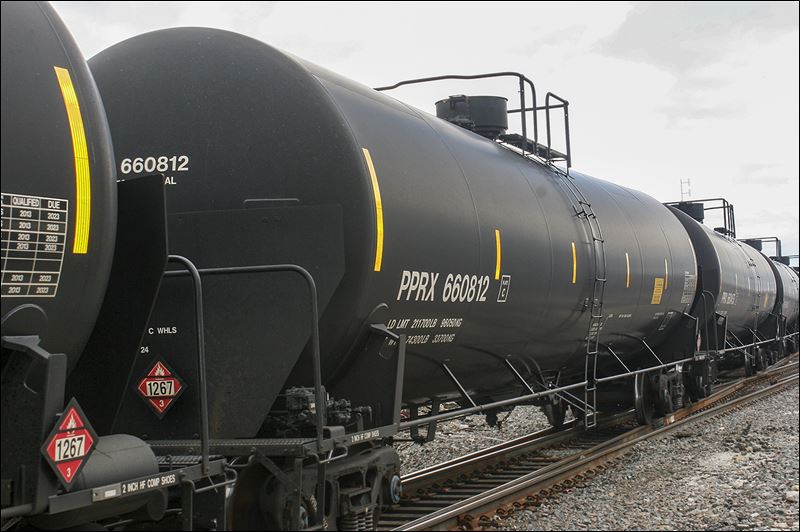
Many oil trains are 100 or more cars long, carrying hydraulically fracked crude and its highly explosive, associated vapors from the Bakken region of Montana, North Dakota, Saskatchewan, and Manitoba.
A majority of those trains also cross northwest Ohio on their way to refineries and barge terminals along the East Coast.
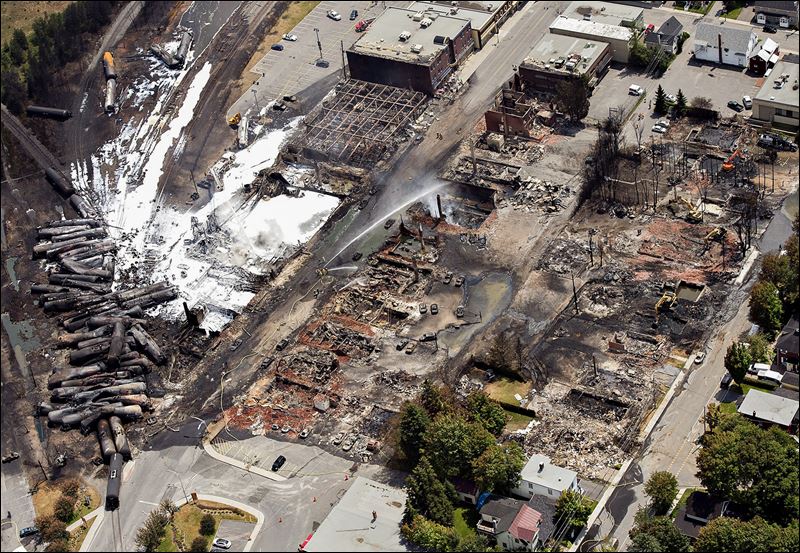
Derailments can lead to massive explosions, such as the one on July 6, 2013, when a runaway train derailed in Lac-Megantic, Que., just across the U.S.-Canada border from Maine. The resulting explosions and fire killed 47 people and leveled the town’s business district.
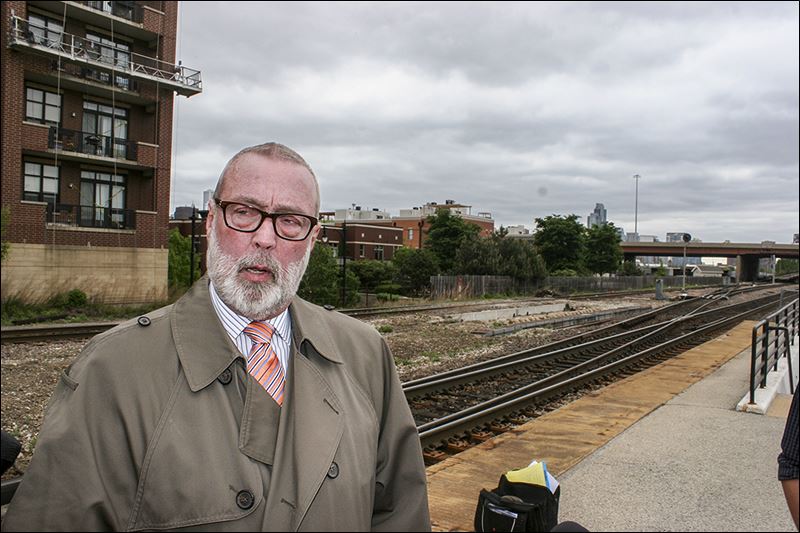
“For me to assure my community there’s no risk, I would be lying,” Aurora, Ill., Mayor Tom Weisner told reporters on the Halsted Station’s elevated platform near downtown Chicago last week. The discussion was arranged by the Institutes for Journalism & Natural Resources, a group that promotes better environmental reporting.
Authorities are concerned a rail accident would be catastrophic, as trains are carrying more heavy crude since fracking became popular. THE BLADE/BRIAN BUCKEY
“A derailment in or around our downtown would be absolutely disastrous,” he said.
One of Chicago’s distant western suburbs, Aurora, with 200,000 people, is the second-largest city in Illinois. Though it has fewer than one resident for every 10 in Chicago (population: 2.7 million), Aurora is somewhat smaller than Toledo, which has 281,000 residents.
Mr. Weisner, whose mayoral office overlooks tracks where many of the oil trains pass going toward Chicago, shrugged when asked about emergency planning.
“That always helps, of course. But you could have a major catastrophe before they could arrive on the scene, and that’s the truth,” Mr. Weisner said, noting the Lac-Megantic explosion on at least three occasions.
Closer to home, he said, are memories of a train explosion on June 19, 2009, in Cherry Valley, Ill., just outside Rockford.
Although that derailment involved a train carrying flammable ethanol — not an oil train — its fire killed a motorist stopped at a railroad crossing, injured seven people in cars plus two firefighters, and forced the evacuation of 600 homes.
Aurora, Ill., Mayor Tom Weisner fears what would happen if an oil train derails and explodes in an urban area. THE BLADE/TOM HENRY
On March 5, 21 cars of a 105-car BNSF Railway train hauling oil from the Bakken region of North Dakota derailed in a heavily wooded, rural area outside Galena, Ill.
The train erupted into a massive fireball 3 miles from a town of 3,000 people in the northwest corner of Illinois, near the Iowa and Wisconsin borders.
No deaths were reported from that incident and, like several other derailments that have resulted in explosions and fires in recent years, it occurred in a rural area.
Mr. Weisner and others fear it is a matter of time before a much higher-profile incident occurs in Chicago or some other big city where the death toll could be significant.
Shortly after he finished, an oil train moved past Halsted Station, whose tracks are flanked by high-rise apartment buildings.
Oil trains move throughout the Great Lakes region after getting filled with Bakken crude, often ending up on the East Coast.
Chicago and the rest of the Great Lakes region is “the heart of the country,” Mr. Weisner said.
“We’re always going to be at one of the highest levels of exposure,” the Aurora mayor said. “There’s no doubt about it.
This July 7, 2013, photo shows fire fighters watering smoldering rubble in Lac Megantic, Que., after a runaway train derailed causing explosions that killed 47 people and leveled the town’s business district. ASSOCIATED PRESS
Environmental activists such as Josh Mogerman, spokesman for the Natural Resources Defense Council’s Great Lakes regional office in Chicago, put the risk in more graphic terms.
“Welcome to the Bomb Train Capital of America,” he told reporters outside a coffee shop at West Maxwell and Halsted streets, three blocks north of the train station where Mr. Weisner would speak moments later.
“Of all the suite of issues I work on for the NRDC, this is the scariest,” Mr. Mogerman said. “These are moving targets going through very, very densely populated areas.”
Tony Phillips is an artist who lives in a condominium adjacent to Chicago’s Halsted Station.
He said he can hear “the rip of noise” and feel his building shudder as oil trains come by, often in the wee hours of the morning. He said he feels a “slosh effect” in the flooring from the oscillating weight of crude if he gets up in the middle of the night.
“That’s a little spooky,” Mr. Phillips said.
He and others want reforms, tighter rules, and more robust train cars, if nothing else. Some efforts are being made through tighter regulations, but critics claim they’re either not enough or being phased in too slowly.
Fracking boom
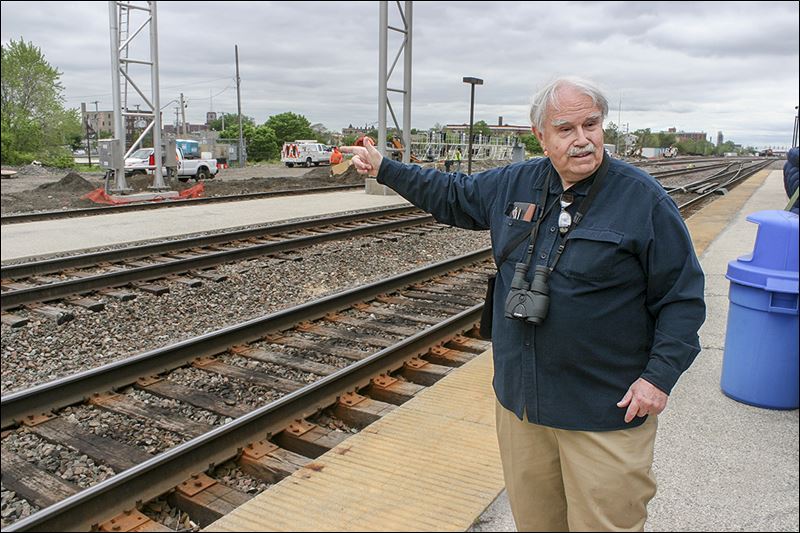
Tony Phillips points to the condo in Chicago where he lives on the other side of the tracks at the Halsted Station, where oil trains pass by. THE BLADE/TOM HENRY
Lora Chamberlain, spokesman for Frack Free Illinois and a new coalition called Chicagoland Oil By Rail, said vapor removal should be on the list of priorities to help mitigate the risk.
In a May 7, 2014, order, the U.S. Department of Transportation called for state emergency responders to receive more information about railroad routes handling 1 million gallons or more of Bakken crude oil per week because the number and type of railroad accidents “is startling.”
In 2013, America moved 8.3 billion barrels (348.6 billion gallons) of crude oil via pipeline — nearly 29 times the 291 million barrels (12.2 billion gallons) moved by rail, according to data from the Association of Oil Pipelines and the Association of American Railroads.
Safety experts see North America at a turning point because of the oil and gas industry’s rapid increase in hydraulic fracturing of shale bedrock, a process commonly known as “fracking” that the U.S. Energy Information Administration predicts will remain strong for at least the next 30 years.
Fracking has occurred commercially since the 1950s. The game-changer occurred less than a decade ago, when a technique developed to combine horizontal drilling with fracking made it economical to go after vast reserves of previously trapped oil and natural gas worldwide — including in eastern Ohio and western Pennsylvania, where the Utica and Marcellus shale regions meet.
Rail traffic
Railroads moved 493,126 tank-car loads of oil in 2014, a nearly 5,200 percent increase over the 9,500 tank cars that hauled oil before the fracking boom began to hit its stride in many parts of North America in 2008, according to the U.S. Department of State. Before the fracking boom, rail shipment of crude was rare and generally confined to a few isolated corridors where pipelines hadn’t been built.
Overall domestic crude production has risen 70 percent during that same period. U.S. Energy Information Administration figures show domestic oil produced at a rate of 8.5 million barrels a day in 2014, up from 5 million barrels a day in 2008.
Mogerman | THE BLADE/ BRIAN BUCKEY
This year, crude is expected to be produced at a rate of 9 million barrels a day, just shy of its peak rate of 9.6 million barrels a day in 1970, according to the Energy Information Administration.
“While pipelines transport the majority of oil and gas in the United States, recent development of crude oil in parts of the country under-served by pipeline has led shippers to use other modes, with rail seeing the largest percentage increase,” a Government Accountability Office report said. “Although pipeline operators and railroads have generally good safety records, the increased transportation of these flammable hazardous materials creates the potential for serious accidents.”
The agency cited a need for better U.S. Department of Transportation rules on flammability of products shipped by rail and a greater emphasis on emergency preparedness, “especially in rural areas where there might be fewer resources to respond to a serious incident.”
In its 2015 forecast, the Association of American Railroads contends railroads “are making Herculean efforts” to improve “an already safe nationwide rail network” now crisscrossing some 140,000 miles of the country.
The trade association said freight railroads plan to spend a record $29 billion in 2015 — a staggering $3 million an hour or about $79 million a day — to rebuild, maintain, and expand America’s rail network. Much of the money will go toward new equipment and locomotives, new track and bridges, higher tunnels, and newer technology.
Freight railroads are expected to hire 15,000 more people this year, continuing its upward hiring trend for an industry that employs 180,000 people, the association said.
While considering safety reforms, Congress must ensure that “any changes to public policy still allow railroads to continue private infrastructure spending and other network investments needed to meet customer demand,” the industry group said.
Union Pacific chief threatens action on oil train brake rules
Robert Wright in New York, May 31, 2015 4:55 pmIn this photo from Aug. 8, 2012, a Union Pacific train travels in Council Bluffs, Iowa. Union Pacific said Thursday, Oct. 18, 2012, that its third-quarter profit climbed 15 percent because price increases and more automotive and chemical shipments helped the railroad offset a 12 percent drop in coal shipments. The railroad reported $1 billion in net income, or $2.19 per share. That’s up from $904 million, or $1.85 per share, a year ago. (AP Photo/Nati Harnik)
The chief executive of Union Pacific, the US’s largest rail network, has vowed legal action over a provision of new rules for oil trains that he says would cost billions of dollars and provide little benefit.
The pledge from Lance Fritz threatens further delay to rules that have already been years in preparation.
The Federal Railroad Administration and Canadian regulators jointly announced the rules less than a month ago to improve the safety of oil movements by rail, which have risen sharply following the surge in US oil and gas production in recent years.
The surge — from only about 1m tonnes of traffic in 2007 to roughly 40m in 2013, the last year for which full data are available — has exposed the shortcomings of existing safety rules for tank cars, with several trains exploding following derailments.
While Mr Fritz said that most of the new provisions were “great regulation”, he criticised provisions demanding that railways start controlling tank cars’ brakes via an electric signal either transmitted wirelessly from the lead locomotive or via electrical wires running along the train.
The new arrangement, known as electronically controlled pneumatic (ECP) braking, is intended to speed up the transmission of the braking command compared with current methods, which rely on pressure changes in a pipe running along the train. That should reduce the number of cars that derail in a crash.
Mr Fritz said, however, that virtually the same improvements could be gained by spacing locomotives out along a train, as Union Pacific frequently does, and the extra benefits of ECP did not justify the costs. The new equipment would cost about $75,000 for each of UP’s 6,500 locomotives, while there would also be substantial costs for fitting out tank cars, nearly all owned by oil shippers or leasing companies.
“The juice isn’t worth the press,” Mr Fritz said. “We think that’s very ill-considered. We provided that feedback and we will continue to provide that feedback.”
The industry could appeal against the rule both through administrative channels and in the courts, Mr Fritz said. “We as an industry are taking that path,” he added.
Railways have been pressing for improvements in tank car design to avoid a repetition of disasters like the Lac-Mégantic explosion in Canada in 2013, in which 47 people died when a poorly secured oil train broke lose, derailed and exploded in the centre of a small town.
Operators are barred from refusing to carry cargo that meets the minimum regulatory requirements but have been concerned that under existing regulations cars were excessively vulnerable in an explosion.
Mr Fritz also criticised the new rules’ standards for thermal protection for cars, meant to prevent their exploding in a fire, saying they were not strict enough.
The Federal Railroad Administration declined to comment publicly on Mr Fritz’s criticisms but looks determined to press ahead with the mandate for ECP brakes.
UP, which has a larger track network than any other US railway, has been a significant beneficiary of the surge in oil movements. Mr Fritz said he expected a strong continuing role for rail in transporting US-produced crude oil.
The sharp fall in the oil price in recent months has shifted traffic away from the routes that UP serves, however, pushing down crude oil movements on its network by 38 per cent in the first quarter compared with last year.
Two-person train crews necessary for safety, lawmakers say
By Zach Pluhacek | Lincoln Journal Star, May 28, 2015 1:45 pm
A BNSF Railway locomotive pulls cars of coal through Lincoln in January. FRANCIS GARDLER/Journal Star file photo
Trains need two-person crews to help prevent disasters like the 2013 derailment and explosion of a crude oil train that killed 47 people in Quebec, some Nebraska lawmakers argued Thursday.
The Federal Railroad Administration has signaled plans to require two-man crews on trains carrying oil and freight trains, which is the industry’s standard practice, but its proposed rule hasn’t been issued.
Rail lines would like to switch to a crew of one on most freight engines as they equip trains with positive train control, a new federally mandated wireless safety system that can force a train to stop automatically to avoid a potential crash.
“This is a risky development for public safety in Nebraska, particularly in light of the hazardous types of freight that are being hauled through our state,” said Sen. Al Davis of Hyannis on Thursday.
Nebraska is home to the nation’s two biggest railroads, Union Pacific, based in Omaha, and BNSF Railway, which is owned by Berkshire Hathaway in Omaha. UP operates the world’s largest railroad classification yard, the Bailey Yard in North Platte, and BNSF has extensive operations in Lincoln and the rest of Nebraska.
Davis sponsored a measure (LB192) this year that would have outright required two-person crews in Nebraska, but it failed to advance from the Legislature’s Transportation and Telecommunications Committee.
Instead, lawmakers passed a nonbinding resolution Thursday that doesn’t specifically call for two-person crews, but it urges the Federal Railroad Administration to adopt a rule that “ensures public safety and promotes the efficient movement of freight, while supporting interstate commerce.”
The resolution (LR338) was adopted on a 36-4 vote.
“These trains are some of the heaviest moving things on this planet, and just having one person in charge doesn’t seem to make sense,” said Sen. Ken Haar of Malcolm, who cosigned the resolution.
But Sen. Tyson Larson of O’Neill argued human mistakes are often to blame when tragedy strikes. “Sometimes true safety does lie within automation,” he said.
Union Pacific opposes the resolution because it falsely implies trains are unsafe and ignores collective bargaining deals that have addressed safe train crew sizes for decades, said spokesman Mark Davis.
Two rail unions — the Brotherhood of Locomotive Engineers and Trainmen and the International Association of Sheet Metal, Air, Rail and Transportation Workers, which represent about 3,700 active members between them — support the resolution.
Cutting down on the number of crew members would almost certainly affect jobs and reduce the number of workers paying into shared retirement plans.
The more critical issue is what happens when a train derails or breaks down, said Pat Pfeifer, state legislative board chairman for the Brotherhood of Locomotive Engineers and Trainmen.
One crew member has to remain inside the engine at all times, so without a second person, there’s no one available on scene to help cut a crossing or take other emergency precautions.
Both unions are also backing a bill in Congress to require two-person crews.
“It’s about public safety; it’s not about jobs,” Pfeifer said.