
Category Archives: Local Regulation

BREAKING NEWS: City of Benicia releases final Resolution to Deny Valero Crude by Rail

By Roger Straw, October 13, 2016

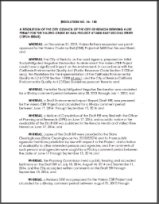
reso_16-160Today the City of Benicia released the final draft of the City Council’s Resolution No. 16-150, A RESOLUTION OF THE CITY COUNCIL OF THE CITY OF BENICIA DENYING A USE PERMIT FOR THE VALERO CRUDE BY RAIL PROJECT AT 3400 EAST SECOND STREET (12PLN-00063)

This document represents the “wordsmithed” version created during the City Council’s October 4 meeting.  This final version has not been previously seen by the public.

At the October 4 meeting, Council members insisted on strengthening the section (now numbered 1. on page 4) that describes the Surface Transportation Board’s decision, clarifying its opinion “that the City has the police power to protect public health and safety so long as it does ‘not discriminate against rail carriers or unreasonably burden interstate commerce.'”

The Council also directed staff to make substantial changes in the format of the staff’s draft version, moving all references to rail-related impacts to a single “informational” item (now numbered 2A-2F on pages 4-6).

The heart of the revised document – findings for denial – are numbered 3-6 on pages 6-9.

NOTE: The 10-page PDF document linked above is large (4.8MB) and slow to download from the City’s website, so be patient.  A smaller unofficial version can be downloaded here or you can download the original from Google Drive here.

Benicia City Council approves “findings,” officially closes the door on Valero Crude By Rail

By Roger Straw, October 5, 2016

benicia_logoAfter lengthy discussion and significant tweaking on Tuesday night Oct 4, the Benicia City Council unanimously approved a Resolution to Deny Valero’s proposal to build an offloading facility for oil trains. After a long list of whereases, the document indicates “findings” that back up the Council’s unanimous September 20 vote to deny Valero’s permit.

Anticipating litigation, Council members spent hours reworking the findings submitted by City Attorney Heather McLaughlin, making every effort to approve a document that would be “bullet-proof” in a court of law.

In the draft submitted to Council by staff, a number of the findings pointed out serious impacts both uprail and onsite.  Council wordsmithed the document to move suggested “findings” that relate to OFFSITE rail impacts to a section of the document that was “for information only.”  That section is included only to alert State and Federal governmental officials and regulators that more needs to be done at those levels to reign in unsafe and polluting transport of North American crude oil by rail.

The remaining findings relating to ONSITE impacts are extensive, and should be more than adequate to stand up in any possible court challenge.

The edited version of Council’s Resolution is not yet available as of this writing.  The draft copy is available here.  Minutes of the Council meeting have not yet been posted, but VIDEO of the Oct 4 meeting is available on the City’s website, here.  The Council’s discussion begins at 2:19:10 on the video and goes for an hour and a half, until the end of the meeting, at 3:49:34.

Valero attorney claims that Benicia APPROVED Crude by Rail on Sept. 20!!

By Roger Straw, October 3, 2016

Incredible: “The permit is therefore approved by operation of law.”

In yet another bizarre legal maneuver, Valero’s attorney John Flynn sent a letter to the Mayor and members of the City Council on October 3, claiming that by various acts of commission and omission, the City Council on September 20 failed to properly deny Valero’s permit, and that therefore the permit is “approved by operation of law.”

The logic is twisted, but stick with me.

Flynn is claiming that “the City Council’s action of September 20 violated both state and federal law” on a variety of grounds:

  • Timing – Valero claims that a decision with proper findings in support of denial was required by September 20, but the Council sent staff back to revise the findings in the draft resolution of denial.
  • Council members’ statements – Valero claims that Council members were required to verbally state the grounds upon which they voted to deny the project, and that they ONLY stated concerns about rail-related impacts, which Valero continues to claim are preempted from consideration under federal law.  Note here that Valero re-states its failed argument that even ON-SITE rail impacts are preempted.
  • Reliance on a letter received on September 20 – Valero claims that the City may not rely on information in a letter from the law firm Adams Broadwell Joseph & Cardozo in framing its arguments for denial. Poor Valero states that it (and the public) didn’t have a chance to rebut the letter. This from the company which sent two last-minute unrebuttable letters which City staff included in the Council’s agenda packet!
  • Reliance on the Surface Transportation Board letter – Valero claims that Council relied on the STB’s dismissal of Valero’s petition in its decision, and that Valero and the public never had an opportunity to comment on the STB’s decision. Valero demands that the City not refer to anything in the federal agency’s decision when drafting findings for denial.
  • Council’s request for staff to edit its draft resolution of denial – Valero claims that any editing of the draft resolution would amount to “post hoc rationalizations.”  Baloney. It’s done all the time.
  • The letter goes on and on, but I will leave it to the City Attorney and others to flesh out Valero’s twisted bullying tactics.

IMPORTANT: The letter concludes by foreshadowing a lawsuit against the City:

“The transcript of the September 20 hearing will no doubt clearly establish for a Court that the only grounds invoked by the Council for denying Valero’s application were rail-related grounds, and that any other grounds invoked in the written findings proposed by staff and by Adams Broadwell are no more than baseless afterthoughts, in a desperate bid to deny Valero’s permit application, despite the lack of any legal or factual bases for such a denial.”

Benicia decision being felt in Albany NY

Repost from the Albany Times-Herald

Ruling on oil trains hailed

Federal action seen as boost to local, state control over projects

By Brian Nearing, Thursday, September 29, 2016 10:03 pm

ALBANY  >  A federal ruling on a oil-by-rail facility in California could hand state and local officials in New York and across the country a powerful legal tool to oversee the projects, which have been controlled primarily by federal rules.

The federal Surface Transportation Board this month sided with officials in Benicia, a small city near San Francisco, in a dispute with an oil refining company over a proposed storage terminal for crude oil brought in by tanker trains. The Valero Refining Company had argued it was exempt from a city denial because it was functioning as a rail carrier, and governed by federal transportation rules — a legal concept called “preemption” — but the federal board rejected the claim.

“Valero is not a rail carrier, nor is it acting under the auspices of a rail carrier,” according to the federal decision. Critics of oil train traffic directed in recent years to two oil terminals at the Port of Albany hailed the ruling as a victory for more state and local control.

“This puts the state Department of Environmental Conservation in a very strong position to require the oil terminals to explain the full impacts of their operations,” said Chris Amato, an attorney for the not-for-profit environmental group Earthjustice.

This month, the DEC announced it was requiring one terminal operator, Global Partners, to answer additional environmental questions on its request to construct a crude oil heating terminal that could be used to process Canadian tar sands oil.

“Nothing in the opinion suggests that DEC’s current course of action with respect the Port of Albany should be altered,” a DEC statement said.

Critics of earlier DEC environmental approvals for the Global and Buckeye oil terminals have been urging the state to rescind its approvals, but the state had responded that such authority rested with the federal government, not the state.