
After Hamas attacked Israel, some U.S. Palestinians said that American politicians and news outlets ignored underlying causes and took Israel’s side.

New York Times, by Mitch Smith, Lauren McCarthy, Ernesto Londoño and Miriam Jordan, October 12, 2023
As news spread over the weekend that gunmen from Hamas, the Palestinian faction that governs the Gaza Strip, had killed hundreds and taken hostages in a surprise attack on Israel, Zarefah Baroud watched in horror from Seattle.
Ms. Baroud, a doctoral student and activist who is Palestinian American, said she felt deep sadness for the Israelis who were killed and kidnapped. And she was immediately worried that those killings would be “used to justify genocide” against Palestinians.
On Monday, Ms. Baroud managed to reach a younger cousin in Gaza. In an exchange of painful text messages, she learned that her aunt and five cousins, ages 9 to 18, had been killed in a retaliatory airstrike.
“Virtually every year there is a bombing campaign, but I’ve never heard my family talk as hopelessly about the situation,” said Ms. Baroud, 24, who faulted Israel for the escalation in hostilities. “There is nowhere to hide.”
Palestinians in the United States have long grappled with the complicated history of their ancestral home and the foreign policy of their adopted one. Many have parents or grandparents who left the Middle East decades ago when the modern Israeli state was founded. Their families found refuge and built new lives in America, starting businesses, joining mosques or churches, enjoying a sense of freedom and stability.
But all that time, their new country has remained a proud ally of Israel’s government, which many Palestinians see as an oppressive, occupying force.
“I cannot understand the double standard of this country,” said Zein Rimawi, a Palestinian who immigrated to the United States in the 1980s and lives in New York City, where he founded a mosque. Mr. Rimawi said he was troubled by the way U.S. leaders were supportive of Ukraine’s fight against Russia, yet, in his view, unable to understand the perspective of Palestinians.
In interviews with more than a dozen Palestinian Americans, many said they were saddened by the violence against civilians, both Israeli and Palestinian, and hoped for a peaceful resolution. But many said that the underlying causes of the conflict could be traced to the policies of Israel and the United States, and decades of Palestinians being denied freedom of movement and basic rights.
Gaza residents have long endured food and medicine shortages, crumbling infrastructure, soaring joblessness and outbreaks of violence that have killed thousands of people. The expansion of Israeli settlements in the West Bank, which complicates the possibility of a two-state solution, has enraged Palestinians.
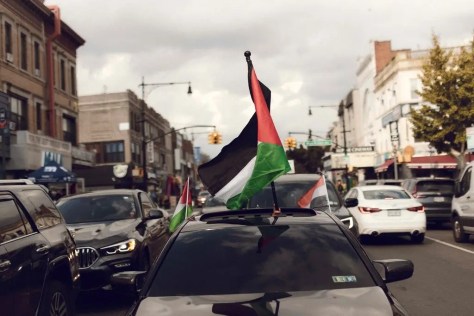
Several Palestinian Americans said they were frustrated by the bipartisan rush by U.S. politicians to support Israel, and by the way the conflict had been covered in American news outlets. Over the last few days, some have organized protests across the country that have included blistering critiques of Israel and calls to “free Palestine,” even amid criticism that such gatherings are tone-deaf.
“We have to have a memory that’s longer than 24 hours,” said Muhammad Sankari, an organizer with the Chicago Coalition for Justice in Palestine, which helped arrange a protest on Sunday outside that city’s Israeli consulate. “There’s 75 years of the occupation of Palestine.”
Clashes over the land date back to biblical times. The establishment of the modern Israeli state in 1948 on land that had been occupied by Britain led to a decades-long conflict over land and statehood for Palestinians.
More than two million Palestinians live in Gaza, a strip of land on the Mediterranean Sea whose borders are tightly controlled by Israel and Egypt. Since 2007, Gaza has been governed by Hamas, which the United States and European Union have labeled a terrorist organization.

More than 170,000 people in the United States identified as having Palestinian heritage in the 2020 census. Other census data shows that a majority of Palestinians in the country are American-born. Among those who immigrated, more than half have been in the country for at least two decades.
Within the Palestinian community, the census figures are considered to be a significant undercount given longstanding challenges in tallying the number of Americans of Middle Eastern and North African descent.
Though Palestinians live across the country, they are concentrated in a handful of large metropolitan areas.
In Anaheim, Calif., a district known as Little Arabia was revitalized with shops and restaurants by immigrants from the Middle East, including Palestinians. Last year in Paterson, N.J., part of Main Street was renamed “Palestine Way.” In a stretch of suburban Chicago that some refer to as Little Palestine, store names are listed in both Arabic and English, bakeries sell the Middle Eastern cookie maamoul and the soccer stadium hosts an annual Palestine Fest.
In the days since Israel began a counteroffensive to the terrorist attacks, health officials in Gaza said that 1,400 Palestinians had been killed and more than 6,200 others had been wounded. Officials said that more than 1,200 people in Israel had been killed, and an estimated 150 abducted.
Essa Masoud, a Staten Island resident who owns a halal grocery store, said his reaction to the war was “mostly regret.”
“Regret that this is happening; regret that people from both sides are getting killed,” said Mr. Masoud, whose parents were Palestinian immigrants, and who has family living in Jerusalem.
Still, the gulf between U.S. foreign policy and the views of many Palestinians has been on sharp display in recent days as protesters gather in American cities to speak against Israel’s government and voice support for Palestinian civilians bracing for counterattacks.
Most American officials, even those leery of the rightward shift of Israel’s government, have loudly defended Israel in recent days. President Biden called the attack against Israel “pure unadulterated evil.” Nikki Haley, the former United Nations ambassador and a Republican presidential candidate, said, “Israel needs our help in this battle of good vs. evil.”
And in New York, where supporters of Palestinians and Israelis held dueling rallies in Times Square, Gov. Kathy Hochul, a Democrat, called the gathering by Palestinians “abhorrent and morally repugnant.”
Sumaya Awad, a Palestinian American writer and activist living in New York City, said responses like those were shocking.
“These statements are really dehumanizing us,” she said, “and telling us that our lives are not worth anything.” In the eyes of those officials, she added, “we are never the victim, we are always the aggressor.”
The attacks by gunmen from Hamas galvanized this country’s Jewish community, which includes about 7.5 million people. Though American Jews hold a range of views about the Israeli government and U.S. politics, they were largely united in shock and anger at Hamas, with many voicing fear about the safety of friends or relatives in Israel. As of Thursday, at least 25 American citizens were known to have died in the violence, with others among the hostages.
Rabbi Nancy Kasten, who leads an interfaith group in Dallas, said she sympathized with the challenges facing Palestinians and believed Israel’s government had long committed human rights violations. But she rejected the idea that Israel’s policies justified or prompted Hamas to attack and kill last weekend.
“I don’t think that the occupation caused Hamas to do this,” said Rabbi Kasten, who said she visited Palestinian territories regularly. “I don’t think Hamas has Palestinian liberation in mind at all.”
The bipartisan rush to voice unwavering support for Israel was disappointing but not surprising, said Abdelnasser Rashid, an Illinois state representative from suburban Chicago who is Palestinian American.
Mr. Rashid, a Democrat who spent part of his childhood in the West Bank — a territory on Israel’s eastern border that’s home to some three million Palestinians — said he was visiting family there this year when Israeli settlers attacked the village where he was staying. He said his relatives, who made it through uninjured, barricaded inside a home as they listened to gunshots outside.
“We have to have a real reckoning with Israeli government policies that got us to this point and the American government policies that got us to this point,” Mr. Rashid said. He said that “we should condemn any attacks on innocent civilians” but added that “this did not start on Saturday.”
Palestinian Americans are a diverse group. They include both Muslims and Christians, recent arrivals and those whose families have been in the United States for generations. Some described a new wave of activism among younger Palestinian Americans, who have organized on college campuses and made common cause with Black Lives Matter organizers. Others sought to distance themselves from the actions of Hamas.

Many U.S. Palestinians interviewed said they were reluctant to speak out on the unfolding situation. Several people declined to be interviewed, citing fear of legal and professional backlash, distrust of the American news media or concern that they could place loved ones at risk overseas. In recent days, the police in some U.S. cities have stepped up security around synagogues and mosques.
“It’s impossible to say anything and not receive harsh criticism or anger,” said Aziza Hasan, a Palestinian American who is the executive director of a group that seeks to forge ties between Jewish and Muslim people in Los Angeles.
Ameen Hakim, a Palestinian American who lives in Brooklyn, said he was born in Jordan as a refugee after his parents, who were from Nazareth, fled their homeland. He was one of several Palestinians who shared complicated opinions about the war — horror at the loss of life, anger about the underlying conditions, hope for a more sustainable solution.
“We’re glad the Palestinians’ story is back on the surface,” Mr. Hakim said, and “we pray that the killing will stop, from both parties.”
Mr. Hakim said he also hoped Western countries would help enforce a cease-fire. “Otherwise,” he said, “it would be continuous, continuous suffering.”
Ms. Baroud, the graduate student in Seattle whose relatives were killed in Gaza, said she had traveled there for the first time last year. She had hoped to pray at the grave of the grandmother she was named after. When she could not find her grandmother’s headstone at the refugee camp cemetery where she was buried, she asked a camp administrator for help.
His answer was crushing, she said. He told her that so many people were dying that workers needed to replace older headstones with new ones. “So it’s not there anymore,” she said.
Robert Chiarito and Robert Gebeloff contributed reporting.
Mitch Smith covers the Midwest and the Great Plains. Since joining The Times in 2014, he has written extensively about gun violence, oil pipelines, state-level politics and the national debate over police tactics. He is based in Chicago.
Lauren McCarthy, a planning editor for live coverage at The Times, is on temporary assignment as a breaking-news reporter.
Ernesto Londoño is a national correspondent based in the Midwest who keeps a close eye on drug use and counternarcotics policy in the United States.
Miriam Jordan reports from the grassroots perspective on immigrants and their impact on the demographics, society and economy of the United States. Before joining The Times, she covered immigration at the Wall Street Journal and was a correspondent in Brazil, India, Hong Kong and Israel.


You must be logged in to post a comment.