Introduction from Elizabeth Patterson, April 29, 026
The California Chamber of Commerce has qualified an initiative on dismantling CEQA. Backed by Silicon Valley tech bros and lots of money, there is pressing need to inform voters. Below is the announcement of an informational zoom meeting. >EP
2026 CEQA Ballot Initiative Briefing
The Planning and Conservation League is hosting an informational zoom meeting about the CalChamber ballot initiative on Tuesday, May 5, at 5pm. The zoom registration link is here.
It is imperative that we spread the word about this CEQA-gutting measure and discuss ways our communities can combat it. People who will be presenting on the zoom include:
Aruna Prabhala, Center for Biological Diversity
Gabriel Tolson, Planning and Conservation League
Rachel Hooper, Legal advisor to PCL
Severn Williams, Public Good PR
As a reminder, the initiative applies to entire sprawl housing subdivisions in wildfire zones, toxic industrial projects like landfill gas facilities, large water infrastructure like dams and desalination plants, and all new freeway projects. For these projects, it eviscerates CEQA’s longstanding rules governing environmental review and radically curtails courts’ authority to issue injunctions and other appropriate remedies. The measure is heavily funded by corporate interests and billionaires – the proponents have already raised over $14 million, and have budgeted an additional $50-100 million to pass the measure.
Finally, we greatly appreciate everyone’s cooperation in signing the joint letter to the Legislature about the initiative. We will circulate the final letter to all signatories after it is submitted.
Benicia’s Subsequent Draft Housing Element available for public review
Benicia City Hall. | Uncredited image.
PUBLIC NOTICE:
The City of Benicia has released a Subsequent Draft Housing Element for 2023-2031 for review by interested members of the public. The Subsequent Draft Housing Element incorporates revisions requested by the California Department of Housing and Community Development (HCD) in their response letter dated April 4, 2023. The Subsequent Draft Housing Element is available on the City website at www.ci.benicia.ca.us/housingelement.
Two versions of the Subsequent draft are posted: a clean copy and a mark-up copy dated June 2023. The mark-up copy shows revisions to the Adopted Housing Element in blue highlight; other tracked changes are earlier revisions in the prior submittal to HCD.
Written comments are being accepted for a seven-day period concluding at 5pm on Wednesday, August 9 and may be submitted via email to comdev@ci.benicia.ca.us or by mail to Planning Division, City of Benicia, 250 East L Street.
City of Benicia Consultants guiding us to accept housing plan in Seeno property
Seeno owned property (Google Earth, 2008) with inset of Benicia’s “North Study Area” (2022) – click to enlarge
By Larnie Fox, April 20, 2020
Good Morning all ~
Bodil and I went to the North Study Area (Seeno) “Community Open House” last night at Northgate Church. There is a Zoom equivalent tonight that you may want to attend:
Online Community Open House
April 20, 2022 at 7:00 p.m. Zoom Link
Passcode: 322062
I have to say it was less of an “open house” and more of a consultant-led workshop ~ the consultant leading us towards agreeing to build housing up there.
The elephant in the room was Seeno’s dismal record of not fulfilling promises and constant litigation. The Benindy has an excellent archive HERE.
To make anything happen there, we will have to amend the General Plan. Personally, I like the plan the way it is: the area is currently zoned for light industrial use with a little bit of commercial use on the Eastern end.
What I don’t want to see up there is more automobile-centric suburban sprawl ~ but it feels like that is where we are headed.
BENICIA – The Benicia City Council unanimously approved zoning amendments this week to facilitate new housing over the next eight years as part of a state requirement that cities in California create a long-term growth plan.
This formal adoption of the housing element on Tuesday came on the state deadline for adoption after controversy over the city’s plans. Last week, more than 80 people filled the council chambers to express concerns about historical preservation and equitable growth.
The housing element is part of the City’s General plan and it is intended to insure that the city can meet future housing needs in an equitable manner. Since 1969, the state has required cities and counties to adjust zoning rules every eight years to accommodate each jurisdiction’s share of the state’s housing goals for all income levels, known as the Regional Housing Needs Assessment (RHNA).
The needs assessment determined that Benicia should add at least 750 new housing units over the next eight years. Benicia’s zoning changes could accommodate up to 1,236 new units.
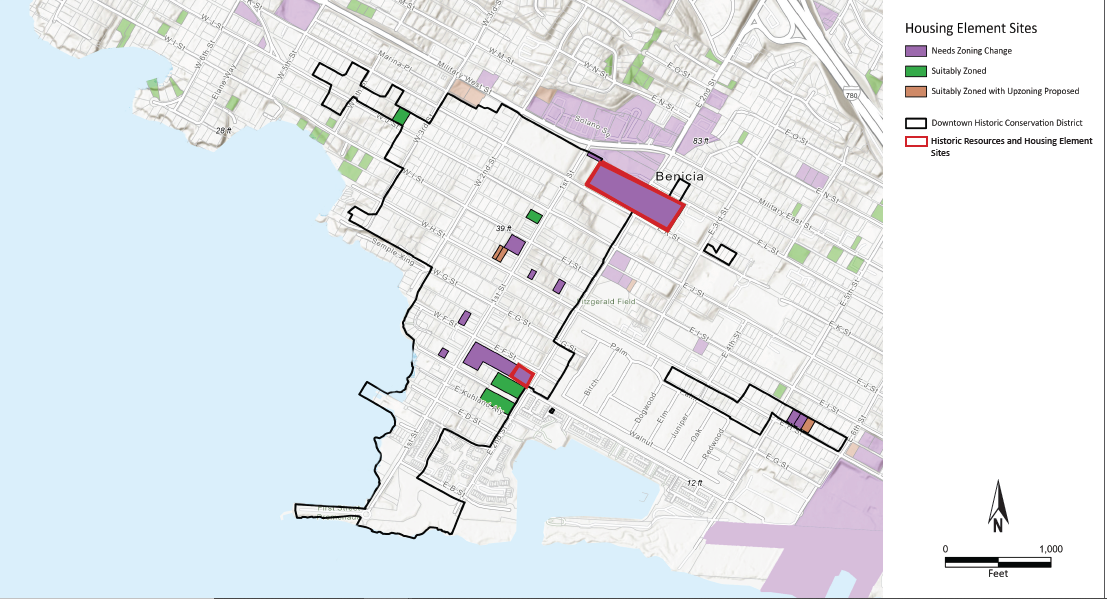
Most of the zoning changes are to the downtown area and the city’s east side. The permitted density for housing will be increased to 30 units per acre and buildings in residential zones will be allowed to cover 45% of the lot instead of 40%. The building height limit in some zones will be increased to three stories instead of the current limits of two to two-and-a-half stories.
Community comments focused on concerns related to Benicia’s historical sites and districts. Several community members brought up concerns about a portion of the Benicia City Cemetery that had been included in the list of sites for possible development. Others spoke about impacts to historic districts that could affect not only specific sites but the character of Benicia.
Rezoned sites in the Downtown Historic Conservation District. Map via city of Benicia.
In preserving the historical aspects of this town, “it’s not just the buildings, it’s the setting, it’s the entire context.” said Benicia resident Linda Chandler.
Many of the commenters requested that the council reject the current housing element and instead revise the proposed project to reflect an alternative identified in an environmental review. The alternative would have significantly reduced impacts to the city’s historic resources by eliminating the rezoning of all of the locations in Benicia’s two historic districts, the downtown area and the Arsenal district.
One of the key complaints from community members about the housing element was that moderate and low income units were more heavily distributed in the east side when the intent of state’s housing law is to create an even distribution of housing units available to all income levels.
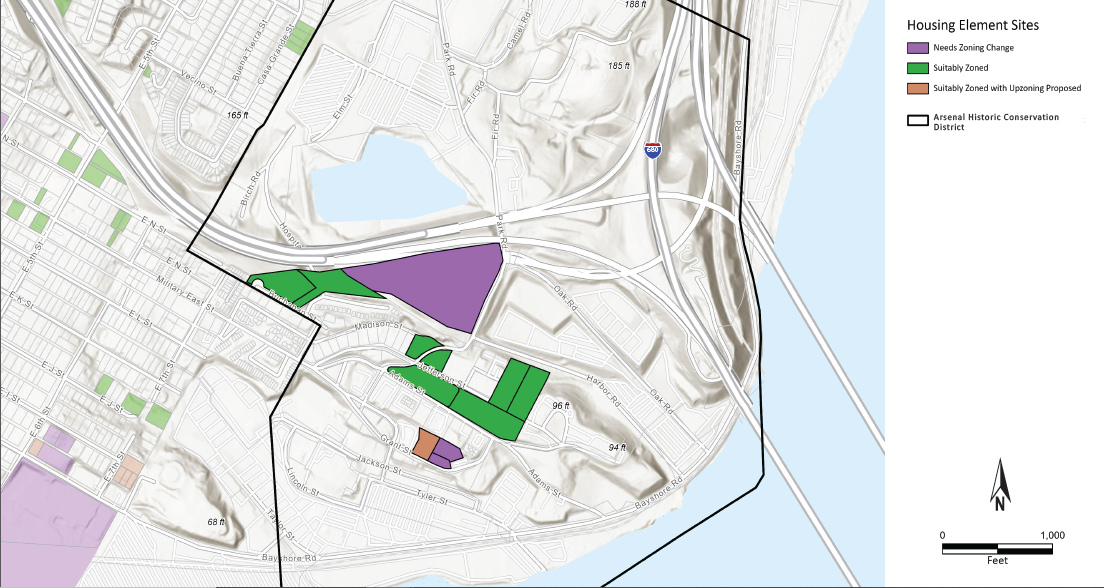
Marilyn Bardet, who has lived on the east side for 37 years, expressed environmental justice concerns about locations in the Arsenal Historic district. She noted that one of the locations, 1471 Park Road, is in a high traffic area close to the Valero refinery and the asphalt plant that may emit dangerous chemicals. “It is surrounded by active pipelines and I-780,” she said. “This is no place to put children and families, especially low-income folks.”
The large triangular site, 1471 Park Road, in the Arsenal Historic Conservation District, will be rezoned under the Benicia housing element plan. Map via city of Benicia.
According to the city staff, only certain sites qualify for low income housing and the staff evenly distributed the low income units across all the available sites. But the east side does have two large sites that meet the qualifications and can accommodate a large number of low income units.
They also noted that the downtown area offered sites that furthered local and state goals of reducing vehicle miles traveled by creating housing near transit, jobs and services.
Mayor Steve Young pleaded with the community members to support the housing element, saying the benefits of the housing development planning include creating more walkable cities, reducing homelessness and reducing commutes.
The mayor also broached more personal and localized points in his appeal to Benicia residents, “Our kids would like to live here and they can’t afford to do that because the houses are simply too expensive and there are not enough of them.”
He added that a variety of housing stock could provide more appropriate housing for seniors and improve the city’s finances. “Frankly, more people and more growth means more tax revenue and we need more tax revenue if we are going to maintain the level of community services that people have come to expect,” he said.
Councilmember Trevor Macenski said that he thought the council has gone above and beyond in their community engagement efforts for the housing element, holding 25 public meetings on the issue.
City staff did make one change based on the community concerns by removing a portion of the cemetery from the list of potential development sites. The staff said that the cemetery site was one of the only sites that could be feasibly removed without requiring extensive revisions that would not allow the City to meet the state’s Jan. 31 deadline.
According to the city attorney, failure to meet the deadline would expose the city to lawsuits from housing advocacy groups and the city would be vulnerable to state laws such as the builders remedy which allow developers to circumvent the local approval process in jurisdictions that are not in compliance with state law. The state could even go as far as to revoke the city’s right to issue permits at all.
“It is entirely feasible that if we don’t do the final adoption of the zoning map tonight, a developer… could build anywhere at any height, at any density and the city would lose all discretion,” Young said. “That’s why the Jan. 31 deadline was so important and why we are intent on meeting that deadline to preserve our ability to regulate housing development.”

 Introduction from Elizabeth Patterson, April 29, 026


You must be logged in to post a comment.