Vice-Mayor Terry Scott honored the hours-long outpouring of community support for Benicia’s Arts & Culture Commission and Human Services Board with a special message
Benicia Vice-Mayor Terry Scott celebrated the many Benicians who wrote, called and showed up to support continued funding for the Arts & Culture Commission and Human Services Board. | Uncredited image.
Message from Benicia Vice-Mayor Terry Scott, June 7, 2023:
After almost four hours of passionate and insightful community testimony, City Council last night agreed to continue future funding for the Arts and Culture Commission and the Human Services Board.
The extended community testimony and the City Council’s decision to continue funding the Arts and Culture Commission and the Human Services Board demonstrate the importance of community engagement in local governance.
I believe when individuals passionately express their thoughts and concerns, it helps shape decisions that directly impact the well-being and development of the city.
The ongoing support and participation of Benicians in the decision making process will undoubtedly continue to play a crucial role in the future of the city as we move into balancing our community priorities within the scope of our budget crisis.
By Elizabeth Patterson, Benicia Mayor 2007-2020, March 19, 2023
Seeno owned property (Google Earth, 2008) with inset of Benicia’s “North Study Area” (2022) – click to enlarge
Hats off to Steve Golub providing residents and businesses news and information in “Benicia and Beyond”. His first stab at this is a recent interview of Mayor Young.
Council member Tom Campbell has expressed concern about how many years someone needs to live here to fully understand Benicia. He, I believe, is right. For instance, what is the status of the Class I landfill and plume of really bad stuff moving down Paddy Creek? Paddy Creek drains toward Lake Herman watershed. This closed landfill is why in the 80s the City Council adopted a resolution prohibiting residential development on Lake Herman road and East Second street (Seeno). Or what about the 90s when the General Plan was updated and the Benicia Industrial Park Association (BIPA) advocated in large red and black lettering on a poster board “no residential” development – same place. Or in the 2000s when there were two organized groups advocating for denial of Seeno project because there was too much grading, six waterways filled, and traffic was going to be ugly adding to our greenhouse gas emissions. City Council denied the project and then adopted a resolution for specific conditions for any future project.
The Benicia Army’s Arsenal Reservation closure was before there was the federal Base Realignment and Closure Act https://wikipedia.org/wiki/2005. Benicia was on its own. Benicia got zero redevelopment planning help, and there was removal of chemical war weapons and nuclear material, but left unexploded ordinance to be found, lead, tetrachloroethylene, and used infrastructure – in some cases hastily built for the war effort. What part of the Seeno site was used?
Context matters. Historic issues and context is not always easy to find.
The General Plan provides some of this history (at least up to 2000). The General Plan process is explained at the end of the General Plan. We were appointed. We did authentic public engagement. We adopted decisions by consensus. We started with common vision and shared values. We were a committee of citizens representing all sectors of the community (the General Plan Oversight Committee). Until that vision and its goals are changed, it is the law of the land.
And this gets me to the main point which is the following:
At the beginning of this piece I acknowledged Steve Golub’s “Benicia and Beyond”. Steve came to Benicia in 2019 and has the right skills for learning about places and people. His inaugural column addressed questions to Mayor Young, including as follows:
SG: What are your thoughts on whether and how [Seeno property or North Study Area] that should ever be developed for housing? Do you see alternative uses for it.
SY: “I would like to withhold my specific preferences on that in deference to the [North Study] planning/visioning process that is currently underway, and that may eventually come to Council for decision. But I can say, that, as one member of the community, I would hope to see a mixed use development including multifamily and single family housing, in addition to some localized commercial development. Ideally, we would have direct micro transit options to downtown and a few locations in Vallejo. And perhaps some office or R/D uses along the East 2nd St. frontage.”
What is the North Study planning/visioning process? The consultants working for the city and paid for by Seeno conducted an in-person open house at Northgate church and virtual sessions and an online survey. None of these sessions have provided the sixty (60+) relevant goals and policies of the General Plan. Not on a poster board. Not linked to the virtual meetings and nothing in the online survey. Opinions are sought without context or consistency to existing policies in the General Plan.
The 1996 Urban Design Background Report by Mogavero Notestine says this about expanding residential use toward Lake Herman:
“[There] is a lack of connectivity to the rest of the community. Southampton has a sense of isolation from the older parts of Benicia. The sense of isolation [Lake Herman] would be more substantial.
In addition, the sense [of isolation nearer Lake Herman Road] would create a substantially higher demand for automobile trips than, for example, infill.
The present value of the full range of [city] capital and operating public costs created by the development could be $57,000 to $75,000 [adjusted for 2023] per dwelling unit . . .”
World renowned urban economist Joe Minicozzi provided information at the Vets Hall before the Pandemic. We learned that the city would prosper by increasing value of the existing urban footprint. If you are in a hole, stop digging. Benicia is a small town, with limited staff and resources. Smart development avoids a deeper hole– meaning the cost of future maintenance of new infrastructure.
Will the consultants evaluate the economic implications for individual households and broader economic impacts for the community? Computer models should be utilized to comprehensively evaluate the broad fiscal and economic implications of various growth alternatives for the Seeno site, including the impacts for individual households.
The cost to the public depends upon, among other things, the location. Residential infill projects do not require the construction or future maintenance of new infrastructure. It can sometimes provide the resources to repair or replace dilapidated infrastructure. Thus infill provides revenue flow where there was none before without creating new infrastructure cost.
The General Plan goals and policies address the overarching goal of the General Plan. Are you comfortable with the process where staff has the final word on the visioning report that goes to the City Council? Would a seat at the table with stakeholders representing all sectors of Benicia to oversee a report to the City Council be a good idea? Better to be at the table than on the menu, right? Where is the table?
End of Patterson article… More below provided by the BenIndy and City of Benicia
BENICIA – The Benicia City Council unanimously appointed Deputy City Manager Mario Giuliani as the city’s interim city manager at a special meeting on Monday night.
Giuliani will replace City Manager Erik Upson who is leaving on March 1 to take a position with a global security firm.
The city is still working on the details of Giuliani’s contract as Benicia’s interim city manager, a position which could lead to the more permanent city manager position after a trial period.
Giuliani has been Benicia’s deputy city manager for two years. Prior to that, he served as the city’s economic development manager for 13 years. Giuliani has lived in Benicia for 30 years, he has worked for Benicia, Walnut Creek and Vallejo parks departments and in the Benicia City attorney’s office.
“So much of a City Manager’s job is about communication, both the ability to convey a message but also to listen.” Giuliani told the Vallejo Sun.
According to Giuliani, a key experience that will inform his approach as city manager is his work on Benicia’s sales tax measures. Measure C, a 1 cent sales tax to provide funding for essential city services, passed in 2014 but Measure R, which would have increased Benicia’s sales tax by three-quarters of a cent to fund roads, failed by a narrow margin in November.
“From that loss it’s important to take stock in the listening piece in communication,” Giuliani said in an email. “There was clearly a sentiment in the community that I missed or failed to properly address. How one accepts accountability in defeat is also a necessary experience and a trait needed for one to be successful.”
In the past, the City Council has filled the city manager position both by recruiting outside candidates as well as drawing from the city’s own ranks – as they did with Eric Upson, who was the city’s police chief prior to his appointment as city manager.
This time, considering the urgency of the city’s current projects and the qualifications of several city staff members, the Council chose to select from internal candidates.
“There are about five or six people who work for the City of Benicia that are very highly qualified, so that’s a blessing and on the other hand… how do you pick one,” Councilmember Tom Campbell told the Vallejo Sun.
The city manager is a difficult position, because the right candidate “has to have good interpersonal and communication skills, but they also have to be able to look at a set of numbers and policies and say this is how the city is going to run,” Campbell said. “Most city managers are really good at one or the other, it’s rare that you see them excel at doing both.”
Upson said that the biggest challenge that the new City Manager will face is balancing revenue with the cost of repairing and upgrading Benicia’s aging infrastructure, such as roads and the city’s water supply and wastewater system. “Unfortunately, it’s this generation that will have to deal with these issues,” Upson said in an email. “The wheels are simply going to come off otherwise.”
Despite the upcoming challenges, Upson said that he feels that he is leaving the city in a good position with a talented staff and a council that works together to address the difficult problems.
Last month, Upson announced that he would retire from his position as city manager just over two years after he was appointed. He accepted an offer from a security firm that recruited him for an international position. He said that the opportunity to travel and a salary that will go farther as his children enter college were the factors that tipped the scales toward the new position.
“You may still see me around as I intend to stay on as a Volunteer Reserve Police Officer, working occasionally to support the Police Department,” Upson said in a statement.
BENICIA – The Benicia City Council unanimously approved zoning amendments this week to facilitate new housing over the next eight years as part of a state requirement that cities in California create a long-term growth plan.
This formal adoption of the housing element on Tuesday came on the state deadline for adoption after controversy over the city’s plans. Last week, more than 80 people filled the council chambers to express concerns about historical preservation and equitable growth.
The housing element is part of the City’s General plan and it is intended to insure that the city can meet future housing needs in an equitable manner. Since 1969, the state has required cities and counties to adjust zoning rules every eight years to accommodate each jurisdiction’s share of the state’s housing goals for all income levels, known as the Regional Housing Needs Assessment (RHNA).
The needs assessment determined that Benicia should add at least 750 new housing units over the next eight years. Benicia’s zoning changes could accommodate up to 1,236 new units.
Most of the zoning changes are to the downtown area and the city’s east side. The permitted density for housing will be increased to 30 units per acre and buildings in residential zones will be allowed to cover 45% of the lot instead of 40%. The building height limit in some zones will be increased to three stories instead of the current limits of two to two-and-a-half stories.
Community comments focused on concerns related to Benicia’s historical sites and districts. Several community members brought up concerns about a portion of the Benicia City Cemetery that had been included in the list of sites for possible development. Others spoke about impacts to historic districts that could affect not only specific sites but the character of Benicia.
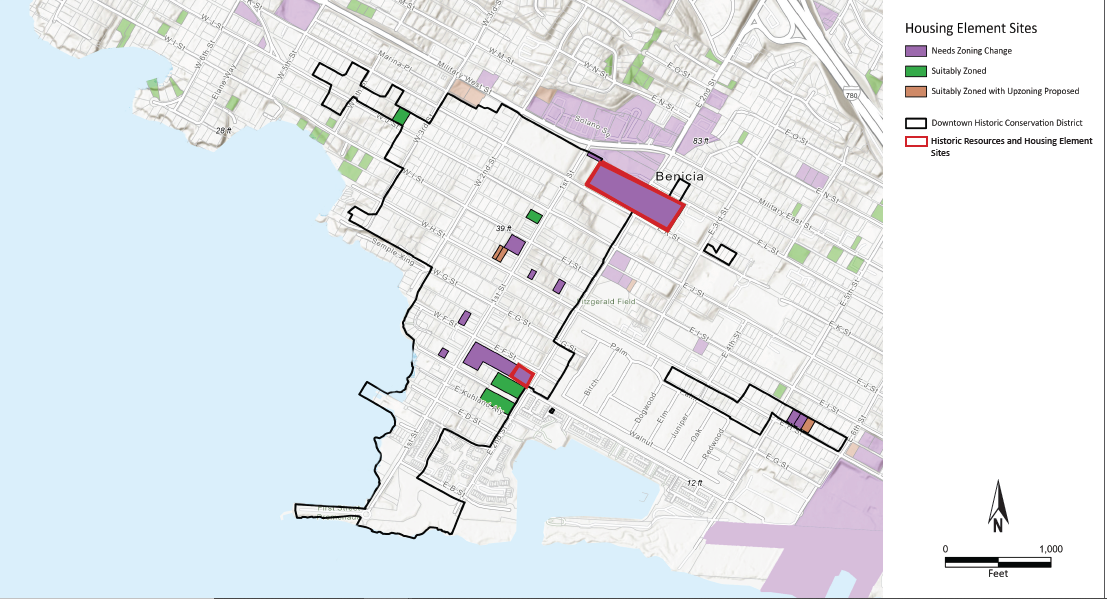
Rezoned sites in the Downtown Historic Conservation District. Map via city of Benicia.
In preserving the historical aspects of this town, “it’s not just the buildings, it’s the setting, it’s the entire context.” said Benicia resident Linda Chandler.
Many of the commenters requested that the council reject the current housing element and instead revise the proposed project to reflect an alternative identified in an environmental review. The alternative would have significantly reduced impacts to the city’s historic resources by eliminating the rezoning of all of the locations in Benicia’s two historic districts, the downtown area and the Arsenal district.
One of the key complaints from community members about the housing element was that moderate and low income units were more heavily distributed in the east side when the intent of state’s housing law is to create an even distribution of housing units available to all income levels.
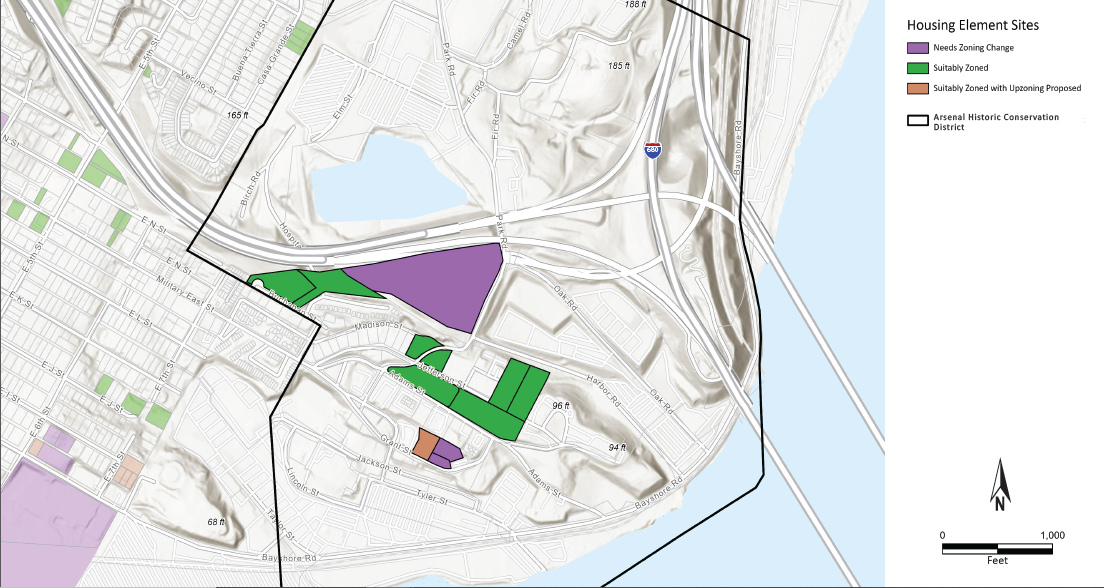
Marilyn Bardet, who has lived on the east side for 37 years, expressed environmental justice concerns about locations in the Arsenal Historic district. She noted that one of the locations, 1471 Park Road, is in a high traffic area close to the Valero refinery and the asphalt plant that may emit dangerous chemicals. “It is surrounded by active pipelines and I-780,” she said. “This is no place to put children and families, especially low-income folks.”
The large triangular site, 1471 Park Road, in the Arsenal Historic Conservation District, will be rezoned under the Benicia housing element plan. Map via city of Benicia.
According to the city staff, only certain sites qualify for low income housing and the staff evenly distributed the low income units across all the available sites. But the east side does have two large sites that meet the qualifications and can accommodate a large number of low income units.
They also noted that the downtown area offered sites that furthered local and state goals of reducing vehicle miles traveled by creating housing near transit, jobs and services.
Mayor Steve Young pleaded with the community members to support the housing element, saying the benefits of the housing development planning include creating more walkable cities, reducing homelessness and reducing commutes.
The mayor also broached more personal and localized points in his appeal to Benicia residents, “Our kids would like to live here and they can’t afford to do that because the houses are simply too expensive and there are not enough of them.”
He added that a variety of housing stock could provide more appropriate housing for seniors and improve the city’s finances. “Frankly, more people and more growth means more tax revenue and we need more tax revenue if we are going to maintain the level of community services that people have come to expect,” he said.
Councilmember Trevor Macenski said that he thought the council has gone above and beyond in their community engagement efforts for the housing element, holding 25 public meetings on the issue.
City staff did make one change based on the community concerns by removing a portion of the cemetery from the list of potential development sites. The staff said that the cemetery site was one of the only sites that could be feasibly removed without requiring extensive revisions that would not allow the City to meet the state’s Jan. 31 deadline.
According to the city attorney, failure to meet the deadline would expose the city to lawsuits from housing advocacy groups and the city would be vulnerable to state laws such as the builders remedy which allow developers to circumvent the local approval process in jurisdictions that are not in compliance with state law. The state could even go as far as to revoke the city’s right to issue permits at all.
“It is entirely feasible that if we don’t do the final adoption of the zoning map tonight, a developer… could build anywhere at any height, at any density and the city would lose all discretion,” Young said. “That’s why the Jan. 31 deadline was so important and why we are intent on meeting that deadline to preserve our ability to regulate housing development.”



You must be logged in to post a comment.