A while ago, I spoke to a close friend who recently moved to the East Coast from the Benicia area. As we were catching up, I mentioned my efforts to educate our community about the La Migra Games. At first, she didn’t know what I was referring to, and as we discussed it further, she got it. Not only was she aware of the game, three of her children, who are now adults, had participated as “undocumenteds” while in high school. Despite our closeness, my friend and I sometimes have completely different perspectives. This was one of those times…
My good friend, whom I will refer to as Alice, was a long time Benicia/Vallejo resident but has since moved away. Alice has several children, and like their mother, her children are smart and adventurous. They enjoy outdoor activities and extreme sports when the opportunity arises. The younger ones attended Benicia public schools, including the high school, spanning from about 2010-2019.
As underclassmen at BHS, they were each challenged to participate in the “La Migra Games” by the seniors who were hosting, and three of them took it on. They loved the idea of a long distance (three-mile) chase game at night where they needed to use their skills and wits to get to the other end of town without being caught by students posing as ICE officers. However, since the chase was what appealed to them rather than the pursuit, they only participated as underclassmen running from their older peers.
Benicia High School staff, administrators, and students have taken steps to prevent students from participating in the game. | Uncredited image.
The eldest of the three, and the one who was at Benicia High School first, was probably the biggest thrill seeker of the family. He apparently had an amazing experience playing the game and encouraged the younger ones to take advantage of this opportunity when it was their turn. One younger brother and even younger sister followed suit a few years later. All of them individually made it to the “safe” zone without being captured, and felt the same exhilaration as did their older brother by their accomplishment. They each shared their experience with Alice, who appreciated that her children voluntarily participated in something that required ingenuity, bravery and physical endurance.
When I brought up my concerns about “La Migra,” it was clear that Alice did not connect the name of the game with the actual event. She really didn’t know what it was called until my clarification, although I’m sure the kids did. This family is of white European heritage and their ancestors have been in the United States for several generations now. The kids don’t have the perspective of a modern immigrant family, so the name, “La Migra” didn’t trigger them the way it does some others. Once we discussed the impact of the name, Alice could definitely see how the title and the assertion could be offensive. She suggested that changing the name and the premise to something less racially charged and continuing the tradition would be the appropriate thing to do.
I need to mention here that this family has deep roots in the military. Two of Alice’s three children who played the game continued on to serve our country, while the youngest is still contemplating service. Being in the military includes participation in potentially dangerous games, in preparation for real life military missions. Neither the kids nor Alice were concerned with the individual and public safety. She dismissed my points that there is no roster, that no one is formally accounted for, that the parents don’t necessarily know where their children are during the game, and that the game is played on public streets and encroaches on private property. She ascertained that if there were formal rules, it would require adult supervision – something that would definitely minimize or even eliminate the independent and thrilling nature of the game.
Some Benicia High School students have taken action against the game, posting warnings to discourage peers from participating. | This image is a still from a 2023 NBC Bay Area report.
As we discussed it more, Alice suggested that the City could let the community know that this game is happening and that we should all exercise more caution that evening rather than try to shut down the game. She sees the game as a unique and important opportunity for teens to participate in an activity which requires them to use their emerging survival skills – something that could be valuable later in life.
One of the few things that did capture Alice’s attention from my extensive list of concerns was that some young people who aren’t voluntarily playing the game are being targeted, with severe trauma often being the result. We agreed that some identifying and visible article of clothing or accessory could be worn so that everyone can unequivocally know who is playing and who is not. She felt that, as in life, there should be a code of ethics among the students. Only those who self-identify as a participant should be chased.
And finally, much to my personal relief, Alice was absolutely concerned about the alleged increasing violence, including the use of gel pellet guns, as part of the game. For this, she put responsibility directly on the shoulders of the parents or guardians of the young people who opt to use verbal or physical assault as part of their chase tactics. She feels that parents need to establish a strict moral code and that children should never be allowed to use weapons, whether real or “toys,” irresponsibly.
Use of gel pellet guns by teens is on the rise, with sometimes violent or even deadly consequences. Youth caught firing pellets at people or animals may be charged with assault and battery or animal cruelty. | NBC Boston.
I care very much about my friend and her family, and I want to hear her perspective and consider this into the equation. From their point of view, there are good reasons for young people to have the opportunity to participate in a game that promotes excitement, fear, exhilaration, and wits, as long as it’s done voluntarily and with honor. The question remains – how do we provide something like this for our young people without inciting racism, bullying, violence and, as I will continue to emphasize, unsafe conditions for those involved and for the public?
If you would like Sheri to hear and share your perspective on the ‘La Migra Game,’ please contact her through theBenicia Independent. Remember that it is your story that is critical for others to hear, not your name, unless you would like to be identified.
[Note from BenIndy: Today, we came across an article claiming that Valero commanded higher profits in California compared to other regions – in the third-quarter of 2023, at the very least. After looking for other articles from Q3 referencing Valero’s higher refining margins in California, we learned that Valero reported gross refining margins of 78 cents per gallon on the West Coast, vs. “41 cents for the Gulf Coast, 49 cents for the U.S. Mid-Continent, and 48 cents for the North Atlantic.” Consumer Watchdog, by the way, suggests that 50 cents is the ‘red line marker’ for price-gouging. Wow. While it’s a little old, the best analysis of the price-gouging allegations levied against Valero and other refining giants comes from this October 2023 Daily Kos post. The images in this post were added by BenIndy are are not original to the Daily Kos post.]
Valero Posts $2.6 Billion 3rd Quarter Profit On CA Gasoline Margins 70% Greater Than Other Regions
Image generated by DALL·E, OpenAI’s AI-driven image creation tool. Please note that this image’s text is gibberish and not connected to reality, a known flaw in AI image generators, but the big “78 cents” referencing Valero’s refining margins in Q3 2023 is certainly correct.
Los Angeles, CA—The third quarter report to shareholders by Valero Energy Corporation shows it made 70% more per gallon in California than in any other region of the U.S. or the globe that it operates in, according to a report from Consumer Watchdog today.
Headquartered in San Antonio, Texas, the corporation operates 15 refineries in the U.S., Canada and U.K.
Consumer Watchdog called for the California Energy Commission to expedite the process for setting a price gouging penalty under a new law passed this year, SBx1 2.
“It is time for the California Energy Commission to put its foot on the gas and set a price-gouging penalty on big refiners ripping us off at the pump,” said Consumer Advocate Liza Tucker. “It is time for the state to prevent refiners from using us as one big ATM.”
Valero, one of the five big California refiners that control nearly the entire gasoline market, reported net profits of $2.6 billion this quarter, down a tick from $2.8 billion the year before, according to Tucker. Its refining sector reported third quarter operating income of $3.4 billion, down from $3.8 billion the year before: investorvalero.com/…
“Our refineries operated well and achieved 95 percent through put capacity utilization, which is a testament to our team’s relentless focus on operational excellence,” gushed Lane Riggs, Valero’s Chief Executive Officer and President in a press release. “Product demand remained strong in our U.S. wholesale system, which matched the second quarter record of over 1 million barrels per day of sales volume.”
Tucker had a quite different assessment of the corporation’s “relentless focus on operational excellence” than Valero CEO Riggs, describing the company’s profit margins on the West Coast, obtained through apparent price gouging, as “eye popping.”
Image from the California Energy Commission’s November 28, 2023 “SBX1-2 Workshop on Maximum Gross Gasoline Refining Margin and Penalty” presentation. To learn more about this workshop, click this link. You will be redirected to the workshop page on the CEC’s website.
“3rd quarter gross refining margins of 78 cents per gallon were eye-popping on the West Coast, far higher than in any other of Valero’s operating regions,” she stated. “Valero reported margins on Gulf Coast at 41 cents; at 49 cents for the U.S. Mid-Continent; and 48 cents for the North Atlantic.”
“The West Coast gross refining margin also blew past Valero’s 60 cents per gallon reported in the third quarter of 2022. Valero only has West Coast refineries in California,” Tucker pointed out.
She also said the gross refining margins reported to investors understate the gasoline profits as jet fuel and diesel are included,
Senate Bill (SB) 1322 requires all refiners of gasoline products in the state to provide monthly data about various price and volume information. The California Energy Commission (CEC) must publish aggregated, volume weighted reports of this data, within 45 days of the end of each calendar month
“Last year, legislation empowered the California Energy Commission to form a special division to investigate gas prices in California and to set a price-gouging penalty, which Governor Newsom has called for. Last week, the Commission voted to begin such a proceeding that first involves the gathering of accurate data from refiners. SB 1322 requires refiners to report their margins to the regulator that then posts them on its website,” concluded Tucker.
WSPA and Big Oil pump Big Money into influencing California regulators
As Valero made 70% more per gallon in California than in any other region of the U.S. or the globe that it operates in, the oil and gas regulators in“green” California, the seventh largest oil producing state in the nation, continue to issue new and reworked oil drilling permits. The Newsom administration has approved a total of 15,722 new and reworked oil wells since January 2019.
This year CalGEM, the state’s oil and gas regulator, “has gone rogue, approving hundreds of oil permits in vulnerable communities breathing poisonous emissions from both active and idle wells,” reported Consumer Watch and FracTracker Alliance. For a complete permit update, see: https://newsomwellwatch.com
Why do California regulators continue to approve hundreds of new and reworked oil drilling permits each quarter as oil companies like Valero gouge Californians at the pumps?
It’s all due to deep regulatory capture by Big Oil and Big Gas in the “green” and “progressive” state of California. The Western States Petroleum Association (WSPA), Chevron and the oil companies exercise their influence and power through a very sophisticated public relations machine in California and the U.S.
WSPA describes itself as “non-profit trade association” that represents companies that account for the bulk of petroleum exploration, production, refining, transportation and marketing in Arizona, California, Nevada, Oregon, and Washington. WSPA’s headquarters is located right here on L Street in Sacramento.
Catherine Reheis-Boyd, the President and CEO of WSPA, is the former chair of the Marine Life Protection Act (MLPA) Initiative Blue Ribbon Task Force for the South Coast to create “marine protected areas” in the same region that she was lobbying for new offshore drilling.
Since 2009 I have documented how WSPA and the oil companies wield their power in 8 major ways: through (1) lobbying; (2) campaign spending; (3) serving on and putting shills on regulatory panels; (4) creating Astroturf groups; (5) working in collaboration with media; (6) sponsoring awards ceremonies and dinners, including those for legislators and journalists; (7) contributing to non profit organizations; and (8) creating alliances with labor unions, mainly construction trades.
The oil and gas industry spent over $34.2 million in the 2021-22 Legislative Session lobbying against SB 1137, legislation to mandate 3200 foot buffer zones around oil and gas wells, and other bills they were opposed to: cal-access.sos.ca.gov/…
For the oil companies, this was just pocket change when you consider that combined profits of California oil refiners, including PBF Energy, Chevron, Marathon Petroleum, Valero, and Phillips 66, were $75.4 billion in 2022.
The two biggest spenders were WSPA and Chevron. WSPA spent $11.7 million in the 2021-22 session, while Chevron spent a total of $8.6 million lobbying California officials.
Lobbying disclosures from Quarter 2 of 2023 reveal that oil companies and trade associations spent more than $3 million lobbying and a grand total of $4,085,639.57 in just three months to shape policymaking efforts in its favor in California. That brings the total spent by Big Oil and WSPA to over $13.4 million total in the first six months of 2023, putting them on track to exceed the 2022 expenditure of $18 million.
Chevron topped the lobbying expenses with $1,139,130, while WSPA placed second with $716,824.
The latest disclosures follow the $9.4 million that Big Oil spent to influence the California Legislature, Governor’s Office and agencies in the first quarter of 2023. Chevron came in first with over $4.9 million spent in the first quarter, while the WSPA finished second with over $2.3 million and Aera Energy finished third with nearly $628,000.
WSPA sponsors media dinners and awards for journalists
This year Big Oil has sponsored a chilling and highly successful campaign to sponsor dinners, awards ceremonies and conferences for journalists and the media. WPSA sponsored a “media dinner” on Tuesday, February 28 in Sacramento as part of #BizFedSactoDays.
The flyer for the event stated, “Journalists who play an outsize role in shaping narratives about state politics and holding lawmakers accountable will join business leaders to pull back the curtain on how they select and tell stories about California policies, policy and power.”
Speakers at the program included Coleen Nelson of the Sacramento Bee, Laurel Rosenhall of the Los Angeles Times, Kaitlyn Schallhorn of the Orange County Register and Dan Walters of Cal Matters.
Then on March 16, the Sacramento Press Club announced in a tweet that WSPA was the new “Lede Sponsor” of the Sacramento Press Club’s Journalism Awards Reception that was held on March 29: “Thank you to our new Lede Sponsor @officialWSPA! WSPA is dedicated to guaranteeing that every American has access to reliable energy options through socially, economically and environmentally responsible policies and regulations. Learn more more at http://wspa.org.
In response to this tweet, investigative journalist Aaron Cantu tweeted back on March 20, “As the recipient of @SacPressClub ’s environmental award last year, it’s concerning to see fossil fuel industry talking points passed off uncritically here. WSPA becoming lede sponsor happened in the context of a global PR turn as the climate crisis worsens.”
Unfortunately, Cantu and this writer are the only journalists with the courage to publicly criticize the sponsorship of a “journalism awards reception” by WSPA.
In addition to sponsoring journalism events in California, the Western States Petroleum Association has expanded its campaign to influence journalists nationally. WSPA and the controversial waste management firm Veolia North America sponsored events at this year’s Society of Environmental Journalists (SEJ) conference in Boise, Idaho, according to a report from DeSmog: https://www.desmog.com/2023/04/11/industry-sponsors-dinner-society-environmental-journalists-veolia-wspa.
The agenda for the conference, hosted in Boise, Idaho, revealed that WSPA and the waste management company Veolia North America sponsored two of the “beat dinners” hosted on April 21, the article by Sam Bright reported.
When #BigOil teams up with journalists, columnists and editors at events and only a couple of writers thinks there’s something wrong with this, you know we must be in deep trouble. Of course, no mainstream media reported on this huge scandal because it unveils the deep links between Big Oil and Big Media.
Background: California Oil Refinery Cost Disclosure Act Monthly Report
Senate Bill (SB) 1322 requires all refiners of gasoline products in the state to provide monthly data about various price and volume information. The California Energy Commission (CEC) must publish aggregated, volume weighted reports of this data, within 45 days of the end of each calendar month.
Specifically, SB 1322 requires the CEC to publish the following information from the refinery operators’ monthly reports:
A volume weighted gross gasoline refining margin for the state.
The gross gasoline refining margin for each refinery with two or more refining facilities in the state.
Volume and price of domestic and imported crude oil.
The breakdown of five types of sales required to be reported by refiners and associated volumes, prices per gallon, and actual or estimated costs associated with the Low Carbon Fuel Standard (LCFS) and Cap and Trade programs.
The data below complies with the CEC’s requirements to post the data as reported by the refiners. CEC continues to investigate the reported numbers. Additional findings, recalculations, further analysis, revised data, or other conclusions will be publicized here as we continue to verify the reported data.
Refiner Margin Data
Data last updated: October 18, 2023.
On October 3, 2023, the California Energy Commission published new petroleum market data showing the net gasoline refining information for California refiners. Volume-weighted average California gross refiner margin, net refiner margin, and numbers in the “Aggregated Data Reported” section are all calculated using information obtained from all six refinery companies. Gross and net margins reported by refinery company only reflect information from California refiners with two or more facilities which are Chevron, Valero, PBF, and Phillips 66.
The data show that in August, California refineries produced and sold 950,529,000 gallons of gasoline for a total estimated profit of $228,126,960.*
CEC staff will continue to collect and report refiner information on a monthly basis in order to analyze long-term trends as part of its assessment of setting a maximum gross refining margin and penalty for exceeding that maximum, as allowed by SB X1-2.
* Based on data reported by California refiners. The total profit estimate does not include spot pipeline transaction sales and may be considered a conservative estimate as a result.
[Note from BenIndy: Valero’s Benicia Refinery is the 5th largest stationary greenhouse gas (GHG) emitter in California. As Sunflower Alliance founding member Shoshana Wechsler notes below, “[t]he thing that continues to strike me is that the Bay Area has no clue how important we are as a major fossil fuel hub. […] We need to understand that refining both petroleum and biofuels has a very negative effect on our public health and obviously contributes mightily to the climate crisis.” Let’s enter 2024 with clear eyes…and hope for clearer lungs come 2025.]
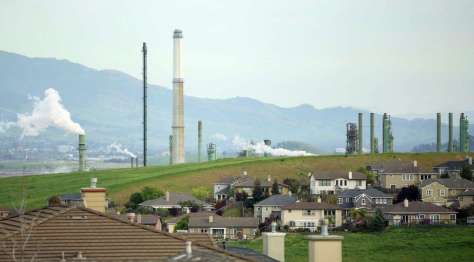
Valero’s Benicia Refinery, a principal contributor of greenhouse gas emissions in California, looms over residential neighborhoods. | Samantha Laurey / The Chronicle 2022.
SF Chronicle, by Kurtis Alexander, December 31, 2023
California’s largest greenhouse gas polluters, from power plants to oil refineries to chemical manufacturers, produced slightly fewer emissions last year than the previous year, federal data shows. But it’s still too much planet-warming gas to cut significantly into the problem of climate change, environmentalists say.
Three of the five biggest carbon emitters in the state were in the Bay Area, according to the Environmental Protection Agency’s 2022 data on large polluting facilities. All three were refineries in the East Bay, where the process of turning crude oil into gasoline, jet fuel and other high-demand petroleum products creates substantial greenhouse gas discharges — even before the fuels themselves are used in vehicles or planes.
The refineries were among 367 large stationary sites in California that collectively reported 93 million metric tons of carbon pollution last year, a decline of about 1% over 2021, according to the data. The facilities produce about a quarter of the state’s total human-generated greenhouse gases, which does not include wildfires. Cars and trucks remain the biggest source of carbon emissions.
“The thing that continues to strike me is that the Bay Area has no clue how important we are as a major fossil fuel hub,” said Shoshana Wechsler, a founding member of the Sunflower Alliance, an East Bay group that advocates for reducing refinery pollution. “We need to understand that refining both petroleum and biofuels has a very negative effect on our public health and obviously contributes mightily to the climate crisis.”
Worldwide discharges of greenhouse gases, notably carbon dioxide, methane and nitrous oxide, have contributed to warming the atmosphere about 2 degrees Fahrenheit in the post-industrial age. The heat, scientists say, has led to a host of problems, from an increase in drought and wildfire to rising seas and more extreme weather. The Earth’s 10 warmest years on record all were logged since 2010. This year is on track to be the hottest yet.
California regulators have established some of the most ambitious policies to restrict the release of greenhouse gases from large polluting facilities, including a cap-and-trade program that forces emitters to buy permits to pollute and requirements that electric utilities generate increasing amounts of clean energy.
Over the past decade, carbon emissions from the state’s big polluters have declined nearly 20%, according to the EPA data.
Many, though, say industry is still given too much leeway and stricter regulation is necessary given the climate challenge at hand. The state has a broad goal of reaching zero carbon emissions, on net, by 2045.
“Major polluters continue to pollute somewhat unabated,” said Nihal Shrinath, an associate attorney for the Sierra Club based in Oakland. “We really need to see much more aggressive emission reductions over the next 25 years.”
Shrinath said much of the decline in pollution from large facilities was due, not to regulation, but to unrelated factors, like Californians being more efficient with their energy use and needing less fossil fuels.
California’s top five greenhouse gas emitters were all oil refineries, according to the EPA data. Two were in Southern California in addition to the three in the East Bay: Chevron Richmond Refinery, Valero Benicia Refinery and Martinez Refining Company.
Ross Allen, a spokesperson for Chevron, described the company’s Richmond refinery as “absolutely essential to modern life in the Bay Area,” saying the facility supplied 60% of the fuel for Bay Area airports and about 20% of the gasoline used in Northern California. It also provides more than 3,000 jobs.
This is a screenshot of SF Chron’s interactive data table that shows greenhouse gas emissions from large industrial facilities in California, 2022. Click the image to be redirected to the webpage with the article and the table. Readers can use the table to search for and filter GHG emitters in this state. There may be a paywall.
“We are working to reduce carbon intensity of our operations, while continuing to provide an essential product,” he said.
The state’s refineries cumulatively emitted 22 million metric tons of carbon pollution in 2022, according to the EPA data. Refineries were the second-most-polluting type of facility, following power plants, which are far more numerous and emitted 35 million metric tons last year. The chemical industry, manufacturing hydrogen, nitrogen and other products, reported 10 million metric tons of emissions.
Also among California’s 25 biggest greenhouse gas polluters were two gas-fired power plants in Pittsburg and an oil refinery in Rodeo.
The EPA data on large polluting sites generally includes facilities discharging at least 25,000 metric tons of carbon dioxide and equivalent greenhouse gases a year, about what’s emitted by burning coal from 136 rail cars, according to the agency.
Since you’re here, learn more about Contra Costa’s search for accountability and transparency from refineries by clicking on any of the following links:
Valero’s Benicia Refinery. | Pat Toth-Smith.Benicia resident and author Stephen Golub
By Stephen Golub, first published in the Benicia Herald on December 24, 2023
Benicia got an early gift from Vice Mayor Terry Scott, Councilwoman Kari Birdseye and the rest of the City Council Tuesday night, December 19, when the Council unanimously voted to move ahead on putting together an industrial safety ordinance (ISO) that will help protect our kids, our older citizens and all of us against the risks of toxic emissions and potential fires/explosions. The decision capped months of patient, arduous work by Scott and Birdseye, who sought to address the views of all concerned parties along the way, resulting in their proposal that triggered the vote.
To be clear, the vote was to start a process, rather than to approve an ISO itself. But after an ISO is drafted and then presumably adopted next year, it will help us stay informed about accidents, incidents, violations, maintenance issues and other developments at Valero (and potentially other major industrial facilities in Benicia) that could affect our safety and health. It could enable Benicia to take preventive and enforcement action when necessary.
This contrasts with our current situation under a voluntary cooperation agreement with Valero, which provides for very limited information for and no enforcement by Benicia. For example, the refinery poured toxic emissions hundreds of times the legal limits into our air for well over a decade, until at least 2019. Even after the Bay Area Air Quality Management District learned of those emissions, that regional regulatory body failed to inform us about them for nearly another three years. We only found out in 2022.
Rather than being left out of the mix, Benicia needs a true seat at the table in order to get such information and take action. An ISO provides such a seat. The cooperation agreement and other current arrangements clearly don’t.
In the spirit of the holidays, I won’t delve into the substance of the debate any further. But I will emphasize that nothing about the ISO, or the effort to adopt it, is directed against the many fine Benician friends and neighbors who work at Valero or who are retirees from its facilities. Quite the contrary: The goal is to bolster safety and health for all of them as well as for the community as a whole.
Smoke from the Valero Benicia refinery during a 2017 incident. | Bay Area Air Quality Management District.
In fact, the hope is also that Valero’s leadership sees this is an opportunity to work with the City to provide its legitimate input. It would be a shame if the corporation walked away from such cooperation. Especially in view of Benicia’s budget problems and their implications for public safety, we need to pull together at this point rather than pull apart. Prompting bad national publicity, spurring divisions locally and other counterproductive fallout will do no good. Far better to act as a good neighbor.
Scott spearheaded the Council deliberations on Tuesday by highlighting how Benicia could construct a model industrial safety ordinance, learning from the experience of the other Bay Area refinery communities, all of which already have ISOs – which, by the way, fees on affected facilities pay for, rather than residents doing so.
Birdseye stood stalwart in repeatedly and successfully pressing for a vote even when there apparently was some temporary hesitancy or lack of clarity about how to proceed.
Thanks to Mayor Steve Young and Councilmembers Tom Campbell and Trevor Macenski, the motion was approved unanimously. And a bit of history was made: Reflecting community sentiment expressed at the meeting and elsewhere, as well as relevant research and experience, the Council decided that it wanted an ISO. If the resulting ordinance is true to that sentiment, research and experience, the ISO will be a strong one.
Thus, the devil will be in the details of what the eventual ordinance entails – something to be decided in the coming months under the direction of a subcommittee led by Scott and Birdseye. But this was a crucial first step.
So big kudos to Scott and Birdseye in particular for making this happen and making history for Benicia. And to the Mayor and other Councilmembers for backing an ISO. Thanks, too, to Fire Chief Josh Chadwick and other hardworking Benicia City staff members for the work they have done and will put into making all this a reality.
Last but not least, let’s also acknowledge the contributions of many other members of this wonderful village we call Benicia. Namely, the many Benicians who spoke, wrote letters and otherwise advocated for an ISO – spurred in part by the Benicia Industrial Safety and Health Ordinance (BISHO) alliance. To join the more than 150 supporters of this effort, or simply to find out more about this matter, please check out the group’s website at www.BISHO.org.
And have safe, healthy and happy holidays!
Subscribe to the Benicia Herald and keep local news alive!
The Benicia Herald does not have an online edition. To support our local newspaper, please subscribe by email at beniciacirculation@gmail.com or by phone at 707-745-6838.
Join the BISHO movement
There is a group of concerned citizens of Benicia who also support the adoption of a Benicia Industrial Safety and Health Ordinance (BISHO). To learn more about the effort and add your support, visit www.bisho.org.





You must be logged in to post a comment.