

By Elizabeth Patterson (Benicia Mayor 2007-2020), January 26, 2026
Introductory Note: Dear Reader, if you are not familiar with Historic Jefferson Ridge, there is a brief description at the end of this editorial. The timeline for the following is uncertain – Santa Rosa project will take at least a year or two. The Benicia story has been going on for a long time and this is a phase that could end in bull dozing and grading by this year unless there is an appeal to the California Supreme Court.
– Elizabeth Patterson
>> Benicia declares it is a City of History with historic districts and landmarks including the State Capitol and Historic Arsenal.
Santa Rosa is debating development on land of its birthplace – Carrillo Adobe, a historic landmark on private land.
Benicia’s downtown is a State Registered Historic District, and the Historic Arsenal includes four districts listed on the National Register of Historic Places. The area is part of the Delta National Heritage Area and became a state historic landmark in 1935.
Santa Rosa like Benicia must approve housing in numbers that are adopted by each city and approved by the state. [Benicia officials approved housing numbers in excess of state requirements – by about 15% with most of the housing designated in two eastside census tracts].
Decedents of the Santa Rosa Carrillo family and Indigenous people are debating the scale of the project that risks paving over one of the most culturally rich pieces of land not yet developed.
The Carrillo site developer will submit formal plans after listening to the public testimony and the plans will trigger a study of the land’s historical resources and other environmental and traffic reviews. The study will identify mitigation measures to maintain the historic values and cultural resources.
In the early 2000s, Benicia officials approved a private development in the Arsenal Jefferson ridge historic district, citing no significant environmental impacts. Opponents sued and initiated a referendum. Developers refused further environmental review, leading the city council to reverse its decision.
A few years later, Benicia officials created a specific plan and Environmental Impact Report for the Historic Arsenal. The report was recirculated because it lacked an assessment of historic impacts, as required by the State Office of Historic Preservation. The state then mandated detailed mitigation measures to protect viewpoints, preserve historic significance, and maintain the district’s designation by the State and National Parks.
The state Department of Toxic and Substance Control also identified U.S. Army pollution in the lower arsenal to be cleaned up which stalled the certification of the EIR and the specific plan.
The Santa Rosa Carrillo developer is quoted saying they are “evaluating ways to address concerns about views” and that “a substantial portion of the site will remain free of buildings.”
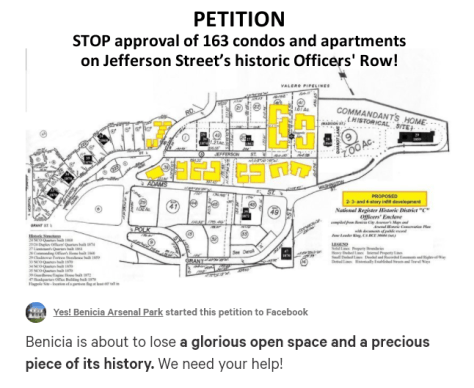
The Jefferson Ridge development in Benicia Arsenal replaces historic views outlined in the City’s 1990 Conservation Plan with buildings that fill the district’s open space. From the 1860s Officers Quarters, the view is now dominated by a wall of the proposed buildings and parking.
While the Carrillo project works with Santa Rosa officials, historians, housing advocates, and Native Americans, the City of Benicia officials accepted the Keith Rogal Jefferson Ridge project as qualifying for staff approval. Arsenal Protectors testified at the Planning Commission citing the Environmental Impact Report for the Specific Plan, summarizing the long list of mitigation measures and the adopted Historic Arsenal Conservation Plan.
The Arsenal Jefferson Ridge developer Keith Rogal has plenty of experience with historic properties since he is involved in the Sonoma project with historic buildings, wetlands, wildlife and open space. The county was sued on his inadequate environmental report. Rogal is currently in more litigation by protectors of historic values, wetlands and open space.
Benicia officials were unmoved by public requests to consider the history of the Jefferson ridge not be erased. The officials have been asked to consider layers of history that have some mystery to them and is a compelling place to be in the presence of and stand with the view sites mapped by the United States Army. [You may hear “we had no choice because of SB 35” – b.s].
The 1847 Arsenal is the first on the west coast. Has the most intact Civil War Era officers’ quarters in the United States (these structures remain, but the context of their being sited on the Jefferson Ridge is lost without the views of the Carquinez Strait as mapped by the Army). The historic infrastructure of paths and recreation for the officers will be bulldozed.
In fact, contrary to the Benicia Municipal Code stipulating the right to appeal staff decisions, the city officials returned the appeal fee and denied a hearing with city council.
Santa Rosa and Sonoma will consider the history, wetlands and open space and their decisions may not please all, but it will be a public process respecting the concerns of their historic resources.
To date the Protectors of the Arsenal are unsuccessful. They want the public to view Arsenal Jefferson Ridge as it appeared from the 1860s to 1964, in line with its status on the National Register of Historic Places and within the Delta National Heritage Area. However, the city and Rogal will proceed with their project ending preservation efforts and overriding these hopes unless halted by the California Supreme Court. It’s your history – will it be for future generations?
Elizabeth Patterson, Mayor 2007-2020
1000 Friends Protecting Historic Benicia
The Officers Row District on Jefferson Ridge in the Historic Benicia Arsenal is a well-defined Civil War era historic district listed on the National Register of Historic Places and within the Delta National Heritage Area. This ridge was initially designated 1847 for an arsenal which is now our Clock Tower. It has a clear vantage point to watch, guard and if necessary, act against threats. It provided protection for 1850 gold rush manufacturing of dredgers and other mining needs.
The historic district exhibits a clear pattern of organization that displays military rank in the arrangement of the officer quarters, retains views of the Strait and sight lines between buildings that were instrumental to the operating a military arsenal, and incorporated parade grounds and exercise grounds in close proximity to the officers’ quarters.
These relationships are still visible today [it is uncertain for how long now], allowing the public to observe and appreciate the logic of the Army’s design for historic districts of this period. As evident from the Benicia Arsenal’s record of entry into the National Register of Historic Places, the relationship between individual structures that make up a historic district is what makes it identifiable as a district having historic preservation value. [Thus, a development that eliminates the relational features and that define an intact historic district and distinguish it from its individual parts would thereby eliminate the district itself – causing the loss of a unique historical structure].
The whole of the Arsenal consisted of approximately 2700 acres of which 235 or so were considered historic and designated by the State in 1935 as a California Landmark.
The Arsenal was a major player in many of the wars including the Civil War (to prevent gold being smuggled to the confederates), the attack on indigenous peoples, a major factor in WW I and WWII and supplied the munitions for the Tokyo raid. Tanks were cleaned on the lower arsenal streets with tetrachloroethene. Machine guns and other guns were repaired and reconditioned by as many an 1000 workers a day (mostly women). It was closed in 1964 without unexploded ordinance cleanup and other pollution except for the Nike missiles. There was no planning, no transition funds, no infrastructure upgrading – zero.
The city officials acted with little public advice. They acted in a manner that earned a law suit which was a major factor for the State Department of Parks and Recreation withdrawing from developing the historic part of the Arsenal as a state park. The city officials were willing partners with the industrial park investors allowing historic structures to be torn down, and new development inconsistent with the Secretary of Interior standards. For instance, the oldest Army cemetery in the West is cut off from the public by pipelines; the first Army Hospital west of the Mississippi sold for use by Amports as headquarters.
And here we are: tourism for cultural and historic resources is popular and brings in revenues to communities. It does not have to be built. It is here. Many former industrial cities in Europe and the United States have rebuilt their economies on tourism. It is the fastest growing investment a community can make. The Arsenal – this district specifically – is in the Delta National Heritage Areaa which is managed by the Delta Protection Commission that receives an annual federal funding of $500,000 to implement the Management Plan with policies and programs for tourism for the cultural, historic and natural resource heritage of the area. But it as if Benicia officials eat their young.
CALL TO ACTION
There is a good chance the California Supreme Court would take the case because of the legal issues involved. This is a cultural resource issue not a housing CEQA issue.
Letters to the editor, to city officials are helpful.
Donations to 1000friendsphb.org are essential. You can donate on the web or send check to address listed. It has been expensive effort to protect the Historic Arsenal. We get our largest donations from San Francisco individuals and historic societies. Now there is city that knows the value of history.


You must be logged in to post a comment.