A number of news outlets are reporting that California Governor Gavin Newsom extended the coronavirus stay-at-home order through May 15.
But as of today, nothing on the Governor’s coronavirus page confirms the extension. Nor do any reliable news sources confirm the extension.
The story seems to have arisen in connection with actions taken by several southern California jurisdictions which extended the order through May 15, including Los Angeles County and the City of Santa Clarita.
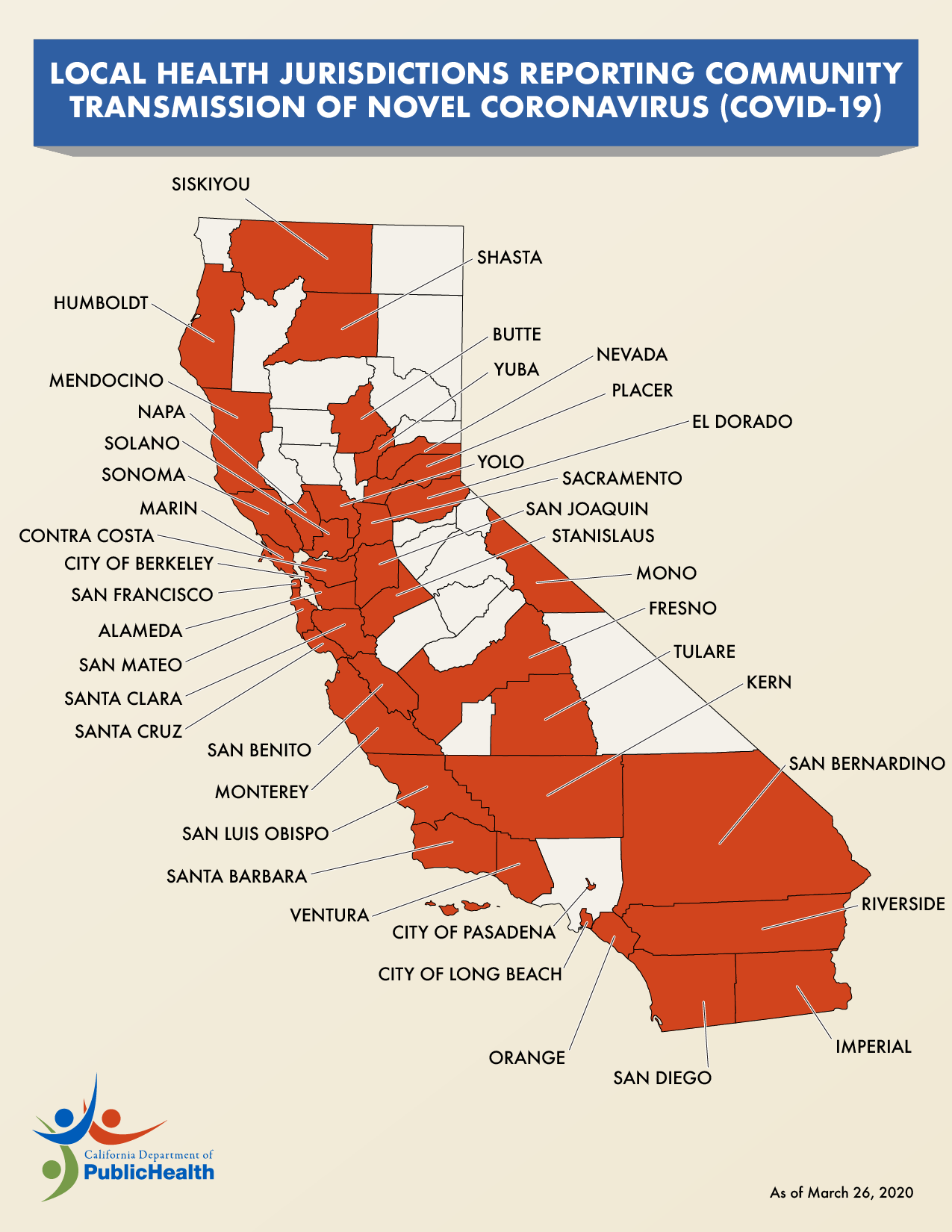
Here in Benicia, we are also under Solano County orders to stay at home. Solano County’s current extension orderwas issued on March 30, and continues through April 30. The City of Benicia declared an emergency on March 15, and has repeatedly issued guidelines supporting the County’s order.
San Francisco Chronicle Editorial Board, April 7, 2020
A health care worker speaks with a driver at a drive-thru coronavirus testing site in a parking lot of the old California Pacific Medical Center on California Street in San Francisco, Calif. on Thursday, April 2, 2020. The appointment only tests were provided for employees and staff of CPMC and Brown and Toland physicians. Photo: Paul Chinn / The Chronicle
California has so far escaped an exponential coronavirus outbreak on the order of New York’s thanks to nation-leading social-distancing measures, particularly in the Bay Area. But the state has lagged in testing for the virus, undermining a relatively encouraging trajectory and threatening its ability to combat the contagion over the long term.
While federal failures have plagued coronavirus testing across the country, California’s capacity to identify the disease it’s fighting has been particularly poor. About 126,000 Californians had been tested for the novel coronavirus as of Saturday, Gov. Gavin Newsom said, or 0.3% of the population. That’s only about half the per capita rate nationwide in a country that has been a global underachiever in tracking the pandemic, ranking 42nd among the states according to one analysis. New York, with about half the population, has tested more than 300,000.
Extraordinary delays in processing those tests that have been conducted exacerbated California’s shortfall. At one point last week, results were still pending for more than 60% of tests. Some patients reported waiting well over a week to find out whether they tested positive, defeating any attempt to quickly identify and contain infections.
To Newsom’s credit, he took responsibility for the problem Saturday and vowed to increase testing “exponentially” by forming a testing task force and several diagnostic “hubs,” coordinating the distribution of supplies, and working with UC Davis and UC San Diego. The governor also reported significant progress on the testing backlog, which had fallen from nearly 60,000 awaiting results to around 13,000 as of last weekend.
Federal miscues early on put the entire country at a disadvantage in detecting the pandemic. Although the World Health Organization had distributed hundreds of thousands of working coronavirus tests by early February, the U.S. Centers for Disease Control and Prevention insisted on developing its own test only to discover flaws that made it largely unusable. The government nevertheless took weeks to relax regulations that prevented labs around the country from employing alternatives, finally doing so in late February.
Those difficulties were compounded in California thanks to shortages of testing supplies, a lack of coordination among dozens of public and private labs, and a huge backlog at one of them. Testing capacity has also been reduced by closures of about a quarter of the state’s public health labs over the past two decades.
If California’s relative success in slowing the spread of of the contagion continues, one likely consequence is that more of the population will remain unexposed and therefore vulnerable until a vaccine is developed, a process expected to take more than a year. A coherent testing regime will be that much more crucial to detecting and controlling any resurgence of the pandemic and beginning to restore a semblance of normalcy.
The Institute for Health Metrics and Evaluation, an independent research center at the University of Washington, has released COVID-19 projections for all 50 states and for nations around the world.
The models predict “extent and timing of deaths and excess demand for hospital services due to COVID-19,” the institute says.
The model for California, as of April 7, predicted that COVID-19 deaths per day would peak on April 17. Projections assume “full social distancing” through May.
The pulldown box at the top of the graphic allows selection of other states and nations.
The “Number of cases” button previously read “Updated daily at 4pm.” Sometime after 4pm on Saturday, March 28, the text below the button was changed to “Updated Monday to Friday at 4pm.”
The County updated the number of cases on Saturday March 21, but starting yesterday, the Solano public will no longer get weekend updates.
The Johns Hopkins interactive map shows no change for Solano County from Friday’s total of 34 cases. Presumably, that map is dependent on reports from County officials – OR, there was no change on Saturday.

 A number of news outlets are reporting that California Governor Gavin Newsom extended the coronavirus stay-at-home order through May 15.


You must be logged in to post a comment.