
Category Archives: Environmental review

Milton Mayor: residents ‘will be lying down on the tracks’ to prevent surprise railyard plan

Repost from The Hamilton Spectator

Milton residents ‘will be lying down on the tracks’ to prevent surprise CN plan

By San Grewal, March 17, 2015
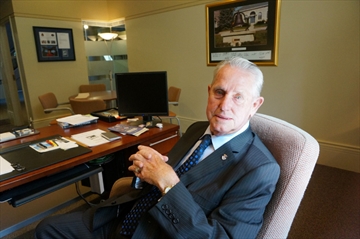
MILTON MAYOR
MILTON MAYOR Gordon Krantz says his town has been “blindsided” by a CN plan to have a facility between Britannia Rd. and Lower Base Line that would bring 1,500 trucks and four additional trains into Milton every day. Zoe McKnight,Torstar News Service

A “David and Goliath” battle is shaping up in Milton, where the Toronto Star has learned CN is about to announce plans for a 400-acre rail distribution centre that throws a wrench into the region’s carefully crafted growth management strategy.

Milton’s mayor and top bureaucrat are vowing the town will not go down without a fight.

“We have 50,000 residents, 20,000 houses planned for the area north of this (intermodal) facility. CN came in last week and pronounced that they are going forward — no formal application, no formal announcement,” said Milton’s chief administrative officer, William Mann.

“We know they are announcing it on Thursday. When Milton residents hear about this, they will be lying down on the tracks.”

Mann said the town, one of Canada’s fastest growing municipalities, has been told that CN, as a former Crown corporation, still has a certain power to circumvent municipal planning as governed by the province of Ontario.

Mann and Mayor Gord Krantz told the Star the town has been “blindsided” by the plan for a facility between Britannia Rd. and Lower Base Line that the town says would operate 24/7, transferring containers between trains and trucks. The town says it would bring 1,500 trucks and four additional trains into Milton every day, on CN-owned land that isn’t supposed to be used for such a facility according to Milton’s planning strategy.

Under Sustainable Halton, the region’s widely lauded plan for growth management, the land has been earmarked for strategic employment, with a mix of residential and commercial development surrounding it, as well as environmentally protected lands.

“It’s completely contrary to what we had planned,” Krantz said. “If I knew what was being proposed by CN I certainly wouldn’t be purchasing. Or if I already purchased one (of the newly built homes) and I wanted to get out from under it — I can imagine the possible legal battles.”

But Krantz is vowing to do everything the town can to fight CN, even if the rail giant has the federal government on its side, along with its powers to ignore local planning jurisdiction.

Referring to the tale of David and Goliath, Krantz said: “We all know how that story ended. I’ve got my one shot ready.”

He said Milton is already working with Halton Region and other partners on a legal strategy, but said he didn’t want to tip his hand.

CN responded to the Star’s questions about the project with a brief statement: “CN owns approximately 1,000 acres of land in the Milton, Ont., area. As part of its ongoing business operations, CN continually reviews its facilities and real estate holdings to ensure they are adequate to accommodate growth in its various businesses. Such is the case with CN’s Milton property. CN has no further comment at this time.”

One of the world’s largest rail companies, CN has a market capitalization of almost $71 billion.

CN had proposed a similar project in 2001 — preceding the province’s strategy to manage growth — that was withdrawn after the town and region identified major issues with it, according to a news release from the Town of Milton.

Multiple sources told the Star the CN plan is to be unveiled Thursday at a breakfast event hosted by the local chamber of commerce. As the MP for Halton riding, Federal Transport Minister Lisa Raitt represents Milton. A statement from the ministry to the Star said only that Raitt would attend the Chamber event Thursday “and looks forward to the presentation.”

The Ministry of Municipal Affairs and Housing was asked whether the province would guarantee a public consultation and that provincial environmental and safety rules as well as municipal planning processes would be complied with. A spokesperson said the ministry, and the Ministry of Transportation, “have been advised by CN that they are revisiting the need for an intermodal yard in the Town of Milton … CN has not provided the province with specific details of their proposal.”

With concern mounting over rail safety in the wake of the Lac-Mégantic disaster and more recent fiery derailments of trains carrying crude oil, Krantz and Mann said they have been disheartened by the province’s unwillingness to address the CN plan.

When asked if he has an idea of what would be passing through the area, Krantz said: “That’s a good question. We don’t know what’s going to be transported.”

Beyond the negative impact on surrounding property values, and environmental and safety concerns, the development industry is going to be extremely upset with CN’s decision, he said.

“You ain’t seen nothing yet. Wait until the developers, especially in the residential sector, hear. I suspect their reaction will be something like mine.”

Mann said Milton has behaved like the model municipality for Ontario’s Places to Grow Act, which established managed population growth targets throughout the GTA. The town has grown from about 7,000 residents in 1971 to 84,362, according to the 2011 census.

“We could go to over 400,000 under Places to Grow. Places to Grow is all about taking your fair share. Now, upward of 500 acres of employment land and all the residential around it, could be taken out of the picture. That means the rest of the GTA will have to pick up that population.

“This plan has nothing but negative consequences for Milton, from a community perspective.”

San Luis Obispo Tribune: Benicia to recirculate Valero DEIR

Repost from the San Luis Obispo Tribune
[Editor: Nice to know that the folks in San Luis Obispo (home of Phillips 66 Santa Maria Refinery) are keeping an eye on Benicia….  – RS]

California city plans more study of crude-oil rail shipments

The Associated PressFebruary 4, 2015

BENICIA, Calif. — The city of Benicia is planning further review of a refinery’s plan to move as many as 100 train cars of flammable crude oil daily through Northern California communities.The Sacramento Bee reports (http://bit.ly/1LLESFw ) Benicia officials said Tuesday that they have decided to redo some sections of an environmental impact analysis of the project. The city plans to release a rewritten report June 30 for public review.

The decision comes after numerous groups, including Attorney General Kamala Harris, called the city’s review of the project inadequate.

The Valero Refining Company in Benicia plans to have trains travel on the Union Pacific line that runs through downtown West Sacramento and Davis, along the same tracks that carry Capitol Corridor passenger trains between Sacramento and the Bay Area.

Information from: The Sacramento Bee, http://www.sacbee.com

Sacramento Bee: Benicia plans more study of crude-oil train impacts

Repost from The Sacramento Bee
[Editor: The Bee presents a good summary of uprail critiques of Valero’s plan, quoting City staff, Valero and the CEO of the American Petroleum Institute.  Note that organized local opposition has also been strong and persistent.  – RS]

Benicia plans more study of crude-oil train impacts

By Tony Bizjak, 02/03/2015
In this July 24, 2014 file photo, an investigator photographs the scene where a locomotive and cars carrying crude oil went off the track beneath the Magnolia Bridge in Seattle.
In this July 24, 2014 file photo, an investigator photographs the scene where a locomotive and cars carrying crude oil went off the track beneath the Magnolia Bridge in Seattle. Mike Siegel / AP Photo/The Seattle Times

A controversial proposal by the Valero Refining Company in Benicia to run two 50-car crude-oil trains a day through Sacramento and other Northern California cities to its bayside refinery has hit another slowdown.

Benicia officials on Tuesday said they have decided to redo some sections of an environmental impact analysis of the project. The city plans to release a rewritten report June 30 for public review and comment over the summer.

The city’s decision comes after numerous groups, including Sacramento leaders, state Attorney General Kamala Harris and state oil spill prevention officials, called Benicia’s review of the project inadequate.

Those critics said Benicia failed to analyze the potential impacts of an oil spill and fire in cities, waterways and rural areas along the rail line, and also did not analyze the project’s potential impacts east of Roseville in environmentally sensitive areas such as the Feather River Canyon. They also challenged Benicia’s assertion that an oil spill between Roseville and Benicia would be a once-in-a-111-year event.

Crude-oil rail shipments have come under national scrutiny in the last year. Several spectacular explosions of crude oil trains, including one that killed 47 in a Canadian town in 2013, have prompted a push by federal officials and cities for safety improvements.

Sacramento and Davis leaders have called on Benicia to require the Union Pacific Railroad to give advance notice to local emergency responders, and to prohibit the railroad company from parking or storing loaded oil tank trains in urban areas. Local officials want the railroad to use train cars with electronically controlled brakes and rollover protection. Sacramento also has asked Benicia to limit Valero to shipping oil that has been stripped of highly volatile elements, including natural gas liquid.

Valero officials had said they hoped to begin receiving crude oil by trains early this year. In an email to the Bee, Valero spokesman Chris Howe said, “The proposed steps (by Benicia) are part of the process which we expect will allow the city to grant us a use permit for the project.”

In a hearing Tuesday in the U.S. House of Representatives in Washington, D.C., Jack Gerard, the president and CEO of the American Petroleum Institute, lamented that lengthy reviews were holding up the development of the country’s energy resources, including the Keystone XL pipeline, which has been under review by the State Department for seven years.

Gerard said some opponents were turning the process into a referendum on fossil fuels. “What we’re seeing across the country today is there’s a small group of individuals who are using permitting processes and infrastructure as surrogates to stop economic activity that they disagree with,” he told the House Subcommittee on Railroads, Pipelines and Hazardous Materials.

Vallejo Times-Herald: Benicia will update crude-by-rail project’s environmental report

Repost from The Vallejo Times-Herald

Benicia will update crude-by-rail project’s environmental report

By Irma Widjojo, 02/03/15

Benicia >> The City of Benicia announced Tuesday that staff will be updating sections of the draft environmental impact review report for Valero Benicia Refinery’s proposed crude-by-rail project.

“There’s a requirement that if we’ve identified any issues that might have new significant impacts we would have to circulate the report,” interim Community Development Director Dan Marks said.

Marks said staff has identified one to two of those issues, and is still reviewing the public comments received after the draft report was initially released in June. However, he did not release any specifics of the identified issues, citing ongoing review.

Marks said the updated sections are set to be recirculated June 30, at the earliest. The public will then have 45 days from the release date to submit any comments on the updates.

“This is a scheduling announcement,” he said. “We’re still working on it. It’s going to take a while.”

The initial report states that the controversial project would have “significant and unavoidable” air-quality impacts within the Sacramento basin because of emissions from oil trains traveling to and from the refinery. However, the project would result in “no impact” or “less-than-significant” impacts locally to biological resources, cultural resources, energy conservation, geology and soils, greenhouse gas emissions, hazards and hazardous materials, water quality, land use and planning and noise, the report finds.

If approved, the proposed project would allow the refinery to bring two 50-tanker car trains of crude oil in and out of Benicia every day, replacing crude shipments by boat.