Valero’s oil refinery in the Solano County city of Benicia. (Craig Miller/KQED)
Benicia lawmakers are considering a proposal that could eventually require the city to fact-check political campaign advertisements — a novel response to alleged election misinformation that could face legal scrutiny.
The ordinance comes after a political action committee funded by Valero, the oil giant that runs a refinery in town, tried to influence voters in the last two city council elections. The company’s involvement in city politics also came as the Valero plant experienced two of the region’s worst refinery accidents in the last four years.
The ordinance was co-authored by Mayor Steve Young, whom the Valero PAC opposed in the last election. He said the committee put out ads that manipulated photos of him and distorted his record.
Now, Young said, the city should consider whether its campaign regulations “can be amended to prohibit digital or voice manipulation of images and whether any lying can be prohibited.”
The PAC, dubbed Working Families for a Strong Benicia, raised hundreds of thousands of dollars for the 2018 and 2020 city council elections. Both votes revived debate between some city officials and environmentalists on one side, who want more regulations on the refinery, and oil executives and unionized refinery workers on the other, who say they fear the city’s real motivation is to shut the plant down.
In 2018, two candidates backed by the PAC, which is also funded by several labor organizations allied with the refinery, won seats on the Benicia City Council. Another candidate, an environmentalist who was opposed by the committee, lost.
Last year, Young won the mayor’s race despite the PAC’s opposition to his candidacy. The ads said that he was against affordable housing and that he didn’t need a job because he receives a pension from previous local government work.
The mayor said he does want cheaper housing and there’s nothing wrong with receiving a pension. He said Valero’s opposition to him began in 2016, when the Benicia Planning Commission, which Young was a member of, voted to reject the company’s crude-by-rail proposal.
“Steve Young wants to turn Benicia into a place where young families can’t afford to live and work,” one flier stated. “Who would vote against kids playing at the ballpark? Steve Young did,” another one said.
Young and the proposal’s co-author, Councilmember Tom Campbell, said the ads mean the city should do a better job of making sure future elections are fair and honest.
But turning the government into a fact-checking body would be ripe for a legal challenge, according to Jessica Levinson, a Loyola Marymount University professor specializing in election law.
“We know the First Amendment does in fact protect lies,” Levinson said in an interview. “I think this is absolutely open to a legal challenge the second they pass it, if they do.”
“Who decides what’s an embellishment, what’s misleading, what’s just an omission versus what’s actually a lie?” Levinson asked.
Since the 2016 election and the beginning of Donald Trump’s presidency, misinformation has become one of the biggest issues in American politics, said Levinson.
“We are tackling a situation where there are more lies and there’s more technology that allows us to lie than for sure the framers every dreamed of,” she added.
At the same time, the local news industry, which traditionally acts like a fact-checking body, has been decimated. Benicia gets some news coverage but is often overshadowed by larger Bay Area cities like San Francisco and Oakland.
“One of the things that keeps me up at night is not just misinformation and disinformation and the fact that people believe it, but the fact that we have a dwindling press corps and particularly in smaller jurisdictions,” Levinson said.
The details over how the city would fact-check political ads has yet to be worked out. The proposal, set to go before the city council on Tuesday, would forward the issue to Benicia’s Open Government Commission, a body that would consider changing the city’s election campaign regulations. The commission would work on new rules and forward them to the city council next April.
Valero fought with the city’s last mayor, Elizabeth Patterson, after she called for more regulations to be placed on the refinery following a May 2017 power outage that led to a major release of toxic sulfur dioxide and prompted emergency shelter-in-place orders. Less than two years later, the plant had a series of malfunctions that led to another significant pollution release.
Jason Kaune, the PAC’s treasurer and head of political law at Nielsen Merksamer, a Sacramento-based lobbying firm, declined to comment. Representatives for Valero and unions that supported the committee did not respond to requests for comment.
On the Baykeeper article with drone video and photos of petcoke pollution at Port of Benicia
Marilyn Bardet
I first heard a report about the petroleum coke plume spreading on the Strait from Benicia’s port on KQED radio yesterday, and now the Vallejo Sun (online news source—see link above)) has run an article that includes a drone video of what appears to be a plume from a coke ship at the Valero dock. Clearly, this can’t be a “first” incident. Thanks to Roger Straw,’s catch, the Benicia Independent ran the story yesterday.
The revelation is no surprise to me, although I’ve never had a drone to capture from the air what I’ve witnessed with my own eyes and photographed from near the port. In 1995, I snapped a picture of a “dust cloud” wafting up into the air from petcoke being dumped into the open hull of a coke ship. That “cloud” had been visible to the naked eye on a misty grey day. I’d reported this to the Air District then, (with photos taken from old camera) and similarly, over the years, to no avail. Petcoke is unregulated by Fed-EPA. (see “why” below).
I also took photos in 2013-2014 of coke trains traveling from the refinery along Bayshore Rd, and I’ve collected petcoke off railroad ties that had sifted out from the hopper cars’ undercarriage (from which hinged flanges open up for dumping coke onto underground conveyor belt at the port, which is then trasferred to the petcoke silos. (see photos below). The coke can still be seen along the tracks–proof of how coke gets airborne from its transport from trains to silos to ships’ hulls.
Petcoke is a dangerous particulate (PM 10 and PM 2.5) that settles on the water and all around the lower Arsenal area in the vicinity of the arts community and Arsenal Historic District. Tiniest invisible particles blow around, becoming part of the carbon grit that settles on cars, window sills, etc. etc.
As most of you know, I’ve railed for years, since 1995, about how petroleum coke is a serious airborne pollutant in our local environment. In 1995, Koch Carbon Industries (subsidiary of Koch Industries) came to Benicia proposing to build a mega-industrial 24/7 petcoke storage and shipping terminal operation that was to serve all five Bay Area refineries including Exxon Benicia (now Valero). That project would have been disastrous for Benicia, creating a massive “toxic coke dump” at our port, with all the cumulative consequences to public health and the environment. We, the public, fought the project fiercely and forced Koch Industries to abandon their proposed “Coke Domes” project. But they went up river and built a smaller coke terminal in Pittsburg instead— speaking of environmental injustice).
If you read no further, the announcement yesterday underscores my point, made over many years and currently, that residential development in the lower Arsenal should not be allowed, because doing so would deliberately create an environmental injustice: the area is inherently industrial and dangerous and polluted by the various specific operations of Valero and Amports. Check it out! Active crude oil pipelines run from the refinery behind our historic Officers’ Row and Clocktower to the Valero tanker dock, (located just east of the Clocktower); petroleum coke is is transferred from the refinery two or three times per week by train along Bayshore Rd to Valero’s petcoke shipping dock (immediately adjacent to Amports’ car import dock); diesel exhaust contributes toxic gases to the air from ships’ engines running while in port and on the Strait. To my knowledge, the cumulative amount of pollution produced everyday in the vicinity of the port has not been calculated.
Petcoke collected from train tracks along Bayshore Road in Benicia (Marilyn Bardet, Oct 9, 2013)
For those of you not sure about how petcoke is produced and why it’s dangerous to human health: Petroleum coke is the name given to the residue left in the hydrocracker processing unit during the refining of crude oil’s distillates. This residue is an oily, black crumbly carbon substance that must be scraped out of the hydrocracker everyday, and transfered to a “coker” for more processing. to create what’s called “petcoke”. The heavier (dirtier) crude oil refined, the more coke residue is created. The coker unit at Valero transforms the coal-like rocks into a fluffed up powdery-fine granular particulate which is marketed as a product, sold mainly to Asia as a cheap fuel for use in place of more expensive coal in steel furnaces and for other domestic uses. With few exceptions, petcoke cannot be used as a fuel in the US.
Burning petcoke as a fuel contributes to global warming, every bit as much as burning coal or any other fossil fuel. It is also hugely dangerous to human health when inhaled. The coke particulates contain heavy metals, depending on the source of crude oil being refined on any given day. Nickel is a carcinogen when inhaled. PM2.5 particulates of petcoke lodge in the lungs and send other toxic gas molecules—which have piggy-backed onto airborne petcoke particulates—into the bloodstream, thus cumulatively affecting circulatory, heart and lung functions from chronic, daily, low-level exposures breathing airborne petcoke. Of course, petcoke ending up in the water on a regular basis can be ingested by fish and waterfowl and other organisms, contaminating the Strait. Much more investigation of this issue is urgently needed!
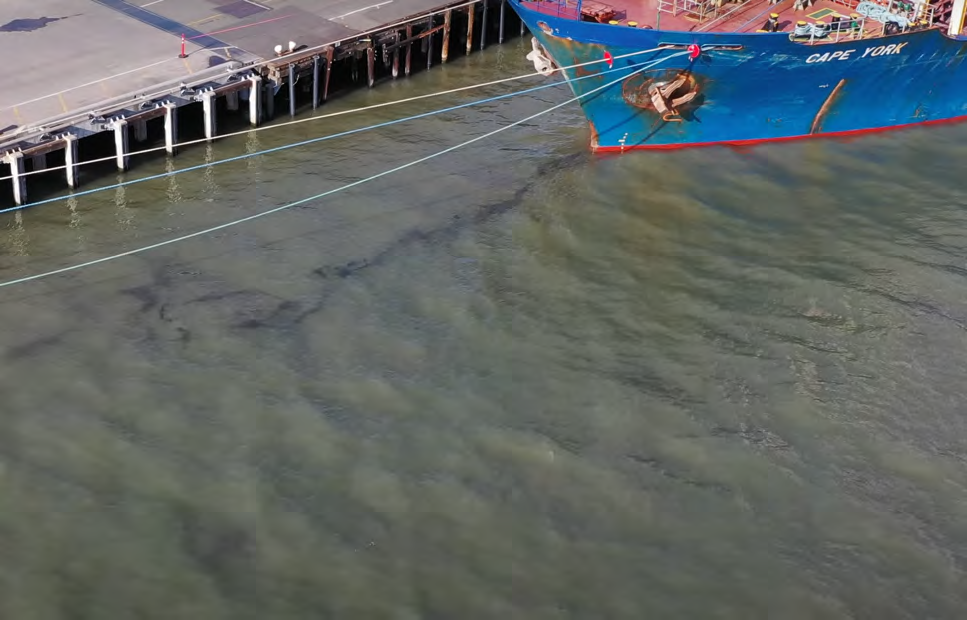
Petcoke plume in Carquinez Strait, Benicia. Photo by San Francisco Baykeeper
The sad, unethical fact is that long ago the oil industry lobbied Fed-EPA to exempt petcoke from regulation as a toxic waste, arguing that petcoke becomes a marketable “finished product” when further processed, and therefore belongs in the same category that includes gasoline, kerosene, diesel, and all other liquid distillates produced by refineries. As more and more heavy crude is being refined in California, our refineries will be producing much more petcoke for export as fuel for burning….
To date, the Bay Area Air Quality Management District (BAAQMD) responds to residents’ complaints about petcoke only if it is visible as an opaque dust cloud when backlit in the air! (This was told to me by BAAQMD staff member).
I hope this helps everyone understand why petcoke is a human health and environmental danger, and why we should NOT be allowing residential development in the lower Arsenal Historic District, for all the enviro reasons cited above. Period!
Please share with your friends!
On the side of public health and safety, social and environmental justice,
In a previous post, I shared the Baykeeper press release announcing the photo and video evidence of illegal polluting of the Carquinez Strait and San Francisco Bay by Benicia AMPORTS.
[sta_anchor id=”summary” /]Summary and notice of 60 days to settle
Re: Notice of Ongoing Violations and Intent to File a “Citizen Suit” Under the Clean Water Act
To Whom It May Concern:
I am writing on behalf of San Francisco Baykeeper (“Baykeeper”) regarding violations of the Clean Water Act1 (“CWA” or “Act”) at the Amports Port of Benicia Terminal, owned and operated by Amports, Inc. (“Amports”) at 1997 Elm Road, Benicia, CA 94510 (“Facility”) and 1007 Bayshore Road, Benicia, CA 94510. The purpose of this letter (“Notice Letter”) is to put Amports on notice that, at the expiration of sixty (60) days from the date the Notice Letter is served, Baykeeper intends to file a “citizen suit” action against Amports in U.S. Federal District Court. The civil action will allege significant, ongoing, and continuous violations of the Act and California’s General Industrial Storm Water Permit2 (“General Permit”) at the Facility, including but not limited to, the direct deposition of petroleum coke (“petcoke”) into the water from the conveyance system, equipment, and ship, aerial deposition of petcoke directly to the water from the deck of the ship, and the uncontrolled discharge of polluted storm water to the Carquinez Strait, a part of the San Francisco Bay.[sta_anchor id=”violations” /]
Detailed list of violations
As described in detail below, Amports is liable for ongoing violations of the Act as a consequence of the Facility’s: (1) direct discharge of petcoke into the Carquinez Strait, both through deck washing and direct aerial deposition; (2) inaccurate use of SIC code designations to avoid coverage for regulated industrial activities under the General Permit; (3) failure to comply with the terms and conditions of the General Permit resulting in unpermitted storm water discharges, including but not limited to the preparation and implementation of a proper Storm Water Pollution Prevention Plan related to Amports’ petcoke loading operation, preparation and implementation of a Monitoring Implementation Plan, and compliance with technology-based Effluent Limitations.
[sta_anchor id=”60day” /]60-day notice and offer of settlement
CWA section 505(b) requires that sixty (60) days prior to the initiation of a civil action under CWA section 505(a), a citizen must give notice of their intent to file suit. 33 U.S.C. § 1365(b). Notice must be given to the alleged violator, the U.S. Environmental Protection Agency (EPA), and the State in which the violations occur. As required by section 505(b), this Notice of Violation and Intent to File Suit provides notice to Amports of the violations that have occurred and which continue to occur at the Facility. After the expiration of sixty (60) days from the date of this Notice of Violation and Intent to File Suit, Baykeeper intends to file suit in federal court against Amports under CWA section 505(a) for the violations described more fully below.
During the 60-day notice period, Baykeeper would like to discuss effective remedies for the violations noticed in this letter. We suggest that you contact us as soon as possible so that these discussions may be completed by the conclusion of the 60-day notice period. Please note that it is our policy to file a complaint in federal court as soon as the notice period ends, even if discussions are in progress.
[sta_anchor id=”photos” /]Background and photos
A. San Francisco Baykeeper
San Francisco Baykeeper (“Baykeeper”) is a non-profit public benefit corporation….
Members of Baykeeper reside in Benicia, California, as well as in many of the surrounding communities. Baykeeper’s members and supporters use and enjoy San Francisco Bay and other waters for various recreational, educational, and spiritual purposes. Baykeeper’s members’ use and enjoyment of these waters are negatively affected by the pollution caused by the Facility’s operations….
B. The Owner and/or Operator of the Facility
Amports, Inc. is a dba of APS West Coast Inc. and is identified as the owner and operator of the Benicia Port Terminal Company. All three entities have the same address, CEO, Secretary, CFO, and Controller.
C. The Facility’s Industrial Activities and Discharges of Petcoke and Other Pollutants
The Facility is a roughly 400-acre site which includes marine cargo loading equipment, the petcoke loading equipment and conveyor system, parking for cars, docking area and equipment for ships, silos to store petcoke, train car petcoke offloading area and equipment, vehicle maintenance, equipment cleaning, ship cleaning, ship maintenance, and other facilities. According to Amports’ 2015 Notice of Intent to comply with the General Permit under the Clean Water Act, at least 8 acres at the Facility consisted of areas that were exposed to storm water.
The Valero Benicia Refinery processes crude oil by separating it into a range of hydrocarbon components or fractions. Petroleum fractions include heavy oils and residual materials used to make asphalt or petcoke, mid-range materials such as diesel (heating oil), jet fuel, and gasoline, and lighter products, such as butane, propane, and fuel gases.
The petcoke is transported via rail to the Facility and is stored there in silos. Amports transfers the petcoke from the silos to a ship’s hold at the Facility’s dock by way of a covered conveyor system. During this process, the petcoke may escape in half a dozen or more ways.
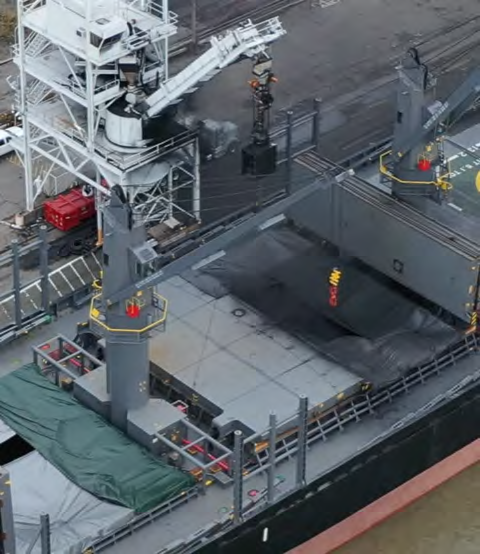
First, petcoke spills off of the conveyor belt system and is deposited onto the wharf and directly into Carquinez Strait. This occurs while the crane boom is in the lowered position, and, as depicted below, continues as the boom is raised while the conveyor continues to operate.
March 2021
Second, petcoke is deposited onto the deck of the ship and into the water, potentially due to overspray from the loading mechanism or other operations, leaving visible plumes of petcoke that can be seen in the water.
February 2021
Third, at the conclusion of the loading, longshoremen hose off the deck of the ship, and the related loading equipment on and around the ship, cleaning the equipment and forcing contaminated runoff directly into the Carquinez Strait, again leaving visible plumes of petcoke that can be seen in the water.
February 2021
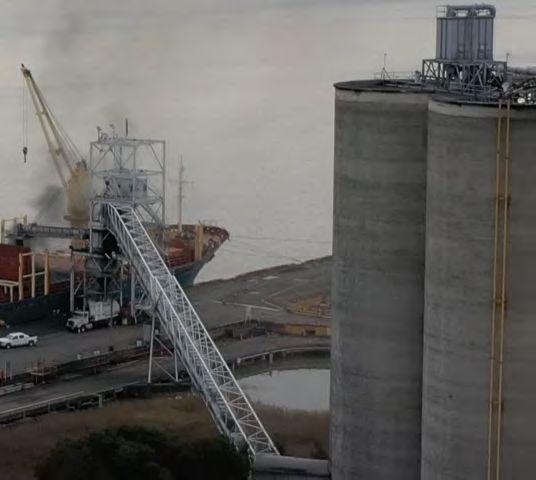
Fourth, as the ship is being loaded, large visible clouds of black particulate matter, presumably petcoke dust, drift through the air away from the ship before being directly deposited into the water and/or onto the nearby shoreline.
Additionally, petcoke may escape and be deposited onto the Facility or into the water during: (a) the offload from trains, (b) the movement of petcoke around the Facility, (c) storage at the Facility, (d) from equipment and vehicle cleaning, (e) from equipment and vehicle maintenance or repair, and (f) each time a sufficient rain event occurs due to the Facility’s discharge of pollutants from industrial activity in storm water, through direct discharges of industrial pollutants.
The deposition of petcoke and other pollutants into San Francisco Bay is harmful and deleterious to the Bay’s wildlife and communities. Petcoke is a petroleum byproduct and is known to contain pollutants including heavy metals such as copper, zinc, nickel, arsenic, mercury, and vanadium, all of which are harmful to aquatic life, including fish and birds.
Additionally, people exposed to petcoke pollutants can experience severe health problems like asthma, lung cancer, and heart disease.
[sta_anchor id=”petcoke” /]Detailed harmful effects of Petcoke
The deposition of petcoke and other pollutants into San Francisco Bay is harmful and deleterious to the Bay’s wildlife and communities. Petcoke is a petroleum byproduct and is known to contain pollutants including heavy metals such as copper, zinc, nickel, arsenic, mercury, and vanadium, all of which are harmful to aquatic life, including fish and birds. Additionally, people exposed to petcoke pollutants can experience severe health problems like asthma, lung cancer, and heart disease.
Amports is permitted by the Bay Area Air Quality Management District (BAAQMD) to process and load 2 million tons of petcoke onto export ships over a 12-month period. Amports does not have any permits from the San Francisco Bay Regional Water Quality Control Board (“Regional Board”). Amports is not permitted to discharge petcoke directly into the Carquinez Strait. And Amports is also not permitted to discharge any storm water, directly or indirectly, that is the result of industrial activity, including water that is commingled with industrial discharges.
Baykeeper’s suit will allege that petcoke is deposited on the site with every instance of: petcoke being transported by rail to the site, petcoke offloading from a train at the Facility, and petcoke being handled and transported on the Facility’s premises. Additionally, Baykeeper will allege that petcoke enters the Carquinez Strait with every instance of: petcoke being loaded and/or oversprayed onto a ship docked at the Facility, petcoke-related equipment, including the conveyor systems, cranes, and ships, being maintained and/or cleaned, and each storm event at the Facility in excess of 0.1” of precipitation.
The discharge of pollutants from industrial facilities contributes to the impairment of surface waters and aquatic-dependent wildlife. These contaminated discharges can and must be controlled for ecosystems to regain their health and to protect public health. As part of its investigation of the Facility, Baykeeper observed and documented by video numerous instances of illegal discharges during Amports’ various activities and handling of marine cargo (specifically petcoke) at the Facility between November 2020 and March 2021.
Additionally, with every significant rainfall event, millions of gallons of polluted storm water originating from industrial operations such as the Facility pour into storm drains and local waterways. The consensus among agencies and water quality specialists is that storm water pollution accounts for more than half of the total pollution entering surface waters each year. Such discharges of pollutants from industrial facilities contribute to the impairment of downstream waters and aquatic dependent wildlife. These contaminated discharges can and must be controlled for the ecosystem to regain its health.
Click image for full 20-page notice
[sta_anchor id=”remainder” /]THE REMAINDER OF THE DOCUMENT is organized into the following sections, which you can study at length here.
II. THE CLEAN WATER ACT (p. 7) A. The NPDES Permit Program (p. 7) B. California’s General Industrial Storm Water Permit (p. 8) C. The Facility’s Permit Enrollment Status (p. 12) III. NAME AND ADDRESS OF NOTICING PARTY (p. 13) IV. COUNSEL (p. 13) V. VIOLATIONS OF THE ACT AND GENERAL PERMIT (p. 13) A. Amports’ Direct, Non-Storm Water Discharges Without an NPDES Permit (p. 14) B. Amports’ Illegal Indirect Discharges Without An NPDES Permit (p. 15) C. Amports’ Illegal Storm Water Discharges (p. 15) D. Violations of the Act and General Permit Reporting and Monitoring Rules (p. 16) E. Violations of the General Permit’s SWPPP Requirements (p. 17) VI. RELIEF SOUGHT FOR VIOLATIONS OF THE CLEAN WATER ACT (p. 17) VII. CONCLUSION (p. 18) ATTACHMENT 1: DATES OF ALLEGED EXCEEDANCES BY AMPORTS FROM OCTOBER 4, 2016 TO OCTOBER 4, 2021 (p. 19) ATTACHMENT 2: SERVICE LIST (p. 20)
[BenIndy editor: Residents of Benicia have for years expressed serious concern about the lack of adequate air monitoring in our “refinery town.” For an excellent background on the lead-up to this important meeting, see Marilyn Bardet’s “Letter to BAAQMD: Must Enforce Refinery Air Monitor Requirements”. Mark your calendar & plan to attend on June 30. – R.S.]
Virtual Meeting on Benicia Community Air Monitoring Site Selection
Invitation to public, sent via email on May 27, 2021
Dear Benicia Community and Stakeholders,
You are invited to attend a virtual community meeting to learn about air quality monitoring and help shape the future of community air monitoring in the Benicia area.
In a joint effort with the City of Benicia, the Air District identified candidate locations in Benicia for a new community air monitoring station. At this meeting, Air District staff will share the sites under consideration and information about how the sites were selected. Community members and stakeholders will have the opportunity to inform final site selection.
When:
The workshop will be held using Zoom and will take place on Wednesday, June 30, 2021, from 6:00 PM to 8:00 PM.
Login information to follow in a subsequent notice.
Why:
The Air District monitors air quality as part of ongoing efforts to inform and protect public health. One of the ways the Air District does this is by collecting fees to install, operate, and maintain air monitoring stations in communities near refineries. These air monitoring stations will provide additional information about the levels of pollution experienced by these communities.
The Air District invites you to participate in this community meeting to discuss and review the site selection process and provide feedback on a community air monitoring station within the Benicia community.
Air District staff want to ensure a fair and equitable virtual workshop experience and provide opportunities for all interested parties to participate. Workshop materials will be available on the Air District’s Special Air Monitoring Projects web page beginning June 7, 2021.
Simultaneous language interpretation can be provided upon request at least 72 hours before the event. Contact Brian Butler at bbutler@baaqmd.gov or 415-603-7721 to request interpretation.
Questions may be sent by e-mail to iperkins@baaqmd.gov.
Para información en español, llame al 415-749-4609
中文聯絡電話 415-749-4609
Nói Tiếng Việt xin gọi 415-749-4609
Working to protect public health, air quality, and the global climate,
Your Air District


RELATED POSTS




You must be logged in to post a comment.