Since summer 2014, the League of California Cities has been carefully monitoring transport of crude oil and other hazardous materials by rail. Staff has researched this issue as part of an ongoing effort to educate our members, and to better advocate for improved rail safety.
To that end, the League has taken the following actions on this issue:
September 2014: Hosted a meeting on Oil by Rail, as part of the proceedings of the League’s Annual Conference in Los Angeles, to update members on recent state legislative and budgetary actions geared toward improving rail safety and improving first responder capability to address derailments involving hazardous materials
September 2014: Issued a Comment Letter to the Department of Transportation on the pending federal rulemaking on rail safety improvements. In that letter, the League called for improved information flow to, and improved training for, first responders, as well as requiring improved safety features for tank cars transporting crude oil, which had already been recommended by federal regulatory agencies.
October-November 2014: Held a series of educational webinars for League members (see links below). The goals of these webinars were to enhance members’ understanding of the transport of hazardous materials by rail generally, the extent of federal pre-emption of rail safety regulations, and the narrow remainder in which local governments are allowed to regulate. Finally, staff shared with League members the League’s draft policy for safety recommendations to help guide local advocacy efforts on this issue with federal agencies and the relevant federal representatives.
February 2015: Featured in Western City, the League’s monthly magazine, a cover article on this issue, entitled “A Growing Risk: Oil Trains Raise Concerns” by Cory Golden.
February 20, 2015: The League Board of Directors approved the draft Recommendations for Improved Rail Safety as the League’s official policy. These recommendations were based on common themes that arose in multiple state regulatory entities’ comment letters, including the Office of Emergency Services, the California Interagency Rail Safety Working Group, and the California Public Utilities Commission.
March 6, 2015: League of California Cities Executive Director Chris McKenzie issued a letter to U.S. Transportation Secretary Anthony Foxx, submitting ten key recommendations for improving rail safety based on the League’s newly adopted policy, and requested expedited action on their implementation. The letter emphasized that the requested changes be implemented as mandates, rather than recommendations to the relevant industries, that they be accompanied by hard deadlines, and finally, that they be included in the final rule for the Safe Transportation of Crude Oil and Flammable Materials currently under consideration by federal authorities.
Below are links to many of the items referred to above, as well as a sample letter for local jurisdictions to use in advocating to their federal elected officials and to Transportation Secretary Foxx.
A Growing Risk: Oil Trains Raise Safety and Environmental Concerns
By Cory Golden, in the February 2015 issue of Western City
George Spade/Shutterstock.com
More and more often, trains snake down through California from its northern borders, with locomotives leading long lines of tank cars brimming with volatile crude oil.
Rail remains among the safest modes of transport, but the growing volume of crude being hauled to California refineries — coupled with televised images of fiery oil train accidents elsewhere — have ratcheted up the safety and environmental concerns of city officials and the residents they serve.
Local and state lawmakers have found that their hands are largely tied by federal laws and court rulings pre-empting new state and local regulation of rail traffic.
Growing Volume and an Increasing Number of Accidents
Until recently, California’s refineries were served almost entirely through ports. An oil boom in North Dakota and Canada from the Bakken shale formation and a lack of pipeline infrastructure have led to a dramatic increase in oil-by-rail shipments nationwide.
Oil imports to California by rail shot up 506 percent to 6.3 million barrels in 2013 (one barrel equals 42 gallons). That number will climb to 150 million barrels by 2016, according to the California Energy Commission.
The surge represents an “unanticipated, unacceptable risk posed to California,” said Paul King, deputy director for the California Public Utilities Commission’s Office of Oil Rail Safety, during a Senate hearing last year.
As the volume of oil being transported by rail has swelled, derailments in the United States and Canada have also increased. Despite $5 billion in industry spending on infrastructure and safety measures — with half of that for maintenance — railroads spilled more crude in the United States during 2013 than in the previous four decades combined, according to an analysis of federal data by McClatchy DC News.
Railroads continue to boast a better than 99 percent safety record, and most spills have been small, but with each tank car holding more than 25,000 gallons of oil, the exceptions — including eight mishaps in 2013 and early 2014 — have been dramatic and devastating, none more so than an accident in July 2013. That’s when 63 cars from a runaway train exploded, leveling much of Lac-Mégantic, Quebec, and killing 47 people.
So far, California has been spared a major crude oil accident, but the number of spills here is climbing: from 98 in 2010 to 182 in 2013, according to the California Office of Emergency Services (OES).
Trains carrying Bakken crude travel south through Northern California, turning from the western slope of the Sierra Nevada and rumbling through the hearts of cities large and small. The trains pass within blocks of the state Capitol, hospitals and schools and through sensitive ecological areas such as the Feather River Canyon and Suisun Marsh.
Lethal Accidents Spur a Push for Increased Safety Measures
The Lac-Mégantic accident and others that have followed have led to a push for change at the federal level. Two agencies of the U.S. Department of Transportation (DOT), the Federal Railroad Administration and Pipeline and Hazardous Materials Safety Administration, shoulder responsibility for writing and enforcing railroad safety regulations.
In early 2014, the DOT and railroad industry announced a series of voluntary steps to increase safety. The DOT released a comprehensive rule-making proposal in July 2014, calling for structurally stronger tank cars, new operating requirements, speed restrictions, enhanced braking controls and route risk assessments, and a classification and testing program for mined gases and liquids.
The DOT proposal calls for phasing out within two years older model tank cars, called DOT-111s, long known to be vulnerable to rupturing in a crash. The National Transportation Safety Board, which investigates accidents, first urged replacing or retrofitting them in 1991.
In September 2014, the American Petroleum Institute and Association of American Railroads jointly asked the DOT for more time — up to seven years to retrofit tank cars.
Another safety measure, called positive train control (PTC), makes use of global positioning systems. It is intended to prevent collisions, derailments due to high speeds and other movements that could cause accidents, like a train using track where maintenance is under way. PTC can alert train crews to danger and even stop a train remotely.
Following a 2008 Metrolink crash in Los Angeles that killed 25 people — caused when an engineer missed a stop signal and collided with a Union Pacific freight train — Congress mandated PTC implementation on 60,000 miles of track nationwide. Large railroads have spent $4.5 billion to implement the technology, but the industry says it cannot meet its 2015 deadline.
Among the members of California’s congressional delegation demanding stricter regulations are Senators Dianne Feinstein and Barbara Boxer, who have called for more information to be released to first responders on train movements.
Sen. Feinstein also wrote a letter that urged the DOT to include pneumatic brakes, which can greatly reduce stopping distances, in its planned review of tank car design, and to extend the PTC requirement to any route used by trains carrying flammable liquids near population centers or sensitive habitat.
Meanwhile, Industry Continues to Grow
The growth in domestic crude oil is reflected in projects that include seven proposed, completed or under-construction expansions that together would have a maximum oil-by-rail capacity of 561,000 barrels per day at Bakersfield, Benicia, Pittsburg, Santa Maria, Stockton and Desert Hot Springs (see “Increasing Refinery Capacity” below).
As of December 2014, the Kinder Morgan Inc. facility in Richmond was the only refinery that could receive unit trains, which are trains with 100 or more tank cars carrying a single commodity and bound for the same destination.
InterState Oil Co. had its permit to offload crude at McClellan Park, in Sacramento County, revoked in November 2014 by the Sacramento Metropolitan Air Quality Management District. The district said it had issued the permit in error and that it required a full review under the California Environmental Quality Act.
Refineries in Bakersfield, Vernon, Carson and Long Beach were receiving crude deliveries from manifest trains, which carry a mix of cargo.
Safety Efforts Focus on Planning, Preparedness and Response
The Federal Rail Safety Act of 1970 authorized the U.S. secretary of transportation to create uniform national safety regulations. States are allowed to adopt additional, compatible rules if they do not hinder interstate commerce and address a local safety hazard. Courts have consistently ruled against almost all attempts by states to use the local safety hazard exception, however.
Thus, unable to regulate train movements, California lawmakers and agencies have pursued three main courses of action: planning, preparedness and response.
In the Golden State, the California Public Utilities Commission (CPUC) shares authority with the federal government to enforce federal safety requirements, and OES and local agencies lead emergency response. In 2014, Gov. Jerry Brown expanded the Department of Fish and Wildlife’s Office of Spill Prevention and Response to include inland areas.
The Legislature approved a Senate Joint Resolution, SJR 27 (Padilla), urging the DOT to safeguard communities and habitat, strengthen the tank car fleet, mandate the earlier voluntary safety agreement with railroads and prioritize safety over cost effectiveness.
Recent legislation includes AB 380 (Dickinson, Chapter 533, Statutes of 2014), which calls for increased spill-response planning for state and local agencies and requires carriers to submit commodity flow data to OES, and SB 1064 (Hill, Chapter 557, Statutes of 2014), which seeks to improve accountability and transparency regarding CPUC’s responses to federal safety recommendations.
The FY 2014–15 state budget also allocated $10 million to the CPUC, which planned to add seven more track inspectors, and authorized the state oil spill prevention fund to be used for spills in inland areas. In addition, the budget expanded the 6.5 cent per-barrel fee to include all crude oil entering the state.
The 10 state agencies that have some hand in rail safety and accident response have formed the Interagency Rail Safety Working Group. It issued a report last June that called for, among other things, older tank cars to be removed from service, stronger cars, improved braking, PTC and better markings on cars so that firefighters know how to proceed in an accident.
Speaking to Richmond residents in December 2014, Gordon Schremp, senior fuels specialist for the California Energy Commission, welcomed the moves to increase safety at the federal level. All indications were that railroads were complying with new measures like lower speed limits, he said.
“Does it mean there will be zero derailments? No, but the goal is to get there,” said Schremp.
Local government officials face a daunting challenge when it comes to disaster response.
The Interagency Rail Safety Working Group also found that, as of June 2014, there were no hazardous materials response teams in rural areas of Northern California and units in other areas of the state lacked the training and equipment needed to take a lead role. Forty percent of the state’s firefighters are volunteers.
“Training is of the utmost importance,” said Deputy Chief Thomas Campbell, who oversees the Cal OES Hazardous Materials Programs. “We understand that local governments are limited in finances and that it’s difficult to get firefighters out of rural communities to train because they are volunteers.”
Some Local Communities Oppose Expansion
At the local level the proposed expansion of California refineries sometimes has run into heated opposition.
After news reports revealed that Bakken crude was being transported into the City of Richmond, City Manager Bill Lindsay wrote a letter to the Bay Area Air Quality Management District in November 2014 calling for it to revoke energy company Kinder Morgan’s permit to offload the crude there. That followed a lawsuit filed by environmental groups to revoke the permit — a suit tossed out by the judge because it was filed too late.
Elsewhere, a proposal by Valero Energy Corp. would bring 1.4 million gallons of crude daily to its Benicia refinery. The proposal has been met with letters questioning the city’s environmental and safety analysis from senders that have included the CPUC, Office of Spill Prevention and Response, the Sacramento Area Council of Governments, the Capitol Corridor Joint Powers Authority and cities along the rail line, including Davis and Sacramento. The Union Pacific Railroad has responded by stressing federal pre-emption of rail traffic.
Even as those proposals played out, a pair of derailments in Northern California underscored the importance of the debate. While neither spill involved crude oil or hazardous materials, both served as a warning of the need for California to improve its emergency response capability. Eleven cars carrying freight derailed and spilled into the Feather River Canyon near Belden on Nov. 25, 2014. Three days later, one car tumbled off the tracks near Richmond. The cars were loaded with corn in the first instance and refrigerated pork in the second.
What’s Ahead
The League continues to closely monitor developments in oil by rail. In September 2014 the League made recommendations to the DOT on the federal rule-making governing rail safety. The recommendations included providing more information and training to first responders, mandating speed limits and stronger tank cars, and using all available data to assess the risks and consequences of crude oil transport. Two months later, the National League of Cities passed a resolution stressing many of the same safety measures.
League of California Cities staff conducted a series of webinars during fall 2014 to better acquaint members with the oil-by-rail issue, and its Public Safety and Transportation policy committees took up the subject in January 2015 meetings.
Increasing Refinery Capacity
The California Energy Commission is tracking the following projects, which would dramatically increase the oil-by-rail capacity of refineries:
Plains All American Pipeline LP in Bakersfield, which took its first delivery in November 2014, has a capacity of 65,000 barrels per day (bpd);
Alon USA Energy Inc. in Bakersfield, under construction, will be able to receive 150,000 bpd;
Valero Energy Corp. in Benicia, which is presently undergoing permit review, would have a 70,000 bpd capacity;
WesPac Energy-Pittsburg LLC in Pittsburg, undergoing permit review, could receive up 50,000 bpd by rail and 192,000 bpd through its marine terminal; and
Phillips 66 in Santa Maria, undergoing permit review, could accept 41,000 bpd.
In addition, Targa Resources Corp. at the Port of Stockton is planning an expansion that would enable it to receive 65,000 bpd. And Questar Gas Corp. is planning a project that could see it offload 120,000 bpd near Desert Hot Springs, then send it through a repurposed 96-mile pipeline to Los Angeles.
Photo credits: Ksb/Shutterstock.com; Steven Frame/Shutterstock.com.
By Paola Loriggio, The Canadian Press, March 17, 2015
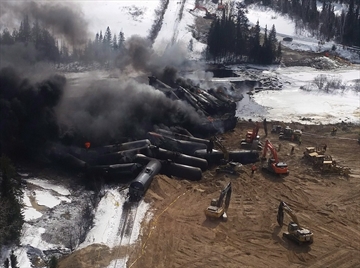
A CN Rail train derailment near Gogama, Ont., is shown in a Sunday, March 8, 2015 handout photo. Canada’s transportation investigator says track infrastructure failures may have played a role in three recent derailments involving oil-laden trains in northern Ontario. THE CANADIAN PRESS/HO – Glenn Thibeault
Canada’s transportation investigator says track infrastructure failures may have played a role in three recent derailments involving oil-laden trains in northern Ontario.
The Transportation Safety Board says it wants Transport Canada to review the risk assessments for a stretch of track known as the CN Ruel subdivision following the fiery derailments in Gogama and Minnipuka.
It says trains have already been ordered to travel slowly on the Class 4 welded rail track due to “various infrastructure and track maintenance issues,” but that heavily loaded tank cars often exert “higher than usual forces” on the track.
The board says that exposes weaknesses in the track and makes it more susceptible to failure.
The agency says its preliminary observations on the March 7 Gogama derailment also found the tank cars performed similarly to those involved in the deadly derailment in Lac-Megantic, Que., despite meeting upgraded safety standards for Class 111 tank cars.
Similar observations were made about a Feb. 14 derailment near the same community, which is about 80 kilometres south of Timmins.
The derailments have fuelled the debate over transporting oil by rail and prompted the transportation ministers of Ontario and Quebec to express concern to their federal counterpart.
Last week, Ottawa proposed tough new standards for rail tank cars used to transport crude oil that would phase out the much-criticized Class 111 tank cars by 2025.
The proposal would require the new tank cars to have outer “jackets,” a layer of thermal protection, and thicker steel walls.
The Transportation Safety Board said Tuesday the proposed standards “look promising,” but must be implemented more quickly than suggested “given initial observations of the performance” of the upgraded Class 111 in recent derailments.
“If older tank cars, including the (upgraded cars), are not phased out sooner, then the regulator and industry need to take more steps to reduce the risk of derailments or consequences following a derailment carrying flammable liquids,” it said.
Milton residents ‘will be lying down on the tracks’ to prevent surprise CN plan
By San Grewal, March 17, 2015
MILTON MAYOR Gordon Krantz says his town has been “blindsided” by a CN plan to have a facility between Britannia Rd. and Lower Base Line that would bring 1,500 trucks and four additional trains into Milton every day. Zoe McKnight,Torstar News Service
A “David and Goliath” battle is shaping up in Milton, where the Toronto Star has learned CN is about to announce plans for a 400-acre rail distribution centre that throws a wrench into the region’s carefully crafted growth management strategy.
Milton’s mayor and top bureaucrat are vowing the town will not go down without a fight.
“We have 50,000 residents, 20,000 houses planned for the area north of this (intermodal) facility. CN came in last week and pronounced that they are going forward — no formal application, no formal announcement,” said Milton’s chief administrative officer, William Mann.
“We know they are announcing it on Thursday. When Milton residents hear about this, they will be lying down on the tracks.”
Mann said the town, one of Canada’s fastest growing municipalities, has been told that CN, as a former Crown corporation, still has a certain power to circumvent municipal planning as governed by the province of Ontario.
Mann and Mayor Gord Krantz told the Star the town has been “blindsided” by the plan for a facility between Britannia Rd. and Lower Base Line that the town says would operate 24/7, transferring containers between trains and trucks. The town says it would bring 1,500 trucks and four additional trains into Milton every day, on CN-owned land that isn’t supposed to be used for such a facility according to Milton’s planning strategy.
Under Sustainable Halton, the region’s widely lauded plan for growth management, the land has been earmarked for strategic employment, with a mix of residential and commercial development surrounding it, as well as environmentally protected lands.
“It’s completely contrary to what we had planned,” Krantz said. “If I knew what was being proposed by CN I certainly wouldn’t be purchasing. Or if I already purchased one (of the newly built homes) and I wanted to get out from under it — I can imagine the possible legal battles.”
But Krantz is vowing to do everything the town can to fight CN, even if the rail giant has the federal government on its side, along with its powers to ignore local planning jurisdiction.
Referring to the tale of David and Goliath, Krantz said: “We all know how that story ended. I’ve got my one shot ready.”
He said Milton is already working with Halton Region and other partners on a legal strategy, but said he didn’t want to tip his hand.
CN responded to the Star’s questions about the project with a brief statement: “CN owns approximately 1,000 acres of land in the Milton, Ont., area. As part of its ongoing business operations, CN continually reviews its facilities and real estate holdings to ensure they are adequate to accommodate growth in its various businesses. Such is the case with CN’s Milton property. CN has no further comment at this time.”
One of the world’s largest rail companies, CN has a market capitalization of almost $71 billion.
CN had proposed a similar project in 2001 — preceding the province’s strategy to manage growth — that was withdrawn after the town and region identified major issues with it, according to a news release from the Town of Milton.
Multiple sources told the Star the CN plan is to be unveiled Thursday at a breakfast event hosted by the local chamber of commerce. As the MP for Halton riding, Federal Transport Minister Lisa Raitt represents Milton. A statement from the ministry to the Star said only that Raitt would attend the Chamber event Thursday “and looks forward to the presentation.”
The Ministry of Municipal Affairs and Housing was asked whether the province would guarantee a public consultation and that provincial environmental and safety rules as well as municipal planning processes would be complied with. A spokesperson said the ministry, and the Ministry of Transportation, “have been advised by CN that they are revisiting the need for an intermodal yard in the Town of Milton … CN has not provided the province with specific details of their proposal.”
With concern mounting over rail safety in the wake of the Lac-Mégantic disaster and more recent fiery derailments of trains carrying crude oil, Krantz and Mann said they have been disheartened by the province’s unwillingness to address the CN plan.
When asked if he has an idea of what would be passing through the area, Krantz said: “That’s a good question. We don’t know what’s going to be transported.”
Beyond the negative impact on surrounding property values, and environmental and safety concerns, the development industry is going to be extremely upset with CN’s decision, he said.
“You ain’t seen nothing yet. Wait until the developers, especially in the residential sector, hear. I suspect their reaction will be something like mine.”
Mann said Milton has behaved like the model municipality for Ontario’s Places to Grow Act, which established managed population growth targets throughout the GTA. The town has grown from about 7,000 residents in 1971 to 84,362, according to the 2011 census.
“We could go to over 400,000 under Places to Grow. Places to Grow is all about taking your fair share. Now, upward of 500 acres of employment land and all the residential around it, could be taken out of the picture. That means the rest of the GTA will have to pick up that population.
“This plan has nothing but negative consequences for Milton, from a community perspective.”



 Lethal Accidents Spur a Push for Increased Safety Measures